Women were never peripheral to the social life of Javanese royal courts. In the palaces of Central Java, rank, kinship, ritual conduct, artistic training, and household discipline formed a single world of authority. Men often appeared more visibly in chronicles of kingship and war, but court women helped sustain the institutions that made royal power recognizable from one generation to the next.
Their roles were not uniform. A queen consort, princess, concubine, female court servant, dancer, teacher, or palace attendant occupied different positions within the court order. Yet together they reveal a larger historical pattern: women preserved dynastic memory not only by birth and marriage, but also through education, ceremonial labor, aesthetic knowledge, and disciplined service.
Dynastic Households and Inner Authority
The Javanese court was both a political institution and an extended household. Royal women helped manage this inner world, where the upbringing of children, organization of servants, care for heirlooms, and maintenance of etiquette were matters of dynastic importance. Household authority could be quiet in form, but it was not insignificant. It shaped the daily habits through which young nobles learned rank, restraint, language, and obligation.
In palace society, domestic space should not be mistaken for a simple private sphere. The inner quarters connected marriage alliances, succession, ritual preparation, and the education of future leaders. Women who supervised these spaces helped secure continuity in a system where legitimacy depended on more than formal titles. A prince or princess was trained into courtliness through repeated exposure to gesture, speech levels, dress, and ceremonial awareness.
This is why the language sometimes used for women as companions behind the scenes requires careful interpretation. It can suggest limitation, but in practice the court household was a place where values were transmitted and authority was cultivated. Museum interpretation benefits from this wider view, because many objects associated with women, from textiles to cosmetic containers, belonged to a larger structure of dynastic care.
Ritual Etiquette and Palace Service
Javanese courts depended on service. The abdi dalem, or palace servants, carried out administrative, ceremonial, and cultural duties that allowed the palace to function as an ordered institution. Women were part of this world of service, and their roles could include preparation for ritual events, maintenance of protocol, participation in processions, and instruction in proper conduct.
Service in the palace was not understood merely as employment. It was often framed as devotion, discipline, and cultural responsibility. Rules about clothing, speech, posture, and ornament made the servant's body a visible part of court order. For women, these rules could be especially precise, since modesty, restraint, and grace were read as signs of refinement. Such expectations could be restrictive, but they also gave women recognized places in the ceremonial life of the court.
Ritual etiquette was one of the ways women helped preserve intangible heritage. A palace ceremony required more than objects and dates. It required people who knew where to stand, how to move, when to speak, and which forms of respect were appropriate. Female attendants and elders carried this knowledge through practice, repetition, and correction. Their expertise often left fewer written traces than royal decrees, but it was essential to the survival of palace culture.
Arts, Dance, and Embodied Memory
Women have long been associated with refined arts in Javanese courts, especially dance, music, textile knowledge, and performance etiquette. Court dances such as bedhaya and srimpi are often discussed through ideals of balance, inwardness, and controlled movement. Female dancers did not simply decorate ceremonies; they embodied courtly values through posture, tempo, gesture, and emotional restraint.
This embodied knowledge matters for museums because dance costumes, jewelry, batik cloth, and musical instruments cannot be fully understood as isolated objects. They belonged to systems of training. A dancer learned not only steps, but also how to carry the body in relation to rank, story, sacred atmosphere, and collective rhythm. Women who trained, performed, or supervised these arts helped keep court memory alive in physical form.
Textile culture also depended on female knowledge, although production and patronage varied by period and court. Batik, dress rules, and ceremonial cloths marked rank and occasion. Women in royal households learned how cloth communicated propriety, beauty, and status. When such textiles enter museum collections, their significance includes the hands and eyes that selected, wore, cared for, and interpreted them inside courtly life.
Women, Defense, and the Mangkunegaran Example
One of the most striking reminders of women's wider roles comes from the Mangkunegaran court in Surakarta. Historical studies discuss the Prajurit Estri Mangkunegaran, a female soldier corps associated with the struggle of Mangkunegara I in the eighteenth century. Their presence challenges any simple assumption that court women were only secluded figures of domestic refinement.
The details of their formation and activity belong to the specific political world of Raden Mas Said, later Mangkunegara I, whose campaigns unfolded amid conflict involving Javanese rulers and Dutch colonial power. Within that setting, female soldiers appear in scholarship as part of a courtly and military history in which loyalty, protection, and honor were not assigned only to men. Their role included symbolic meaning as well as practical service.
For heritage interpretation, the Prajurit Estri matter because they widen the visual imagination of Javanese court history. Weapons, uniforms, and parade traditions can be read alongside stories of women trained for defense and display. This does not mean every Javanese court had the same institution, but it shows that gender roles in royal environments were more flexible and historically specific than a simple domestic model allows.
Education, Reform, and Public Culture
By the late colonial and early modern periods, court women also became visible in debates about education, modernity, and public cultural life. The Mangkunegaran court under Mangkunegara VII is an important example. Studies of his daughters describe a pattern of upbringing that gave princesses access to artistic expression and wider social experience beyond the most protected palace environment.
Such changes did not erase court tradition. Instead, they reframed it. Royal daughters could learn to represent Javanese culture before broader audiences while remaining connected to inherited standards of refinement. Arts became a way to negotiate modernity: a princess could participate in public culture through dance, music, or cultural performance without abandoning the symbolic authority of the palace.
This period helps explain why court women should be understood as agents of adaptation. They were not only bearers of old rules. They also helped decide how courtly values could survive in schools, performances, publications, and public ceremonies. Their education linked the intimate discipline of palace life to the wider cultural politics of a changing Indonesia.
Reading Objects Through Women's Work
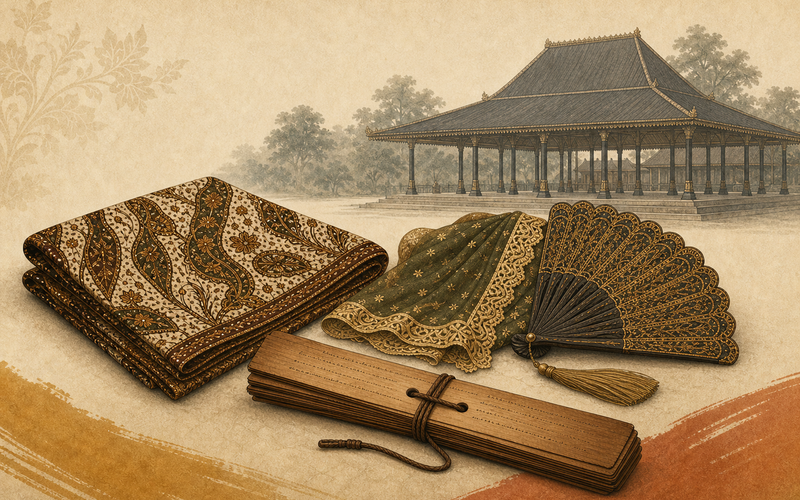
Objects connected to Javanese courts often appear in museums as beautiful things: batik cloths, jewelry, dance costumes, manuscript cases, cosmetic boxes, fans, weapons, and photographs of palace ceremonies. A women's-history approach asks what kinds of labor made those objects meaningful. Who prepared the dancer? Who taught the correct gesture? Who guarded the memory of a family heirloom? Who understood which cloth suited which ceremony?
These questions do not reduce objects to biography. Instead, they restore their social depth. A necklace may signal rank, but it may also point to marriage, ritual display, inheritance, and the discipline of wearing adornment correctly. A court dance costume may show textile skill, but it also records hours of training and the authority of teachers who corrected posture and expression. A photograph of palace servants may preserve a hierarchy of service that depended on women's participation as well as men's.
The historical role of women in Javanese royal courts is therefore best seen as a spectrum. It includes domestic management, dynastic education, ritual service, artistic transmission, symbolic refinement, and occasional military or political participation. The forms changed across courts and centuries, but the underlying importance remained. Without women's work, the palace would have lost much of the order, grace, and memory through which Javanese kingship was made visible.
Women in Javanese royal courts shaped history through continuity as much as through dramatic events. Their influence often moved through disciplined gestures, careful teaching, and the quiet authority of household and ritual knowledge. For museums, attending to that influence makes court objects more human and more complete. It shows that heritage is not preserved by objects alone, but by the people who know how to make them speak within a living cultural order.