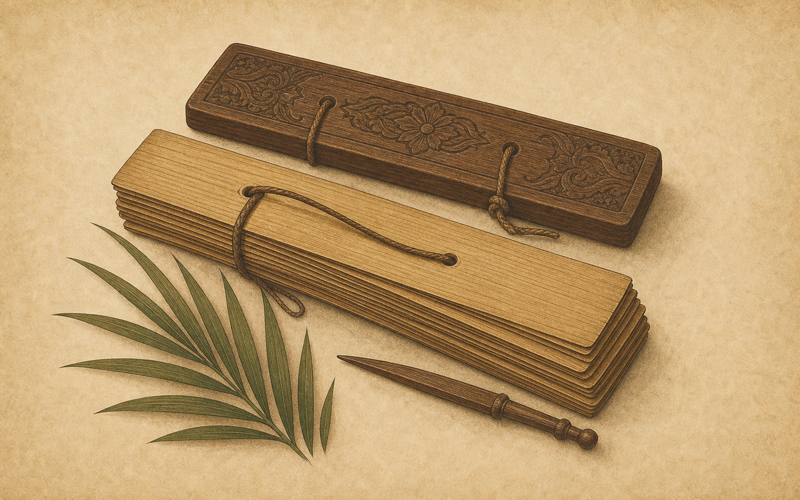
Indonesian manuscripts preserve religious teaching, literature, genealogy, law, and practical knowledge on materials including palm leaf, bark, bamboo, and paper. Their languages, scripts, and uses vary by region and community. Sacred texts form part of this wider manuscript heritage: understanding a volume requires attention to both its contents and the people who copied, recited, or consulted it.
The phrase "sacred texts and manuscripts" should therefore be understood broadly. Some Indonesian manuscripts are explicitly religious, tied to Islamic scholarship, Hindu-Balinese ritual knowledge, or older literary cosmologies. Others are not sacred in a narrow doctrinal sense, yet they still hold moral and ceremonial authority within the communities that used them. Looking at these manuscripts as cultural objects reveals a history of literacy that was multilingual, regionally varied, and closely linked to performance, recitation, and instruction rather than silent reading alone.
Materials, Formats, and Regional Environments
One of the clearest lessons from Indonesian manuscript culture is that writing technologies were deeply shaped by local environments. In Bali and Lombok, many texts were written on lontar, processed palm leaves incised with a stylus and darkened so the letters became legible. Elsewhere, communities used bamboo, bark paper, or later paper manuscripts. These formats mattered because they affected how texts were copied, handled, stored, and read. A palm-leaf manuscript, for example, is not just a neutral surface for words. Its narrow leaves, string holes, and sequence of folios shape the physical rhythm of reading and preservation.
For museums, the material form of a manuscript is often as informative as the text itself. Wear patterns, bindings, script styles, and marginal notes can reveal how a manuscript circulated through households, ritual specialists, or scholars. The Endangered Archives Programme's work in Bali and Lombok emphasizes how fragile many private lontar collections remain and how conservation must address both physical vulnerability and local knowledge about handling the objects. This is a useful reminder that manuscript heritage is inseparable from the communities that preserved it.
Scripts, Languages, and Intellectual Diversity
The Indonesian archipelago never possessed a single manuscript language or script tradition. Javanese, Balinese, Bugis, Malay, Sundanese, and many other languages appear in surviving texts, written in regional scripts as well as Arabic-derived forms such as Jawi and Pegon. This diversity matters historically because it shows that literacy was not confined to one political center or one religious tradition. Manuscript production grew in courts, pesantren, ritual communities, and family settings, each with its own priorities and conventions.
That diversity also complicates any simple distinction between sacred and secular writing. A manuscript might contain theological instruction, but it could also include advice on ethics, calculations, healing, or courtly conduct. The National Library of Indonesia's manuscript initiatives and the scholarly work published in Jumantara both reflect this wide range of subjects. Indonesian manuscript studies therefore ask readers to pay attention not only to famous texts, but also to the ordinary documents that show how people taught, remembered, and interpreted the world in local terms.
Manuscripts as Carriers of Sacred Knowledge
Many manuscripts preserved forms of knowledge treated as sacred because they were connected to revelation, ritual authority, or cosmological order. Islamic manuscripts copied in the archipelago transmitted Qur'anic learning, jurisprudence, prayer, theology, and devotional instruction. In Bali, lontar manuscripts recorded ritual procedures, calendrical systems, and teachings used by priests and healers. In other regions, genealogical and mythological texts could also carry sacred force because they explained the origins of communities, dynasties, or ceremonial obligations.
What makes these texts especially significant in museum interpretation is that sacredness often resided not only in doctrine, but in use. A manuscript could be recited, consulted on auspicious days, inherited as a family trust, or opened during healing and ritual practice. In such cases, the manuscript was not merely a container of information. It was part of a social relationship between text, specialist, and community. Exhibiting these objects responsibly means acknowledging that some manuscripts were active participants in ritual life rather than relics detached from meaning.
Epic Literature, Moral Instruction, and Cultural Memory
La Galigo is a Bugis epic cycle preserved through manuscripts and oral performance. UNESCO describes its narrative as a pre-Islamic mythological world rather than a chronicle of events. It is therefore evidence for literary and cultural memory, not a direct historical record of the events it recounts. The manuscript witnesses and the story's transmission each have their own histories. UNESCO: La Galigo.
Literary manuscripts also show that reading in the archipelago often overlapped with listening and performance. Texts could be recited aloud, adapted, taught, or interpreted in communal settings. Their value did not depend solely on a fixed authorial original. Instead, copying was itself a form of cultural transmission. Each manuscript witness might preserve local spelling, commentary, or choices of selection. From a museum perspective, this means a manuscript is both a textual source and a material record of how one community received and renewed inherited knowledge.
Courts, Scholars, and Community Custodians
Manuscript preservation depended on institutions, but not always on formal libraries. Royal courts were important centers for copying and storing texts, especially where political legitimacy and literary prestige were closely linked. Religious teachers and scholars also maintained manuscript lineages through study circles and teaching networks. Yet many manuscripts survived because families, village custodians, and ritual specialists kept them in homes, shrines, or local collections rather than in state repositories.
This dispersed pattern of preservation explains why manuscript heritage is both rich and vulnerable. Collections remain scattered, sometimes uncatalogued, and often exposed to humidity, insects, or handling damage. At the same time, local custody preserved materials that might otherwise have disappeared. Projects such as Khastara and field-based digitization efforts in Bali and Lombok show how current preservation increasingly depends on collaboration between national institutions, researchers, and private owners. The goal is not only to transfer objects into centralized storage, but to document and sustain the knowledge systems around them.
Preservation, Digitization, and Access Today
Modern preservation efforts have changed how Indonesian manuscripts are studied and presented. Digital repositories can reduce handling of fragile originals while helping scholars and communities compare texts across regions. The National Library of Indonesia presents manuscript heritage through Khastara, a portal dedicated to ancient manuscripts and documentary heritage. Meanwhile, specialized research forums such as Jumantara support philology, codicology, and related scholarship that can turn difficult manuscript evidence into more accessible historical understanding.
Still, digitization is not a complete solution. A digital image preserves visual access, but it cannot fully replace the tactile, material, and ceremonial dimensions of a manuscript. Nor does scanning automatically solve questions of script expertise, local interpretation, or cultural sensitivity. Museums and libraries therefore face a double responsibility: to protect fragile objects and to preserve the intellectual traditions needed to understand them. When done well, manuscript preservation keeps both the physical artifact and its living context in view.
Conclusion
Sacred texts and manuscripts of the Indonesian archipelago reveal a deeply plural intellectual world. They preserve religion, literature, healing knowledge, genealogy, law, and ritual practice in many scripts and languages, across materials adapted to local environments. Their survival shows that Indonesian history was recorded not through one single canon, but through many regional traditions of copying, teaching, and remembering.
For museums, these manuscripts invite a careful kind of interpretation. They should be read as beautiful artifacts, but also as working instruments of knowledge and authority. By placing manuscript materials, scripts, and preservation histories in conversation, exhibitions can show that the archipelago's written heritage is not a closed past. It remains an active field of cultural memory, scholarly study, and public stewardship.