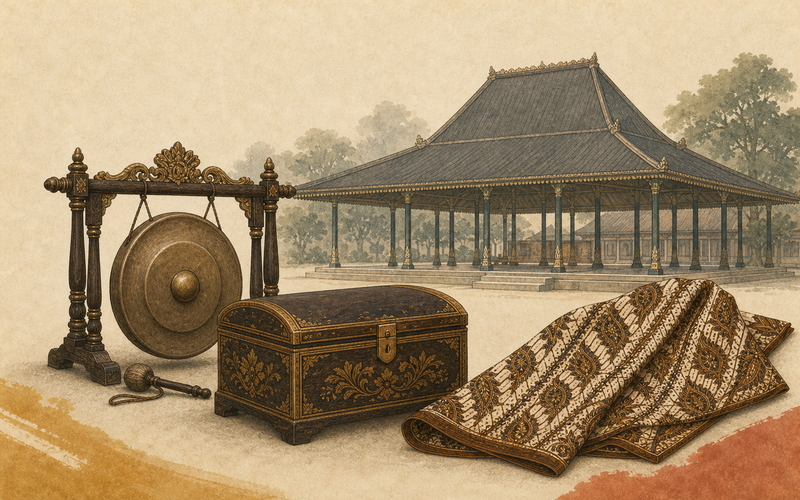
The royal courts of Yogyakarta and Surakarta occupy a central place in the cultural history of Java. They are not simply surviving palaces from a precolonial past. They are institutions in which architecture, ritual, language, music, dress, and systems of rank have been preserved, adapted, and interpreted over generations. For museums, the courts matter because they help explain why many objects from Java were never meant to be viewed as isolated artworks. A batik cloth, a kris, a gilded carriage, or a gamelan instrument originally belonged to a larger ceremonial world shaped by protocol and inherited meaning.
The two courts are often discussed together because both grew out of the division of the Mataram realm in the eighteenth century. Yet they also developed distinctive styles, political memories, and courtly preferences. Studying them side by side reveals how Javanese royal culture could remain shared in principle while varied in expression.
Where this article gives detailed examples from Yogyakarta, it draws on official Kraton Yogyakarta material. Surakarta is kept at the broader historical and comparative level supported by general references unless a Surakarta-specific source is cited.
Courts Born from Political Division
The histories of Yogyakarta and Surakarta are closely tied to the fragmentation of the Mataram kingdom during a period of political struggle involving Javanese rulers and the Dutch East India Company. The division did not erase the older prestige of Mataram. Instead, it produced new royal centers that each claimed legitimacy through genealogy, sacred authority, and control of court ceremony. In this context, ritual became more than ornament. It was a visible language of power.
Because political authority was contested, the courts invested heavily in forms that conveyed order and refinement. Palace layouts, ranked audiences, regulated dress, and carefully timed ceremonies all helped project stability. Court chronicles, heirloom regalia, and ritual observances connected reigning houses to an older conception of kingship in Java.
For historians, this background explains why the courts cannot be reduced to picturesque survivals. Their traditions were shaped in response to real political pressures. For visitors today, the result is a cultural landscape in which memory, legitimacy, and artistic patronage still appear intertwined. The courts became custodians not only of dynastic history but also of the refined behavior expected from a Javanese center of power.
Palace Space and the Ordering of Ceremony
The kraton, or palace complex, is itself a key document of court culture. In both Yogyakarta and Surakarta, palace space expresses hierarchy through sequence. Gates, courtyards, pavilions, and audience halls guide movement from more public zones toward more restricted areas. Such arrangements do practical work, but they also create an experience of graded access. One does not simply enter a palace; one approaches it according to status, occasion, and protocol.
For Yogyakarta specifically, the palace's own Tata Rakiting Wewangunan page describes the kraton as more than a residence: it is a system of philosophy, spatial layout, buildings, ornament, plants, and function. That official framing supports the article's Yogyakarta examples without requiring every detail to be projected onto Surakarta.
This organization reflects a broader Javanese understanding that power should be ordered, centered, and made visible through balance. Ceremonial architecture frames royal processions, receptions, and commemorative observances. Open pavilions allow for performance and assembly, while enclosed sections protect more intimate aspects of court life. In a museum context, architectural plans and palace photographs help clarify why many court objects were designed for specific spatial settings rather than for neutral display cases.
The importance of palace space also helps explain the significance of annual ceremonies. Commemorative processions, royal anniversaries, and ritual distributions of food or offerings draw meaning from movement through the palace and the city beyond it. These events connect ruler, court retainers, and public audiences.
Etiquette, Language, and the Courtly Ideal
Royal court tradition is sustained as much by conduct as by monuments. In Java, refined speech levels, controlled gesture, and careful bodily comportment long formed part of the ethical language of the court. Respect had to be shown through how one sat, stood, walked, spoke, and addressed others. Such practices are sometimes described as etiquette, but they also express a moral discipline associated with self-control and social harmony.
The courtly ideal is especially visible in language. Javanese contains speech registers that signal rank and social relationship, and court environments historically placed great emphasis on the proper use of elevated forms. Mastery of this register was not merely technical. It marked education, emotional restraint, and awareness of place within a larger social order. Courtly language therefore shaped literature, diplomacy, performance, and everyday interactions among palace circles.
Museums and cultural institutions often face a challenge when presenting these intangible dimensions to modern audiences. A throne, textile, or manuscript can be exhibited, but the atmosphere of deference and the cadence of formal speech are harder to preserve. The ideal of halus, or refinement, remains one of the clearest interpretive keys for understanding the social world of both Yogyakarta and Surakarta.
Performance Traditions under Royal Patronage
The courts of Yogyakarta and Surakarta have been major patrons of the performing arts, especially gamelan, court dance, and wayang. These arts were not peripheral entertainments. They formed part of education, ritual, and prestige. A court performance could affirm dynastic memory, mark a ceremonial occasion, or cultivate a highly disciplined aesthetic valued for its emotional restraint and inner concentration.
In the Yogyakarta case, the palace's Kagungan Dalem material documents court-owned cultural assets, including gamelan categories and other inherited objects. This gives a concrete institutional setting for reading performance equipment as part of palace heritage rather than as detachable instruments.
Court dance in particular illustrates how movement can preserve historical knowledge. Choreographies associated with palace traditions emphasize measured tempo, precise posture, and controlled expression rather than display for its own sake. They communicate rank, gendered roles, and ideals of balance. Gamelan provides the sonic environment in which such dances unfold, while wayang performance links palace audiences to epic and moral narratives that have circulated in Java for centuries.
These forms later moved beyond palace walls into conservatories, public festivals, and national cultural programs, but royal patronage remained foundational. The courts gave artists an environment in which repertories could be maintained and transmitted. For this reason, a museum object such as a dance costume or a gamelan instrument should be read not only as material culture but also as evidence of rehearsal, pedagogy, and embodied memory.
Textiles, Heirlooms, and Signs of Authority
Material culture offers another window into royal court traditions. Batik associated with court environments in central Java is especially important because pattern, color, and usage have historically carried social meaning. Certain designs became closely tied to palace circles and to ideas of rank, discipline, and ceremony. Cloth was therefore not just decoration. It helped compose a visible order of bodies in formal settings.
Heirlooms, often called pusaka, occupy an even deeper symbolic register. These may include kris, lances, carriages, gamelan sets, manuscripts, or other treasured objects associated with dynastic continuity. Their value lies not only in craftsmanship but also in attributed history and ritual potency. Palace communities may treat such objects with reverence, maintain them through prescribed care, and present them during specific ceremonies. In that sense, pusaka are active participants in court tradition rather than inert relics.
In the Yogyakarta context, Kagungan Dalem refers to cultural property belonging to the Sultan and the palace. That term usefully anchors the discussion of heirlooms and regalia in a documented palace vocabulary, while still leaving room for Surakarta to be interpreted through its own evidence.
For museums, this point is essential. Removing an heirloom from its ceremonial context can make it appear purely aesthetic or antiquarian. Interpreting court collections responsibly means acknowledging that authority, memory, and sanctity may have been attached to an object as strongly as its visual form. Yogyakarta and Surakarta provide rich examples of how textiles and regalia helped materialize political and moral order.
Continuity, Adaptation, and Public Heritage
Royal court traditions have not remained unchanged, nor have the courts existed outside modern history. Colonial rule, revolution, republican nation-building, tourism, urban growth, and changing media have all affected how palace culture is practiced and presented. Yet continuity does not require complete immobility. In both Yogyakarta and Surakarta, court tradition has endured partly because palace institutions, artists, and local communities have found ways to reinterpret inherited forms for new audiences.
Today, the courts function simultaneously as historical centers, ceremonial institutions, and public heritage sites. Visitors may encounter museums within palace grounds, staged performances, educational programs, or annual rituals that continue to attract broad interest. Artisans trained in court-linked traditions still produce batik, costumes, and musical knowledge that connect present-day practice with older standards of refinement. Such activity demonstrates that court culture remains socially meaningful even when its political role has changed.
This continuing relevance also invites careful interpretation. Heritage presentation can simplify complex histories into spectacle, while scholarly study reminds us that the courts were shaped by negotiation, hierarchy, and historical change. A balanced museum approach therefore treats Yogyakarta and Surakarta neither as frozen symbols nor as obsolete institutions. They are better understood as living archives of Javanese cultural practice, where the past is continuously curated through ceremony, teaching, and memory.
Related Reading
Court tradition is closely tied to gamelan music, wayang puppet storytelling, Indonesian batik, and traditional Indonesian weapons and their ceremonial roles.
In the royal courts of Yogyakarta and Surakarta, tradition survives through relationships rather than through objects alone. Buildings frame ritual, language shapes respect, music orders movement, and heirlooms anchor collective memory. Together these elements show how Javanese court culture joined aesthetics with governance and ceremony with everyday discipline. For anyone studying Indonesian heritage, the two courts remain vital guides to the enduring cultural imagination of Java.