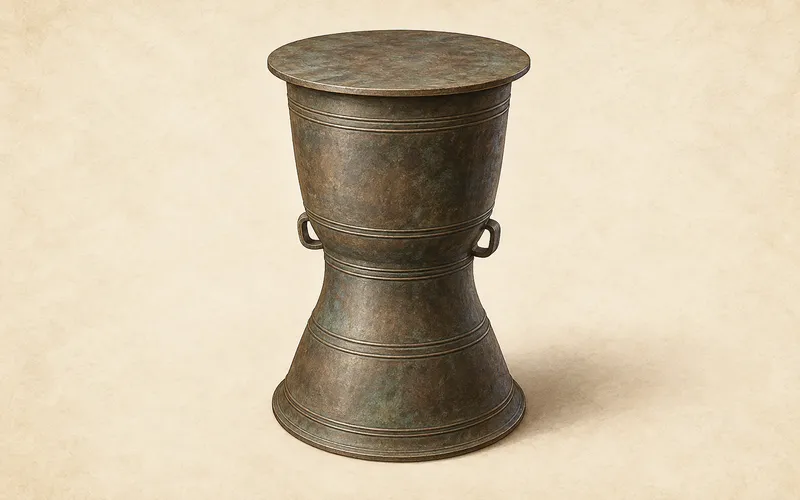
Moko are slender metal drums with a narrowed middle and a flat striking surface, strongly associated with Alor in East Nusa Tenggara, Indonesia. Often described as bronze drums, they are also valuables used in marriage exchange, inherited possessions, and signs of social standing. Their significance reaches beyond the sound they can produce.
A moko can therefore be approached in several ways: as a cast object, a recognized kind of wealth, or a possession whose history links families. These approaches are complementary. Understanding the drum requires attention both to its physical form and to the names, negotiations, and memories that give it a place in island life.
Recognizing a Moko: Form and Material
In their study of Alor, archaeologists Truman Simanjuntak, Retno Handini, and Dwi Yani Yuniawati describe a hollow, elongated body with a constricted waist, side handles, and a flat upper surface. Decoration varies, and some examples lack ornament. This gives a practical starting point for recognizing the type without assuming that every drum carries the same design. Kalpataru: moko form.
Material labels also need care. A conservation account from Indonesia's heritage service identifies two moko in the West Nusa Tenggara provincial museum as brass, one measuring 43 centimetres high and another 32 centimetres. “Bronze drum” is therefore a familiar category name, not a chemical analysis of every example. A museum should retain the material description supported by its record, while acknowledging when the composition has not been tested. BPCB Bali: conservation records.
Origins: Moko and the Wider Bronze-Drum Tradition
The Kalpataru study distinguishes slender moko from larger nekara and explicitly leaves their historical relationship unresolved. It discusses a possible connection with the wider Đông Sơn bronze-drum tradition, rather than establishing a single origin for all moko. A resemblance between object types is evidence for comparison, not proof that they were made in the same workshop or century. Kalpataru: nekara and moko.
For the visitor, three dates should remain separate: when an object was made, when it reached a particular island, and when it entered a museum. Likewise, a community's association with a drum need not identify its maker. These distinctions allow the object's local importance to remain clear even when its earlier journey is uncertain. The museum's introduction to metal casting in Java offers a broader craft context, without assigning a Javanese origin to an undocumented moko.
Belis: A Negotiated Relationship between Families
Putu Eka Juliawati's study, published in the 2013 volume of Forum Arkeologi, describes moko moving from the groom's family to the bride's family as belis. The receiving family requests a type and number of drums, with negotiation continuing toward agreement. This account makes the identity of the object important: the transaction is not simply a demand for any metal drum of a certain weight. Juliawati: moko as belis.
The word “dowry” appears in some English summaries, but stating the direction of transfer is clearer than relying on a term used differently across societies. Equally, describing the exchange as an ordinary purchase obscures its place in family relationships. The museum's overview of marriage rituals situates such negotiations within a broader range of practices. It should not turn one reported arrangement into a rule for every household in Alor.
Names, Value, and Social Standing
Shiyue Wu and Francesco Perono Cacciafoco's 2024 research documents names of moko drums in Abui, Sawila, and Kula. Their systematic lists connect linguistic documentation with questions about value and provenance. Naming these languages matters: Alor contains multiple communities, and an island-wide label cannot replace their distinct vocabularies and explanations. Wu and Perono Cacciafoco: lexical data.
A named category allows people to recognize more than a silhouette. It provides a way to discuss which object is being requested, remembered, or compared. Recording that vocabulary beside a photograph helps a museum preserve knowledge that would otherwise disappear behind the general label “drum.” It also discourages the assumption that two objects of similar size necessarily carry the same recognized value.
Exchange, Authority, and Scholarly Interpretation
Historian Leonard Yuzon Andaya examines why elephant tusks and metal drums acquired exceptional social importance in particular eastern Indonesian societies. He argues that trade carried ideas about authority, rain, and fertility alongside the objects. This is a historical interpretation of their value, not a universal symbolic dictionary for every drum or a claim that all communities explain them identically. Andaya's study.
The distinction between an object's market price and its recognized social value is useful here. A family negotiation may require a particular category of heirloom, while a collector might focus on material, age, or visual appeal. Those are different ways of assessing a possession. Comparing moko with Sumba's mamuli helps show the breadth of exchange valuables, provided that each island's objects and practices retain their own context.
A Drum with More than One Role
The official record for Museum 1000 Moko's Moko Kolmalei Cap Cicak describes uses in marriage exchange, exchange more generally, music, and the settlement of customary problems. It also identifies the object as part of the museum collection. The entry brings several roles together without requiring us to choose between “musical instrument” and “valuable.” Museum 1000 Moko: collection record.
These roles suggest different kinds of documentation. A recording can preserve a performance; an account from participants can explain an exchange; a collection history can trace a change in ownership. None replaces the others. A silent display becomes more informative when it explains which use is documented for that object and which belongs to the broader category. It should not invent a performance or family history to fill a gap.
Museum 1000 Moko and Island Memory
The Ministry of Culture records that Museum 1000 Moko opened on 4 May 2004 following an Alor government initiative begun in 2003. Its explanation of the name emphasizes the abundance of moko, ancestral heritage, and the region's diversity. The number “1000” is part of that public identity; it should not be read as an audited count of drums on display. Official museum profile.
An island museum can connect objects with the people who know their names and histories. Good interpretation would identify speakers, distinguish recollection from archaeological dating, and leave room for differences between accounts. “Island memory” is most useful in this concrete sense: knowledge attached to particular objects and relationships. The Community Life collection offers related examples of material culture shaped by social obligations and inheritance.
Conclusion
Moko belong to histories of sound, movement, and exchange. Their durable metal bodies are only one part of their significance; recognized names and relationships make them meaningful as possessions.
Following a drum from manufacture to exchange and museum display means accepting that some parts of its history remain unknown. Preserving what can be documented, alongside the voices that explain its value, gives a fuller account of Alor's heritage.