Traditional marriage rituals in Indonesia cannot be reduced to one national script. The archipelago contains hundreds of ethnic communities, and each has developed its own ways of arranging unions, recognizing kinship, and marking the passage from courtship to married life. A museum perspective is useful here because it shifts attention away from the wedding as spectacle alone and toward the social structures it makes visible. Through ritual, clothing, gifts, speech, food, and processions, marriage reveals how a community understands family, obligation, status, and continuity.
That diversity does not mean the ceremonies are unrelated. Across many parts of Indonesia, marriage is treated as a public event that joins not only two individuals but also wider networks of relatives. Negotiation, consent, exchange, and ceremonial acknowledgment often matter as much as the legal or religious moment itself. For this reason, marriage rituals are valuable historical evidence. They show how local societies organize descent, define propriety, and balance inherited custom with changing religious and national frameworks.
Marriage as a Social Institution
In many Indonesian communities, marriage is best understood as a social institution before it is interpreted as a private celebration. The ceremonies often make visible the relationship between households, lineages, or clans. Elders, spokespersons, or ritual specialists may play formal roles because the event concerns collective standing as well as personal choice. Even when a modern wedding appears streamlined, it often retains traces of older expectations about who must be consulted, who speaks for the family, and how agreement is publicly demonstrated.
This broader framework helps explain why ritual sequence matters. Steps such as visits, proposals, exchanges, or family meetings are not decorative preliminaries. They clarify whether an alliance has been accepted and under what terms. From a curatorial point of view, these stages can be read as a form of social documentation performed in public. They convert informal intention into recognized relationship and give material form to values such as respect, reciprocity, and responsibility.
Adat, Religion, and Local Authority
Marriage rituals in Indonesia are frequently described through adat, or customary practice. Adat does not function as a frozen survival from the distant past. Rather, it is a living field of local norms that can coexist with religion, state law, and regional identity. In practice, many weddings combine customary stages with Islamic marriage contracts, Christian blessings, Hindu rites, or civil registration. The resulting ceremony may therefore contain several layers of authority without participants seeing them as contradictory.
This coexistence is one reason Indonesian marriage traditions remain dynamic. A community may preserve customary exchanges, ritual speech, or symbolic objects while shortening the event, changing the venue, or adapting to urban life. Museums should be careful not to present adat as if it exists outside history. The more accurate interpretation is that customary marriage practices have persisted precisely because they can be reformulated. Continuity often lies not in an unchanged script, but in the continued importance of kinship and ceremonial recognition.
Kinship and Negotiation Across Communities
One of the clearest recurring themes in Indonesian wedding traditions is negotiation between families. This is visible in societies with very different kinship systems. In parts of Sumatra, historical studies of marriage customs document how ceremonial procedure addresses relations between lineages, affines, and community expectations. Such rituals are not only about festivity. They articulate who gives consent, what obligations accompany the union, and how the new relationship should be understood by both sides.
The importance of kinship becomes especially visible when customs differ from one ethnic community to another. Britannica notes, for example, that the Minangkabau hold a distinctive position in Indonesia as a matrilineal society, where descent and inheritance are reckoned through the female line. Recent scholarship on Minangkabau wedding traditions likewise emphasizes consultation, mutual respect, and cooperation between families. A museum need not flatten these practices into a single formula. It is enough to show that marriage ritual often mirrors the structure of the society that performs it.
Regional Examples and Local Meaning
Regional examples illustrate the range of Indonesian marriage customs especially well. Among the Batak, older cultural documentation from North Sumatra treats marriage as inseparable from broader adat arrangements and social categorization. In west Sumatra, Minangkabau traditions are shaped by matrilineal principles and the importance of extended kin. In Kalimantan, the Kenyah Lepo tradition known as Pekiban includes symbolic objects and actions presented as markers of seriousness, unity, deliberation, and commitment between the families of the bride and groom.
These examples should not be read as isolated curiosities. Each one shows that marriage ritual operates as a language of values. A blade, a mat, a ceremonial visit, or a sequence of speeches is meaningful because the community already understands what it signifies. For museum interpretation, this is crucial. Wedding objects are not merely decorative accessories. They are carriers of social meaning, and their use inside a ceremony makes visible a locally shared philosophy of alliance, household formation, and moral order.
In Alor, moko drums used in belis provide a specific example of how named valuables enter negotiations between families.
On Sumba, mamuli ornaments are another documented form of ceremonial gift and marriage exchange. Comparing them with Alor's moko draws attention to the particular valuables used in each setting, rather than a single Indonesian exchange system. Asian Art Museum: mamuli.
Material Culture, Dress, and Performance
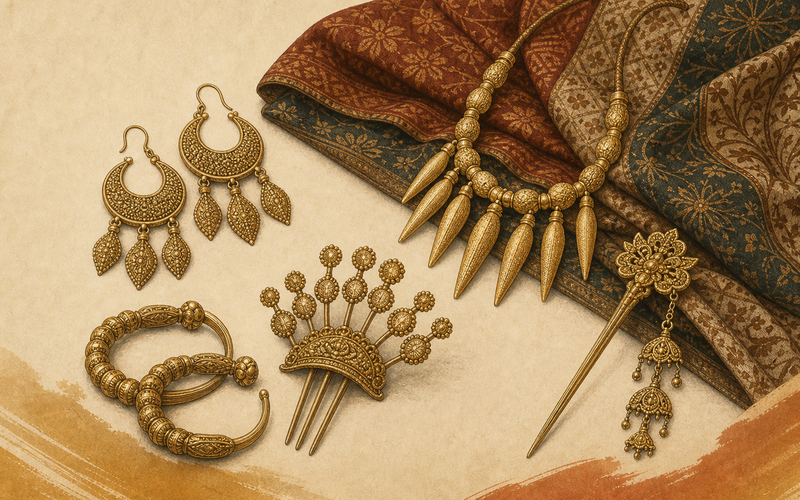
Marriage rituals also deserve attention as material culture. Clothing, ornaments, seating arrangements, trays, textiles, food, and processional objects all contribute to the meaning of the event. In many Indonesian weddings, dress is among the most visible declarations of identity. It can situate the couple within a regional style, a courtly tradition, a religious framework, or a claim to ancestral continuity. The ceremony is therefore both social and visual. It communicates through texture, color, arrangement, and movement as much as through spoken words.
Performance is equally important. Processions, ritual dialogue, blessings, formal greetings, and collective meals turn marriage into an event that is watched as well as enacted. This performative dimension explains why weddings often occupy a central place in community memory. They gather many expressive forms in one moment: music, costume, etiquette, cuisine, and public speech. For a museum, that concentration of forms makes marriage rituals especially useful for teaching how intangible heritage and material heritage work together.
Continuity, Adaptation, and Modern Indonesia
Traditional marriage rituals have not disappeared in modern Indonesia, but neither have they remained unchanged. Urbanization, migration, education, interethnic marriage, and economic pressures all affect how ceremonies are organized. Some families condense multi-day rites into shorter sequences. Others combine customs from different ethnic or religious backgrounds. The growth of interethnic marriage documented in modern scholarship also means that ritual choices may now reflect negotiation across more than one local tradition.
Yet adaptation does not necessarily mean decline. In many cases, the continuing desire to include adat elements shows that marriage remains one of the principal occasions through which people express belonging. Even a shortened or hybrid ceremony may preserve symbols that families consider essential. From a museum perspective, this is a reminder that living traditions survive by selective renewal. Indonesian marriage rituals remain culturally powerful not because they are identical everywhere, but because they continue to give public form to kinship, memory, and identity.
Related Reading
For nearby community-life topics, see ceremonial jewelry and status markers, the meaning of tumpeng in ceremonial feasts, and Community Life.
Conclusion
Traditional marriage rituals across Indonesia reveal the extraordinary cultural range of the archipelago while also showing several shared concerns. They make marriage visible as an alliance, a negotiation, and a moral commitment recognized by a wider community. Through adat, religion, speech, gift exchange, dress, and performance, weddings transform private intention into public relationship.
For museums, these rituals matter because they show how social history becomes tangible. A wedding is never only a festive occasion. It is also an archive of kinship rules, regional aesthetics, inherited symbols, and changing ideas about community life. Reading Indonesian marriage ceremonies in that way allows us to see them not as picturesque customs alone, but as living institutions that continue to interpret what family means.