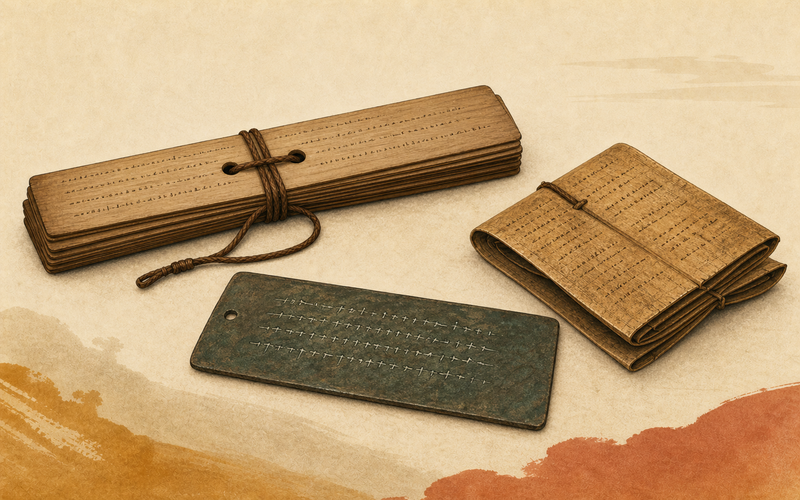
The history of writing in the Indonesian archipelago is not the story of a single alphabet or a single literary center. It is a history of adaptation, exchange, and local creativity across islands, courts, monasteries, and village communities. Long before the modern use of the Latin alphabet became dominant, scribes in different regions wrote in scripts suited to local languages, ritual needs, and political institutions.
These writing systems survive in stone inscriptions, copper plates, palm-leaf manuscripts, bark books, and paper codices. Together they show that precolonial Indonesia was deeply connected to wider currents from South and Southeast Asia while also sustaining highly distinctive regional traditions. For museums and historians, they are among the most important witnesses to the intellectual life of the archipelago.
Early inscriptions and the arrival of literacy
Among the earliest surviving written records are the Yupa inscriptions of Kutai in East Kalimantan and the Ciaruteun inscription associated with Tarumanagara in West Java. These Sanskrit texts use Pallava-related letter forms. Their dating relies on comparison of those forms; approximate fourth- to fifth-century dates should not be read as years written on the stones. The records document royal and religious authority, rather than the full extent of literacy in their societies. Indonesian heritage directorate; Bogor cultural office.
Sanskrit was not a local vernacular language. Its use indicates participation in a wider cosmopolitan sphere that linked courts and religious specialists across much of Asia. In the archipelago, as elsewhere, Sanskrit carried prestige in royal and sacred settings. The adoption of Indian-derived scripts and language did not mean passive imitation. Local rulers and scribes selected these forms to express their own legitimacy, genealogy, and ritual standing.
Over time, inscriptions increasingly incorporated Old Malay, Old Javanese, and other local languages. This shift suggests that writing became more deeply rooted in local administration and literary culture, moving beyond the earliest phase in which Sanskrit dominated formal public expression.
From Indian models to local scripts
Most precolonial scripts of Indonesia belong to the broad family of Brahmic writing systems, meaning that they ultimately derive from ancient South Asian models. Yet the scripts used in the archipelago were not simple copies. They evolved into regional forms shaped by local pronunciation, scribal habits, and writing materials.
Kawi names a historical script used for several languages, including Sanskrit and Old Javanese. Old Javanese is a language, not a script. The word Kawi also occurs in literary terminology, so identifying the language and the letter forms separately makes inscriptions and manuscripts easier to compare. Unicode: Kawi.
Regional scripts include Javanese and Balinese, as well as Batak and Lampung traditions in Sumatra. In South Sulawesi, Lontara has been used for Bugis and Makassar writing. Unicode distinguishes this Buginese script from the older Makasar script: the two should not be collapsed into a single alphabet. Script names and language names do not always map one to one. Unicode: Buginese and Makasar.
Writing materials and the craft of the scribe
The physical form of writing in precolonial Indonesia depended greatly on available materials. Stone inscriptions were used for durable public statements, often recording royal grants, victories, or religious foundations. Copper-plate charters could preserve legal privileges and land rights with a degree of permanence.
Manuscript culture was more varied and intimate. In many regions, texts were written on palm leaves, which required incision with a stylus and the rubbing of pigment into the cut lines. Palm-leaf manuscripts are especially well known from Java and Bali, where they preserved literary, religious, and calendrical works. The lontar traditions of Bali and Lombok show how leaf preparation and repeated copying sustain these collections.
Other communities used bark, bamboo, or imported paper. Batak pustaha, for example, are bark books associated with ritual specialists and contain divination, medicine, and protective knowledge. A manuscript was not only a container of words; it could also be a ritual instrument, a family heirloom, or a sign of learned authority.
Scribes occupied an important place in this world. Their work required technical skill, linguistic knowledge, and familiarity with conventions of copying and interpretation. In courtly settings, scribes helped sustain dynastic memory and literary prestige, while in village and ritual contexts they could preserve genealogies, customary law, and esoteric knowledge.
Scripts, courts, and political authority
Writing in precolonial Indonesia was closely tied to power. Inscriptions issued by rulers could define tax exemptions, confirm land grants, or commemorate acts of piety and conquest. Such texts were not neutral records. They were instruments through which authority was announced, justified, and remembered. The very act of inscribing a text in stone or metal gave political decisions a durable and public form.
In Java, inscriptions from the early medieval period are among the principal sources for reconstructing the history of kingdoms for which narrative chronicles are limited or much later. They record names of rulers, administrative terms, religious endowments, and local place names. Historians rely on them to trace changes in political geography and institutional life. Without these written records, much of early Javanese history would remain obscure.
Court literature also played a political role. Old Javanese kakawin poetry articulated ideals of kingship, moral order, and refined conduct. In later periods, literary and historical texts in Javanese and related traditions continued to shape how courts understood their own past.
Religion, knowledge, and literary transmission
Religious change in the archipelago left a strong mark on writing traditions. Hindu-Buddhist courts and monastic communities used written texts to transmit doctrine, ritual, and narrative. Adaptations of the Ramayana and Mahabharata entered local literary life through these channels, but they were reworked in ways that reflected Javanese and Balinese aesthetics and social values. Writing made such transmission possible across generations.
Bali is especially important for the preservation of older textual traditions. After the decline of major Hindu-Buddhist courts in Java, many literary and religious works continued to be copied and studied in Bali. Balinese manuscript collections today preserve a wide range of texts, including ritual manuals, epics, law codes, and works on language and cosmology. This continuity has made Bali a major center for the study of precolonial Indonesian literature.
The spread of Islam introduced Arabic script and new manuscript practices to many parts of the archipelago, but this did not erase earlier traditions. Malay was written in Jawi, an adapted Arabic script, while local scripts remained in use for other purposes in some regions. Script choice could reflect religion, language, audience, and genre rather than a simple civilizational replacement.
Regional diversity beyond Java
Although Java and Bali are often central in discussions of Indonesian manuscript culture, other regions developed significant traditions. In South Sulawesi, the Bugis and Makasar manuscript world preserved chronicles, legal materials, genealogies, and the great Bugis epic cycle known as La Galigo.
In the Batak regions of North Sumatra, writing was associated in part with ritual specialists. Batak manuscripts could include divination systems, calendrical calculations, healing formulas, and protective instructions. Literacy in the archipelago was not confined to royal centers; it also served local ritual and social needs.
The Rejang, Lampung, and other Sumatran script traditions further demonstrate the breadth of Indonesia's written heritage. Some are less well known to the general public, yet they remain crucial evidence of regional intellectual life.
Preservation, interpretation, and modern significance
Many precolonial Indonesian manuscripts and inscriptions survive only in fragmentary form. Climate, insects, war, neglect, and the fragility of organic materials have all taken a toll. Collections are now dispersed across Indonesian libraries, palaces, temples, museums, and international institutions. Preservation requires not only conservation techniques but also collaboration with communities for whom these texts remain culturally meaningful.
Interpretation presents its own challenges. Scripts changed over time, orthography was not always standardized, and many texts survive in later copies. Scholars must compare versions and place texts within linguistic and historical context. In some cases, dating remains debated, and responsible scholarship acknowledges uncertainty.
Yet the significance of these writing systems is clear. They reveal long-standing traditions of record keeping, literary production, and scholarly exchange before colonial rule. Oral tradition was vital, but it existed alongside rich written cultures.
Today, renewed interest in manuscripts and scripts supports broader efforts to understand Indonesia's plural past. Museums, archives, and universities increasingly present these materials not as isolated relics but as evidence of living heritage. Script traditions connect language, art, religion, and political history, offering a powerful reminder that the archipelago's cultural diversity has deep historical roots.
Related Reading
This topic connects closely with the history of lontar manuscripts in Bali and Lombok, sacred texts and manuscripts of the archipelago, and the Kediri Kingdom and the literary heritage of Old Java.
Conclusion
Precolonial writing systems of the Indonesian archipelago form a map of cultural encounter and local invention. From early Sanskrit inscriptions to regional manuscript traditions in Java, Bali, Sumatra, and Sulawesi, they document how communities used writing to express authority, preserve knowledge, and shape memory.
For museum audiences, these scripts are more than notation. They are artifacts of thought, belief, and social organization. To study them is to encounter Indonesia not as a single historical voice, but as a chorus of literate traditions spread across islands and centuries.