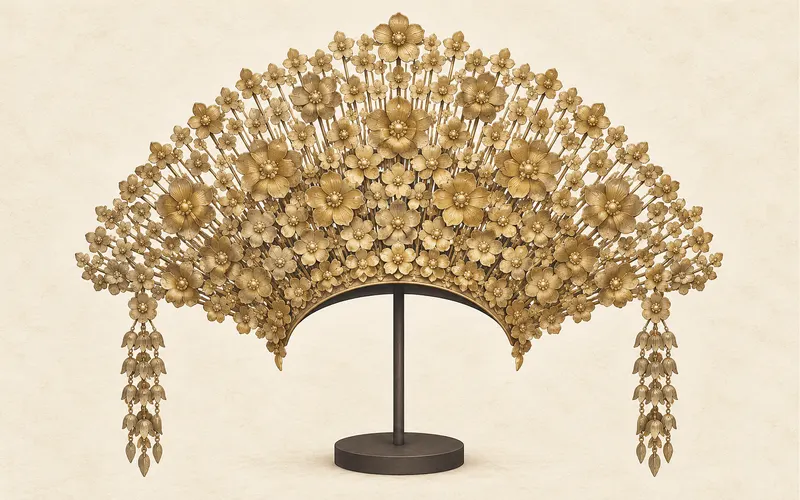
Suntiang is a ceremonial headdress associated especially with the anak daro, the Minangkabau bride of West Sumatra. Its familiar large form spreads above the head in a fan of tiered, gold-colored ornaments. The object belongs to wedding dress: its scale, arrangement, and occasion of use help distinguish the bride within the gathering.
Our overview of ceremonial jewelry and status markers places suntiang among Indonesia's socially significant ornaments. This specialist article examines how the headdress is assembled and how its meanings depend on the wearer and locality, within the wider community life collection.
Recognizing the Form and Materials
Wira Gusti Mustika and Budiwirman's 2019 study describes a semicircular headdress with plant and animal motifs. It distinguishes suntiang gadang, the large bridal form, from suntiang ketek, the smaller form worn by bridal attendants called pasumandan. In this account, size and tiers help identify different ceremonial roles. Mustika and Budiwirman.
Gold-colored appearance is separate from material composition. The Directorate of Museums' 1995/1996 catalogue, Hiasan dan Ikat Kepala Nusantara, records a brass suntiang from the West Sumatra provincial museum, named Adhityawarman in the catalogue. Entry 8, on printed page 10, gives its length as 50 centimetres and height as 35 centimetres, describing flowers, peacock motifs, and gem decoration. These measurements identify that collection example. They also show why a label saying only “golden crown” would miss useful material evidence. Museum exhibition catalogue.
Assembling Suntiang Tusuak in Padang
Vivi Efrianova and Ambiyar's 2019 research documents suntiang tusuak in Padang through observation and interviews with bridal dressers, makers, bundo kanduang, and cultural practitioners. The process starts with a sanggul, or hair arrangement, supported by shredded pandan leaves wrapped in banana leaf. Individual ornaments are then inserted into that foundation. The structure beneath the decoration is part of the craft. Efrianova and Ambiyar, pp. 51–54.
Their documented arrangement includes small serunai ornaments, larger suntiang elements, sinar blong, and paired peacocks. Kote-kote hang at the sides; a laca occupies the forehead; pisang saparak covers the back of the sanggul. Counts are adjusted to the bride's head. The study records a practiced sequence of assembly rather than a single detachable crown with a universal number of ornaments. Efrianova and Ambiyar, pp. 55–58.
Bridal Status and the Interpretation of Weight
Mustika and Budiwirman report weights of roughly 3.5–5 kilograms and interpret the burden as an expression of responsibilities after marriage. Their account also describes smaller, lighter adaptations and plated aluminium versions. The weight range belongs to the forms they discuss, rather than every suntiang. Mustika and Budiwirman.
Here, “status” concerns recognition as a bride and expectations surrounding married life. Grandeur alone cannot identify a wearer's hereditary rank or personal wealth. Read alongside the smaller attendant's headdress, the large bridal form directs attention to a particular participant in a particular ceremony. Its social meaning emerges through that relationship.
For comparison, mamuli of Sumba connect metal ornaments with marriage exchange and ancestral wealth. That comparison opens a question about how objects participate in marriage; it does not give suntiang the exchange functions of mamuli.
Local Variation: A Groom Wearing Suntiang
Bridal use is prominent, but a study by Rintan Sahsabila Romice documents marapulai basuntiang, a groom-wearing tradition in Pancung Soal, Pesisir Selatan. Based on observation, interviews, and documentation, it describes a gold-colored suntiang gadang with a head covering and floral and bird ornaments. The reported meanings concern men's leadership, protection, and family responsibility. This named local practice broadens the picture beyond an exclusively female wearing rule. Romice, EDUTECH.
Reading Suntiang in a Museum
The 1995/1996 catalogue offers a dated record of a museum-held suntiang, while the Padang research records knowledge needed to assemble and wear one. Together they allow visitors to connect the surviving metalwork with skilled preparation and ceremonial use.
A useful display can identify the material, locality, wearer, and arrangement before explaining attributed meanings. Photographs or demonstrations of assembly can make the sanggul and its supports visible alongside the ornaments. The illustration accompanying this article represents a general floral type; it is an interpretive image, not a reproduction of the catalogued object.