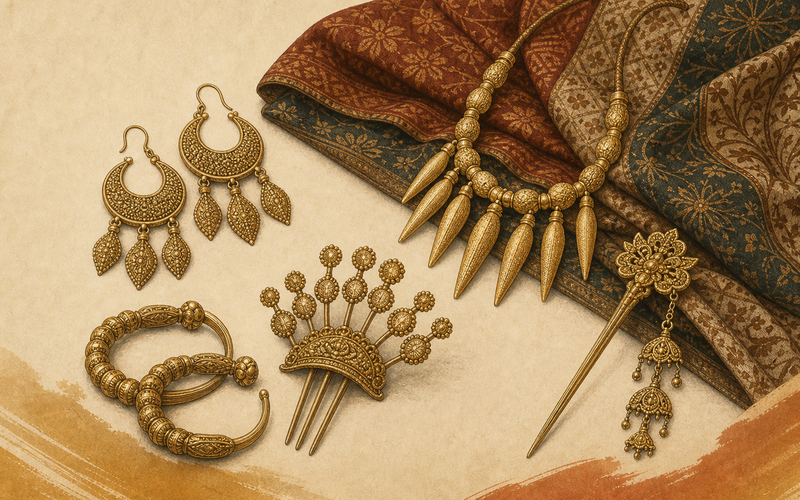
Jewelry is often the smallest object in a gallery case, yet it can carry some of the largest social meanings. In Indonesia, ornaments have marked the body at moments when people needed to be recognized: as rulers, brides, elders, dancers, priests, guests, heirs, or members of a particular community. A pendant, crown, ear ornament, belt fitting, or bead necklace could make rank visible without a written document.
This does not mean every ornament had one fixed meaning. The same material might signal wealth in one setting, sacred danger in another, and family continuity in a third. Ceremonial jewelry is best understood as a social object: it shines because it is made well, but it matters because people know when it may be worn, exchanged, hidden, inherited, or displayed.
Materials That Made Status Visible
Gold occupies a special place in many Indonesian jewelry histories, especially in museum collections from Java, Sumatra, Sumba, Sulawesi, and other regions. Its brightness, rarity, and resistance to decay made it useful for objects that were meant to outlast a single owner. Yale University Art Gallery notes that gold was rarely found on Java and was likely imported from Sumatra or possibly Borneo before Javanese goldsmiths transformed it into jewelry, courtly objects, and temple paraphernalia.
Material value, however, was never only economic. Gold could be linked with divine radiance, royal proximity, fertility, and ancestral blessing. Silver, brass, copper alloys, beads, shell, and imported stones could also carry meaning depending on local systems of value. A museum visitor should therefore ask not only what an ornament is made of, but what that material allowed the owner to claim.
Weight and scale also mattered. A delicate ear ornament could signal refinement, while a large headdress or pendant could make the body a public surface for social recognition. The point was not simply display. In many ceremonial contexts, the burden, shine, sound, and placement of jewelry helped turn a person into a ritual figure.
Courts, Goldsmiths, and Sacred Display
Courtly societies in Java provide important evidence for jewelry as a language of hierarchy. Surviving gold ornaments from the Central and Eastern Javanese periods include ear ornaments, rings, crown elements, and decorated fittings. These objects suggest an elite world in which metalwork was tied to rank, ritual, performance, and the visual vocabulary of Hindu-Buddhist kingship.
The exact original users of many archaeological ornaments are difficult to identify, so interpretation must be careful. A gold crown element in a museum collection may have adorned a person, a sculpture, or a ritual setting. What can be said with more confidence is that such objects belonged to a world where precious materials helped distinguish sacred and courtly bodies from ordinary ones.
Goldsmiths were central to that transformation. Their work required technical control over thin sheets, repoussé surfaces, granulation, inlay, casting, and joining. Skill itself became part of status. The more carefully made an ornament was, the more it could demonstrate access to trained artisans, rare material, and the social networks needed to commission or preserve such work.
Marriage Jewelry and Social Responsibility
Wedding jewelry is one of the clearest places where ornament becomes public language. In Minangkabau society, the suntiang is a tiered, golden-colored bridal headdress associated with the anak daro, or bride. Research on suntiang describes it as an important element of Minangkabau wedding dress, with floral and animal ornaments arranged in a semicircular form.
The suntiang is admired for beauty, but its meaning is not merely decorative. Scholars have interpreted its weight as a sign of the responsibilities a woman carries after marriage. The bride appears dignified beneath an object that is physically demanding to wear, making the headdress a visible lesson about adulthood, kinship, and social expectation.
Such wedding ornaments also announce family participation. Jewelry, textiles, and dress assemble many hands: makers, relatives, ritual specialists, and guests all recognize the bride through a shared visual code. The ornament does not speak alone. It works because the community understands the ceremony around it.
Heirlooms, Exchange, and Ancestral Power
On Sumba, mamuli ornaments show how jewelry can move between adornment, exchange object, sacred heirloom, and status marker. The Metropolitan Museum of Art describes mamuli as distinctive ornaments used in ceremonial gift exchanges and notes that they were once worn as ear ornaments, while today they are often worn as pendants. Museum Nasional Indonesia also describes mamuli as symbols of personal identity, social status, ritual importance, and heirloom value.
Mamuli are especially important because they are not merely personal accessories. In Sumbanese contexts, precious metal objects may be held among clan treasures, used in marriage exchanges, associated with funerary obligations, or connected with ancestral forces. Their value depends partly on restricted circulation. Some objects are powerful because they are not always visible.
This is a useful reminder for museum interpretation. Display cases make objects available to the eye, but many Indonesian heirloom ornaments gained authority through controlled access. They might be brought out only for weddings, funerals, dances, oath taking, or negotiations. To exhibit them well, a museum must explain the difference between seeing an object and having the right to use it.
Regional Identity on the Body
Ceremonial jewelry also works as a map of regional identity. A Minangkabau suntiang, a Sumbanese mamuli, Javanese gold ear ornaments, Dayak beadwork, Balinese ceremonial flowers and metalwork, or eastern Indonesian shell and metal ornaments do not belong to one uniform national style. Each points toward a particular social world, even when modern audiences group them under the broad label of Indonesian heritage.
The body is the first display space. Head, ears, neck, chest, arms, waist, and hands all offer different symbolic positions. A crown emphasizes dignity and visibility; an ear ornament may refer to older practices of bodily modification; a necklace can carry amulets close to the chest; a belt or chest ornament can structure formal costume. Placement helps define meaning.
Regional identity is also historical. Trade brought metals, beads, stones, and motifs across seas and islands. Local communities then adapted these materials into their own systems of rank and ritual. Jewelry therefore records both movement and belonging: it may contain imported material while expressing a deeply local idea of status.
Reading Jewelry in the Museum
Museums often begin with material facts: gold, silver, brass, shell, bead, date, region, and dimensions. These facts are essential, but they are only the first layer. Ceremonial jewelry asks for social questions. Who was allowed to wear it? Was it owned by an individual, a household, a lineage, or a ritual office? Was it bought, inherited, exchanged, commissioned, or received as obligation?
Labels should also distinguish between everyday adornment and ceremonial authority. Some ornaments were worn frequently, while others appeared only in highly structured events. Some marked wealth, others marked descent, gender, marital status, ritual role, or relationship to ancestors. A beautiful object may also have been heavy, dangerous, restricted, or morally demanding.
The best interpretation treats jewelry as evidence of relationships. It connects metalworkers to patrons, brides to families, rulers to courts, heirs to ancestors, and regions to wider trade routes. When presented this way, Indonesian ceremonial jewelry becomes more than ornament. It becomes a compact archive of social life.
Conclusion
Ceremonial jewelry in Indonesian society shows how visible beauty can carry invisible rules. Gold, silver, beads, crowns, pendants, and heirlooms helped people recognize authority, responsibility, alliance, ancestry, and place.
For museums, the task is to slow the viewer's gaze. The question is not only how an ornament looks, but when it appeared, who could touch it, what obligations it carried, and why a community trusted it to speak for status. In that fuller view, jewelry becomes one of Indonesia's most intimate forms of historical evidence.