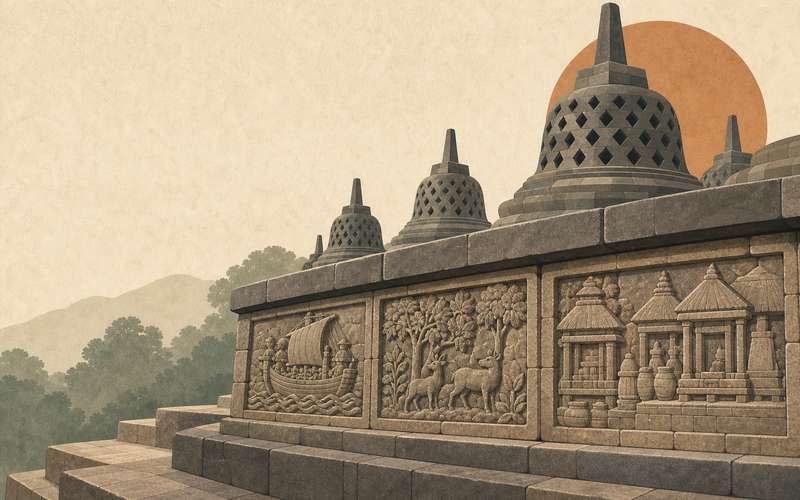
Borobudur is often introduced as a great Buddhist monument, and rightly so. Built in Central Java in the eighth and ninth centuries, it is organized as a pilgrimage architecture of terraces, stairways, stupas, Buddha images, and carved stone. UNESCO describes the walls and balustrades as carrying low reliefs over a vast surface, while the upper circular platforms are ringed by openwork stupas containing Buddha figures.
Yet the reliefs also invite another kind of looking. They are sacred narrative, but they are also a gallery of observed life. Palaces, village houses, boats, forests, animals, musicians, servants, merchants, teachers, and worshippers appear in stone. A visitor walking Borobudur is not only moving through Buddhist cosmology. The visitor is also passing through an early Javanese imagination of society, ethics, landscape, and exchange.
A Monument Read by Walking
Borobudur was designed to be experienced through movement. Its galleries guide the body along corridors and upward across terraces. The reliefs belong to that route. They are not isolated pictures hung on a wall; they are part of a sequence in which walking, looking, remembering, and ritual orientation work together.
This matters for museum interpretation because the panels should not be treated as loose illustrations. Their position on the monument shapes their meaning. The lower and middle zones are visually dense, while the upper circular terraces become more open and less narrative. The architectural experience moves from crowded carved scenes toward a quieter field of stupas and sky.
That transition is often explained through Buddhist cosmology: the world of desire, the world of form, and the formless realm. The exact theological reading of every feature should be handled carefully, but the broad experience is clear. Borobudur teaches through ascent. Stone narrative prepares the pilgrim for a different kind of seeing above.
Buddhist Stories in Stone
Many panels translate Buddhist stories into carved form. The Lalitavistara tradition recounts the Buddha's final birth, princely life, renunciation, awakening, and first teaching. At Borobudur, episodes from this sacred biography become public images, arranged so that viewers encounter the Buddha's path step by step.
Other reliefs draw on Jataka and Avadana stories, which tell of virtuous deeds, former lives, generosity, sacrifice, and moral consequence. These stories were never only entertainment. They taught ethical conduct through memorable scenes. A king, animal, merchant, ascetic, or ordinary person could become the center of a lesson about compassion, discipline, wisdom, or the results of harmful action.
The Gandavyuha material, connected with the spiritual quest of Sudhana, extends this teaching into a journey of seeking. Sudhana meets teachers across social and cosmic worlds, learning that wisdom may appear in many forms. For museum visitors, this is a useful reminder that the reliefs are not a single storybook. They are a layered curriculum of Buddhist vision.
Everyday Worlds Inside Sacred Narrative
The most striking surprise of Borobudur's reliefs is how much ordinary life appears within sacred teaching. Carvers needed to show courts, houses, forests, roads, boats, markets, servants, attendants, and ritual spaces so that stories could be understood. In doing so, they left a rich visual record of the world around them.
These details should be read with caution. A carved palace may represent an ideal court rather than a measured architectural record. A village scene may combine observation with convention. Clothing, hair, tools, and vessels may be stylized. Even so, repeated patterns across many panels give historians clues about how early Javanese artists imagined social rank, labor, hospitality, travel, and ceremony.
The panels also show that religious art did not stand apart from daily experience. Buddhist teachings were made visible through recognizable settings: a person offers a gift, a ruler receives counsel, a household gathers, a traveler arrives, a boat moves across water. Moral worlds were carved through material worlds.
Architecture, Boats, and Social Detail
Borobudur's reliefs are especially valuable for studying built environments. The panels show raised structures, roofs, pavilions, enclosed spaces, gates, and courtly settings. These are not blueprints, but they preserve visual ideas about shelter, status, and ceremonial space in early Java.
Maritime imagery is equally important. Some panels show vessels with outriggers and sails, often discussed in relation to the wider seafaring world of island Southeast Asia. Such images help visitors connect inland Central Java with broader networks of movement. Even a monument set among hills can contain a memory of rivers, seas, merchants, and long-distance contact.
Social roles are also visible. Royal figures sit with attendants. Ascetics appear in forest settings. Musicians, servants, soldiers, animals, and supernatural beings fill the scenes. The result is not a modern social survey, but it is a remarkably varied visual field. Borobudur lets museums discuss early Java through bodies, gestures, objects, and spaces.
The Hidden Foot and Moral Vision
One of Borobudur's most intriguing features is the hidden foot, whose reliefs are largely covered by an additional base. The exposed and photographed panels are associated with Karmavibhangga, the working of karma through action and consequence. They show both harmful and meritorious behavior, along with the results imagined within Buddhist moral teaching.
The hidden foot reminds us that not all heritage is equally visible. Some evidence survives behind later construction, through old photographs, conservation records, and partial exposure. A museum can use this history to explain that monuments are not frozen objects. They are studied through restoration, documentation, debate, and changing access.
The moral force of these panels is direct. They show that actions matter. Charity, violence, deceit, discipline, and devotion are not abstract ideas but embodied choices. In this sense, Borobudur's gallery of life is also a gallery of responsibility.
Reading the Reliefs Today
Modern viewers often want the reliefs to answer direct historical questions: What did people wear? What ships did they use? What did houses look like? These are good questions, but the answers must remain careful. The panels are sacred art, not photographs. Their value lies in the meeting of observation, convention, doctrine, and local artistry.
The best museum reading keeps several lenses open at once. As Buddhist narrative, the reliefs teach the path toward wisdom. As sculpture, they show disciplined carving and composition. As architecture, they belong to a route through the monument. As cultural evidence, they preserve clues about Javanese society and the wider maritime world.
This layered approach protects the reliefs from being reduced to only one meaning. Borobudur is not merely an archive of daily life, and it is not only an abstract diagram of Buddhist thought. Its power comes from holding both together in stone.
Conclusion
Borobudur's reliefs make early Javanese life visible through sacred storytelling. They show how Buddhist ideas were carved into recognizable scenes of courts, journeys, houses, forests, boats, offerings, and moral choices. The result is a monument that can be read as scripture, sculpture, architecture, and social memory.
For a museum, this is the heart of their importance. The reliefs ask visitors to slow down and look closely. Each panel belongs to a larger path, but each also preserves small details of human presence. In those details, Borobudur remains one of Indonesia's richest galleries of ancient life.