Introduction
Borobudur, the magnificent Buddhist temple located in Central Java, Indonesia, stands as a testament to the architectural and spiritual achievements of the ancient Javanese civilization. Constructed in the 9th century during the reign of the Sailendra Dynasty, Borobudur is not only a marvel of engineering but also a profound representation of Buddhist cosmology. This article delves into the architectural features of Borobudur and explores how its design embodies the Buddhist understanding of the universe.
Historical Context of Borobudur
The construction of Borobudur began in the early 9th century and was completed over several decades. It was built during a period when Mahayana Buddhism was flourishing in Java, under the patronage of the Sailendra Dynasty. The temple's location on a hilltop in the Kedu Plain was strategically chosen, offering a panoramic view of the surrounding landscape, which was believed to be imbued with spiritual significance.
The Sailendra rulers were known for their devotion to Buddhism and their support for the construction of religious monuments. Borobudur was conceived as a mandala, a symbolic representation of the universe, and was intended to guide devotees on a spiritual journey from the earthly realm to enlightenment.
Architectural Design and Symbolism
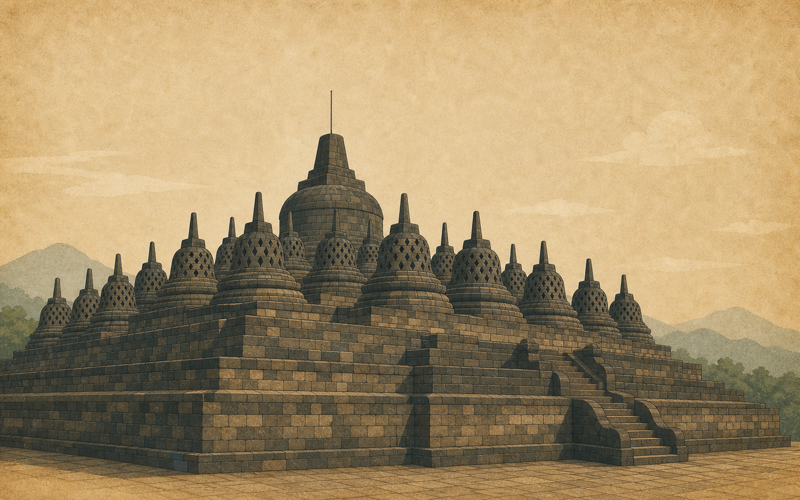
Borobudur's design is a unique blend of Javanese indigenous elements and Indian Buddhist architecture. The temple is structured as a step pyramid, consisting of nine stacked platforms topped by a central dome. The lower six platforms are square, while the upper three are circular, symbolizing the transition from the earthly realm to the spiritual.
The temple is adorned with over 2,600 relief panels and 504 Buddha statues, each meticulously carved to convey various aspects of Buddhist teachings. The reliefs depict scenes from the life of the Buddha, Jataka tales, and other Buddhist scriptures, serving as a visual guide for pilgrims.
The Journey of Enlightenment
The architectural layout of Borobudur is designed to lead pilgrims on a symbolic journey towards enlightenment. Visitors begin their ascent at the base of the temple, which represents the world of desire (Kamadhatu). As they ascend through the square terraces, they enter the realm of forms (Rupadhatu), where the reliefs illustrate the teachings of the Buddha.
The circular terraces at the top represent the formless world (Arupadhatu), where physical forms are transcended, and spiritual purity is attained. The central dome, surrounded by 72 perforated stupas, symbolizes the ultimate goal of enlightenment, Nirvana.
Borobudur and Buddhist Cosmology
Borobudur is often described as a three-dimensional mandala, reflecting the Buddhist cosmological view of the universe. The temple's design embodies the concept of the Trikaya, the three bodies of the Buddha: the Nirmanakaya (earthly body), Sambhogakaya (heavenly body), and Dharmakaya (transcendent body).
The structure also aligns with the Buddhist concept of the universe as a series of concentric circles, with Mount Meru at the center. Borobudur's central dome represents Mount Meru, the axis mundi in Buddhist cosmology, around which the universe revolves.
Preservation and Cultural Significance
Borobudur has undergone several restoration efforts to preserve its structural integrity and cultural heritage. In the 20th century, a major restoration project was undertaken by the Indonesian government and UNESCO, ensuring that this architectural masterpiece continues to inspire future generations.
Today, Borobudur is a UNESCO World Heritage Site and a major pilgrimage destination for Buddhists worldwide. It stands as a symbol of Indonesia's rich cultural heritage and the enduring legacy of Buddhist philosophy.
Conclusion
The architecture of Borobudur is a remarkable synthesis of art, religion, and cosmology. Its design not only reflects the spiritual aspirations of its creators but also serves as a timeless guide for those seeking enlightenment. As a monument of profound historical and cultural significance, Borobudur continues to captivate scholars, pilgrims, and visitors from around the world, offering a glimpse into the spiritual and architectural achievements of ancient Java.