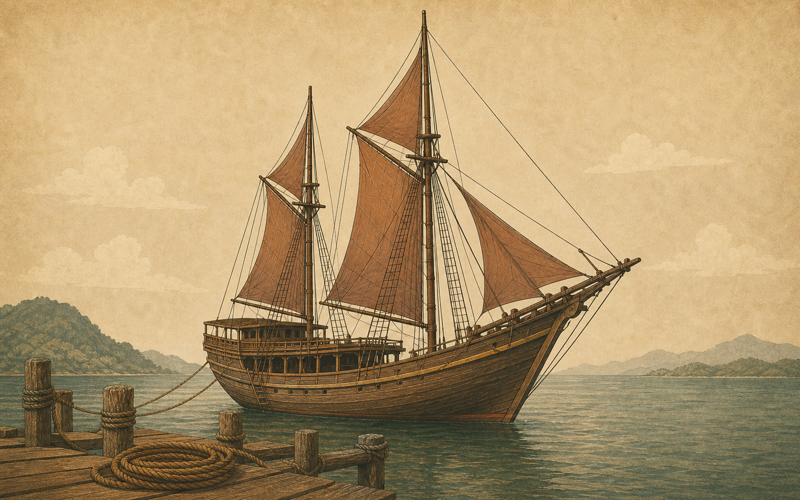
Traditional Boat Building Techniques in Eastern Indonesia
Across eastern Indonesia, boats have long been more than practical vehicles. They are tools of livelihood, markers of regional identity, and material expressions of how island communities understand wind, water, timber, and distance. In a landscape made up of seas, straits, and scattered coastlines, the ability to build a dependable vessel has been essential to fishing, trade, pilgrimage, migration, and political contact.
Museum collections and maritime studies show that traditional boats from this part of the archipelago cannot be reduced to a single type. Instead, they reveal a family of related craft traditions shaped by local resources and historical needs. When curators study these vessels, they often look not only at hull form and decoration, but also at the social world around them: who selected the wood, who cut the planks, who financed the construction, and what rituals accompanied the moment when a boat first entered the sea.
Boat Building in an Island Environment
Eastern Indonesia has never been a peripheral maritime zone. Seas around Sulawesi, Maluku, Nusa Tenggara, and neighboring islands formed active corridors that connected communities to one another and to wider networks in the archipelago. Boats therefore developed in response to regular movement across variable waters, from sheltered coasts to more demanding open-sea routes influenced by monsoon winds and seasonal currents.
Because travel conditions varied widely, local builders learned to match a vessel to purpose. Some boats were designed for carrying goods, some for fishing, and some for collective expeditions. This practical adaptation is one reason traditional boat construction remained highly regional. Builders did not produce abstract designs. They made forms that answered recurring needs in their own waters, using tested proportions remembered through apprenticeship rather than through written blueprints.
Materials, Joinery, and Embodied Knowledge
Traditional boat building depends first on careful material selection. Builders have historically chosen timber for qualities such as strength, buoyancy, flexibility, and resistance to marine conditions. Knowledge of which trees could serve as keels, ribs, or planking was part of a wider environmental understanding that also included the right season for cutting wood and the handling of timber before assembly. Such judgments were not secondary details. They were at the core of whether a boat would endure.
Construction techniques also reflected deep practical experience. In many Indonesian maritime traditions, hulls were assembled through plank-based methods that relied on skilled shaping, fitting, pegging, lashing, or fastening, depending on local custom and historical period. Measurements were often carried in the builder's body and memory rather than in standardized industrial units. Hand tools, repeated gestures, and long observation allowed master builders to transmit proportions that produced balance at sea. For this reason, the craft is best understood as embodied knowledge: expertise stored in practice, speech, and disciplined repetition.
Regional Forms and Shared Maritime Logic
One of the best-known vessels associated with the eastern archipelago is the phinisi of South Sulawesi, especially linked to Bugis and Makassarese shipbuilding communities. UNESCO has recognized the art of phinisi boatbuilding as intangible cultural heritage, highlighting that the significance of the tradition lies not only in the finished vessel but also in the specialized knowledge, labor organization, and intergenerational teaching that sustain it. Although the phinisi is widely celebrated today, it belongs to a broader seafaring world in which many communities produced distinct craft for cargo, fishing, and travel.
Elsewhere in Maluku, historical accounts describe the kora-kora as a long vessel associated with rowing, mobility, and collective action. Other eastern Indonesian communities used smaller sailing and paddling craft adapted to reef environments, narrow channels, or coastal fisheries. The external appearance of these vessels could differ greatly, yet a shared maritime logic runs through them: builders responded to local conditions while preserving a view of the boat as a social project. A vessel was rarely the achievement of one individual alone. It condensed the labor of carpenters, sailors, patrons, kin groups, and neighbors.
Ritual, Labor, and Social Meaning
Boat building has often involved ceremonial acts as well as technical work. In many Indonesian communities, the cutting of timber, the laying of the keel, and the launching of the vessel have been treated as moments requiring careful timing and proper observance. These acts did not mean that construction was unscientific. Rather, they expressed the belief that a successful boat depended on correct relations between human labor, natural materials, and unseen forces. Ritual language and offerings could frame the craft within moral as well as mechanical order.
The labor process itself also carried social meaning. Master builders trained younger workers through prolonged participation, not through quick instruction. Patrons or owners might sponsor the project, but the work commonly drew on reciprocal help, kinship obligations, and neighborhood cooperation. In this sense, the boatyard functioned as a place where hierarchy and solidarity were made visible. Knowledge was respected, but so too were patience, discipline, and the ability to work collectively toward a vessel that would later serve many households or an entire coastal community.
Boats as Vessels of Exchange and Memory
Traditional boats helped move products, people, and stories across the eastern archipelago. They supported the transport of forest goods, sea products, ceramics, cloth, and foodstuffs between islands. More than that, they enabled contact between language groups and ritual communities. Maritime routes carried news, marriage ties, religious ideas, and political influence. When a museum interprets a traditional boat, it therefore interprets a history of exchange. The vessel becomes evidence of connected lives rather than isolated settlements.
That interpretive value is especially important today because many communities now navigate between inherited practices and industrial materials. Engines, factory-made components, and new market pressures have changed maritime life, yet older knowledge has not simply vanished. In some places it survives in active shipyards; in others, in memories, songs, carved models, or museum collections. Preserving these traditions does not require freezing them in a single past form. It requires recognizing that boat building has always been adaptive, even while its social meaning remains rooted in lineage, locality, and seafaring experience.
Continuity in the Present
Contemporary interest in traditional boat building is driven by more than nostalgia. Heritage institutions, local communities, and scholars value these vessels because they demonstrate sophisticated responses to a maritime environment using locally grounded knowledge systems. They also challenge older assumptions that non-industrial technologies are simple or unsystematic. A carefully built wooden vessel embodies engineering judgment, material science, and navigational understanding developed over centuries of observation.
For Indonesia, the continued visibility of these traditions carries national as well as regional meaning. The archipelago's history has always depended on movement across water, and eastern Indonesian boatbuilding offers some of the clearest material evidence of that reality. Whether encountered in a working harbor, a ceremonial setting, or a museum gallery, these boats remind viewers that maritime heritage is built not only from voyages, but from the skilled hands and disciplined communities that made those voyages possible.
Traditional boat building techniques in eastern Indonesia deserve attention as living heritage because they unite craft, ecology, and social memory. By studying how these vessels are made and understood, museums can illuminate a wider history of island connectivity and the enduring knowledge that allowed communities to thrive across the sea.