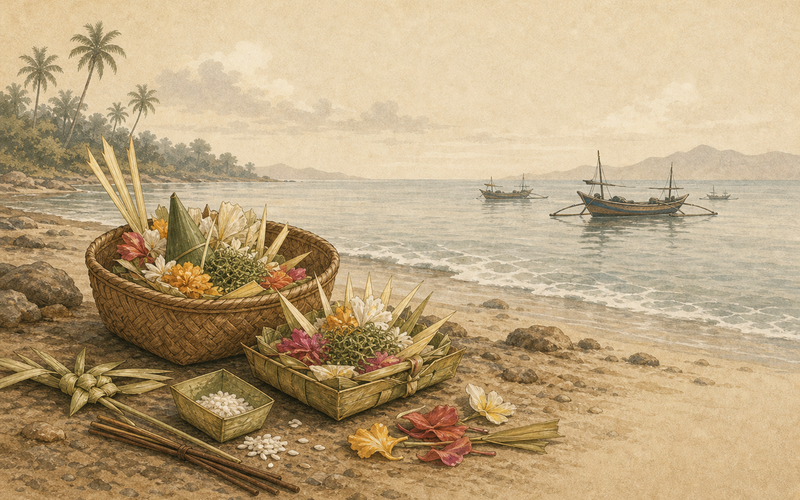
Indonesia's maritime culture is often described through ships, ports, and trade routes, but coastal ritual offers another way to understand the archipelago's relationship with the sea. In fishing settlements from Java and Banten to Madura, Bali, Lombok, Sulawesi, and eastern Indonesia, the shoreline is not merely a border between land and water. It is a social and spiritual meeting place where danger, livelihood, memory, and gratitude are made visible.
Sea-offering ceremonies are not identical across Indonesia. They may be called sedekah laut, nadran, petik laut, larung sembonyo, nyadran, or by other local names. Some are held near the Javanese month of Sura, some after Idul Fitri, and some according to local ritual calendars. Yet many share a recognizable theme: coastal communities gather to thank God, honor inherited custom, pray for safety, and mark the sea as a source of both abundance and uncertainty.
The Sea as Livelihood and Risk
For fishermen, the sea is never an abstract symbol. It is the place where food, income, weather, skill, and danger meet each day. Boats leave before dawn or after dark, crews read wind and current, and families wait on shore for the return of people whose work depends on conditions that cannot be fully controlled. Rituals of gratitude are shaped by that practical reality.
Sedekah laut is commonly explained as a thanksgiving ceremony for the previous year's catch and a prayer for future safety. This does not mean that every participant interprets the ritual in the same way. Some emphasize Islamic prayer and community charity, while others also remember older ideas about guardians of the sea, ancestral protection, or local sacred places. The ceremony holds these interpretations within a public event where livelihood is acknowledged as a shared concern.
Offerings, Processions, and Shared Food
Many sea-offering ceremonies include a procession from village or harbor to shore, followed by the carrying of offerings toward the water. These offerings may include rice cones, agricultural produce, cooked dishes, flowers, symbolic objects, or a decorated boat. In some places, part of the offering is set afloat or cast into the sea, a practice often described with the word larung.
The visible objects matter, but the ceremony is more than the objects themselves. Preparation requires cooperation among fishers, families, religious leaders, elders, youth groups, musicians, vendors, and local officials. Shared meals, markets, performances, and boat decorations turn ritual into a temporary public festival. Through this gathering, the community renews relationships on land before asking for safety on water.
Local Names and Regional Variation
Regional names reveal how widely maritime ritual has been adapted. In parts of the north coast of Java and Banten, sedekah laut may also be known as nadran. In Banyuwangi and nearby coastal areas, petik laut is associated with fishing communities and the marking of maritime gratitude. In Trenggalek, larung sembonyo or related local ceremonies connect offerings with origin stories and coastal memory.
These differences are important for museums because a single label can flatten local meaning. A visitor may see a miniature boat, a ceremonial food display, or a photograph of a procession and assume that all sea rituals follow one standard form. In reality, each ceremony is shaped by language, religious history, local ecology, migration, fishing technology, and the authority of adat or village institutions.
Religion, Adat, and Debate
Coastal rituals often sit at the intersection of religion and customary practice. Many communities frame sedekah laut as gratitude to God and ask for blessing through prayer, Qur'anic recitation, communal meals, or acts of charity. At the same time, some ritual forms preserve older symbolic patterns, including offerings to the sea or references to unseen powers associated with particular coastlines.
This layered character has sometimes produced debate, especially where participants, religious teachers, or outside observers disagree about whether particular offerings are cultural symbols, social tradition, or religiously problematic acts. A careful museum account should not turn this debate into a simple conflict between religion and tradition. In practice, communities negotiate meaning, adapt language, change ritual details, and continue to use ceremony as a way to hold coastal society together.
Maritime Identity and Public Memory
Sea-offering rituals create public memory. They remind younger generations that fishing is not only an occupation but a way of life supported by skills, kinship, boat ownership, seasonal knowledge, and collective risk. The decorated harbor, the sound of prayer or music, and the movement of people toward the shore make maritime identity visible to those who may no longer work at sea every day.
These ceremonies can also become cultural attractions. Local governments may promote them as tourism events, and visitors may attend for photography, performance, or regional food. Tourism can bring income and recognition, but it can also shift attention from communal obligation to spectacle. The most respectful interpretation keeps both dimensions in view: the ritual may welcome visitors, yet its deeper center remains the coastal community's relationship with the sea.
Environmental Meaning and Changing Coasts
Modern coastal life is changing through harbor development, climate uncertainty, fishery pressure, plastic waste, tourism, and migration. These changes affect the meaning of maritime ritual. A prayer for safety may now sit beside worries about fuel prices, declining catches, storm patterns, or damaged coastal ecosystems. Ritual continuity therefore does not mean that coastal life has remained unchanged.
At the same time, ceremonies can support environmental awareness when they bring people together around the condition of the sea. Some communities combine ritual events with beach cleaning, public education, or discussions about fishery management. Even where this is not the central purpose, the ceremony reminds participants that the sea is not an unlimited space outside moral responsibility. It is a shared environment that sustains life and demands care.
Reading Sea Offerings in a Museum
Museum collections can interpret sea-offering traditions through objects that appear modest at first glance: miniature boats, woven trays, fishing gear, photographs, ritual textiles, musical instruments, or containers used for food. Each can open questions about who prepared the ceremony, which materials were chosen, where the procession moved, and how the community explained the offering.
The interpretive challenge is to avoid treating offerings as curiosities detached from living practice. A rice cone or decorated boat is meaningful because it belongs to a sequence of preparation, speech, prayer, procession, and return. Displaying such material alongside oral testimony, maps, seasonal calendars, and images of working harbors can help visitors understand ritual as part of maritime life rather than as an isolated performance.
Conclusion
Coastal rituals and sea offerings in maritime Indonesia show how communities turn uncertainty into shared action. They do not remove the dangers of the sea, but they give people a way to express gratitude, remember obligations, and affirm that livelihood is never only an individual matter.
For museums, these ceremonies offer a rich path into Indonesian maritime heritage. They connect boats and fishers with prayer, food, music, debate, tourism, environmental concern, and local identity. Seen in this fuller frame, the shoreline becomes not just a place of departure, but a cultural stage where communities continue to negotiate their relationship with the sea.
For the smaller scale of daily worship, compare Balinese banten and canang sari; the same materials should not imply the same rite.