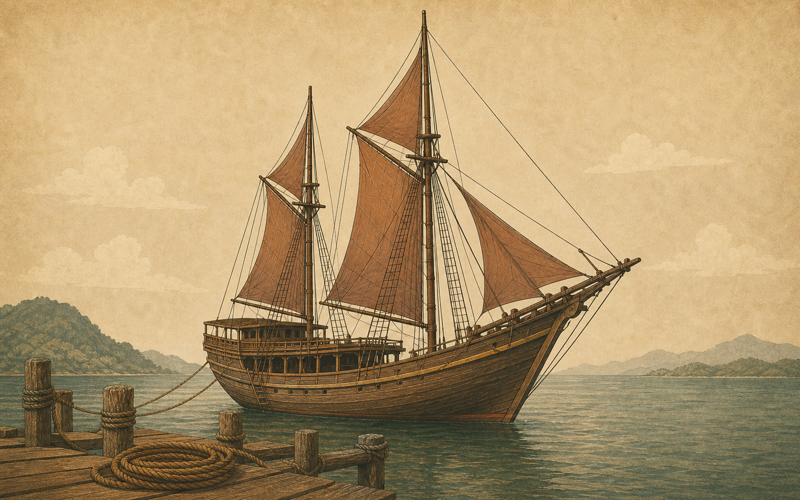
The early history of Indonesia cannot be understood only from palaces, temples, or battlefield stories. Much of its power was made on water. Ships moved between islands, river mouths, and foreign ports; sailors waited for monsoon winds; rulers tried to protect harbors and persuade merchants that their ports were safe, useful, and sacred.
From Sumatra to Java and beyond, early maritime kingdoms turned geography into authority. They did not always resemble compact land empires with fixed borders. Often they were networks of ports, river settlements, alliances, tribute relations, and ritual centers. Their history shows how the Indonesian archipelago became a meeting place for commerce, Buddhism, Hindu traditions, diplomacy, and local knowledge.
Geography as Political Power
Indonesia's island world gave early rulers both opportunity and difficulty. The sea connected communities, but it also required skill. A ruler who wished to influence trade had to understand tides, river access, monsoon seasons, anchorage, food supply, and the loyalties of coastal groups. Control of one harbor was useful; control of a chain of useful stopping places was far more powerful.
The Strait of Malacca was especially important because it linked the Indian Ocean with the South China Sea. Ships moving between India, China, mainland Southeast Asia, and the island world passed through this corridor or through nearby alternatives. Sumatra's eastern rivers and coasts therefore became politically valuable, not because they were isolated, but because they were so connected.
Java offered a different balance. Its interior agricultural wealth could support large religious and political projects, while its northern coast opened toward overseas exchange. This combination helps explain why early Javanese courts could build monumental sacred landscapes while also participating in maritime diplomacy and trade.
Srivijaya and the Straits
Srivijaya is the clearest example of an early Indonesian maritime power. Britannica describes it as a maritime and commercial kingdom that flourished from the 7th to the 13th century, with origins in Palembang and influence over the Strait of Malacca. Its authority rested less on a single continuous territory than on the ability to organize movement through a crucial sea passage.
The Musi River region helped connect inland products with ships at the coast. Forest goods, resins, aromatic woods, and other commodities could move outward, while imported objects, religious texts, and prestige goods moved inward. A port such as Palembang was not simply a market. It was a place where merchants, monks, envoys, scribes, and local leaders negotiated protection and status.
Srivijaya also mattered as a Buddhist center. Chinese pilgrims traveling toward India used maritime routes, and Srivijaya became one of the places where religious learning and travel overlapped. In museum terms, this means that a bead, inscription, ritual image, or ship model can belong to the same historical story: each points to a world where trade and sacred knowledge moved together.
Java, Sailendra, and Coastal Connections
Central Java's 8th- and 9th-century kingdoms are often remembered through temples, especially Borobudur. UNESCO identifies Borobudur as a major Buddhist monument built in the 8th and 9th centuries during the Syailendra dynasty. Although Borobudur stands inland in the Kedu Valley, it belonged to a world connected to wider Asian religious and artistic currents.
The Sailendra dynasty shows that maritime history was not only about ports. Agricultural wealth, ritual authority, and overseas links could reinforce one another. A court supported by rice-growing regions could commission religious monuments, send or receive envoys, and participate in networks that carried Buddhist ideas across the Bay of Bengal and the South China Sea.
Britannica notes that the dynasty's power extended toward Java's northwestern coasts, where emissaries traded with and raided parts of the Malay Peninsula and Indochina. Such evidence should be handled carefully, because early inscriptions and later traditions do not always give a complete map. Still, they show that Javanese power was not locked inside the island's interior.
Goods, Gifts, and Diplomatic Exchange
Early trade was not a modern marketplace separated from politics. Goods moved through relationships. Rulers offered protection, harbor facilities, ritual prestige, and diplomatic recognition. Merchants brought textiles, ceramics, metals, aromatics, beads, and information. Some exchanges were commercial, some were ceremonial, and many were both at once.
Tribute missions to China, contacts with India, and links with mainland Southeast Asia helped rulers present themselves as legitimate powers in an international order. A mission could carry local products and return with titles, gifts, or prestige. These diplomatic movements strengthened the ruler's position at home because foreign recognition could be displayed as proof of cosmic and political standing.
For local communities, trade networks also changed everyday life. Imported ceramics entered households and ritual settings. New religious vocabulary appeared in inscriptions. Craftspeople adapted foreign forms to local materials and tastes. The result was not simple imitation, but translation: objects and ideas were remade inside Indonesian social worlds.
Rivers, Ports, and Inland Communities
Maritime kingdoms depended on inland communities as much as sailors. Rivers carried products from forests, farms, and highlands toward the coast. People who gathered resins, cut timber, farmed rice, mined metals, or guided boats through difficult waters all helped sustain port power. The sea lane was only the visible edge of a deeper economic landscape.
This is why early Indonesian trade networks should be imagined as river-and-sea systems. A ruler at a port needed the cooperation of upstream groups. In return, inland leaders might gain access to imported goods, ritual objects, iron tools, cloth, or political alliances. Authority moved along waterways in both directions.
Museums can make this network visible by placing humble and prestigious objects together: a ceramic bowl beside a forest product, a temple image beside a boat fitting, an inscription beside a market weight. Such displays remind visitors that maritime history was made by laborers, pilots, farmers, artisans, and monks, not only by kings.
Religious and Cultural Currents
The same routes that carried commodities also carried religious texts, teachers, artistic models, and languages of prestige. Sanskrit, Old Malay, and Old Javanese inscriptions show how local rulers used imported religious and political vocabulary while shaping it to local needs. Buddhism and Hindu traditions became part of courtly life, but they did not erase older Indonesian landscapes of ancestor reverence, sacred mountains, and local ritual authority.
Borobudur is a powerful example of this blending. Its Buddhist cosmology was expressed through Javanese stone, landscape, labor, and royal ambition. Srivijaya offers another example: maritime trade supported a Buddhist center whose reputation reached beyond Sumatra. In both cases, religion was not separate from political economy. Sacred prestige helped rulers attract people, gifts, and loyalty.
These cultural currents were selective. Indonesian communities did not receive foreign ideas passively. They chose, adapted, translated, and localized them. The long-term result was a maritime civilization whose art and inscriptions speak in connected Asian languages while remaining deeply rooted in island environments.
Conclusion
The maritime kingdoms of early Indonesia show that power can be built from movement. Straits, rivers, monsoon winds, harbors, and ritual centers formed a political landscape as meaningful as walls or roads. Srivijaya, the Sailendras, and many smaller coastal communities made the archipelago part of a wider Asian world.
Their legacy survives not only in famous monuments, but also in the idea of Indonesia as a culture of crossings. Boats, ports, river products, inscriptions, ceramics, and sacred images all tell the same broad story: early Indonesian history was shaped by people who knew how to turn water into connection.