Jawi manuscripts are handwritten texts in Malay using an adapted Arabic script, associated in Indonesia with Malay-speaking communities and Islamic intellectual networks. Often called Arab-Melayu, Jawi carried stories, religious instruction, correspondence, and legal writing. Dwi Essy Ramala situates these uses within Malay cultural history. Ramala.
The museum’s manuscripts and literature collection places Jawi alongside other writing traditions. The precolonial writing-systems overview introduces that broader setting; here, named manuscripts and collections show how Malay writing connected people across islands.
Arabic Letters for Malay Words
Jawi runs from right to left and adapts Arabic letter forms to Malay sounds. Singapore’s National Heritage Board describes this adaptation as part of the influence of Islam on Malay literary culture. National Heritage Board.
Script and language need separate identification. A Malay text in Jawi differs from an Arabic text, even when both appear in one collection. It also differs from Pegon writing in Javanese and Sundanese, another adaptation of Arabic letters. Recognizing the script is a first step toward reading the words and understanding their audience.
Islamic Learning in West Sumatran Suraus
The Endangered Archives Programme’s EAP144 documents manuscript collections in West Sumatran suraus, local Islamic institutions. Its project account lists Qur’anic interpretation, Sufism, jurisprudence, grammar, stories, letters, and medicine. The eighteenth- and nineteenth-century manuscripts use Arabic, Malay, and Minangkabau; most are on European paper, with some on daluang. EAP144.
This multilingual setting helps explain Jawi’s place in Islamic learning. Malay offered a language for transmitting knowledge within a manuscript culture that also preserved Arabic and local-language works. The collection is broader than Jawi alone: identifying each text’s language reveals how learning moved between them.
A Copying Record between Semarang and Makassar
British Library Or 14350 contains Hikayat Raja Handik and an incomplete Hikayat Raja Pasai in Malay Jawi. The first work’s colophon dates its copying to 6 February 1797: Encik Usman copied it in Encik Johar’s house in Semarang’s Kampung Melayu for Encik Usep of Makassar, using Abdullah, Kapitan Melayu of Semarang’s manuscript. British Library catalogue.
That record names a copyist, host, requester, and manuscript owner across two ports. It provides concrete evidence for inter-island literary connections, without specifying the copy’s voyage. The date belongs to this copying event, rather than the original composition of either story.
Riau-Lingga: Writing beyond Religious Books
A Riau-Lingga state document, accession 2001-00374 in Singapore’s Asian Civilisations Museum, bears Jawi text and the date AH 1310 / 1892 CE. It places the script in court administration as well as literary and religious life. National Heritage Board.
The EAP153 preservation project describes Penyengat as a centre of nineteenth-century book culture associated with Raja Ali Haji. Its account also draws attention to collections on Lingga, Natuna, and Karimun. These island collections extend the picture beyond one author or court: their contents help reconstruct what owners read and kept. EAP153.
Read beside sacred texts and manuscripts of the archipelago, such records show why genre matters. Religious study, narrative reading, and administration used manuscript writing for different purposes.
Reading the Material Object
Paper connects the written page to exchange in materials. The National Heritage Board notes imported European paper, black ink, and loose or sewn leaves among Malay manuscript practices. National Heritage Board.
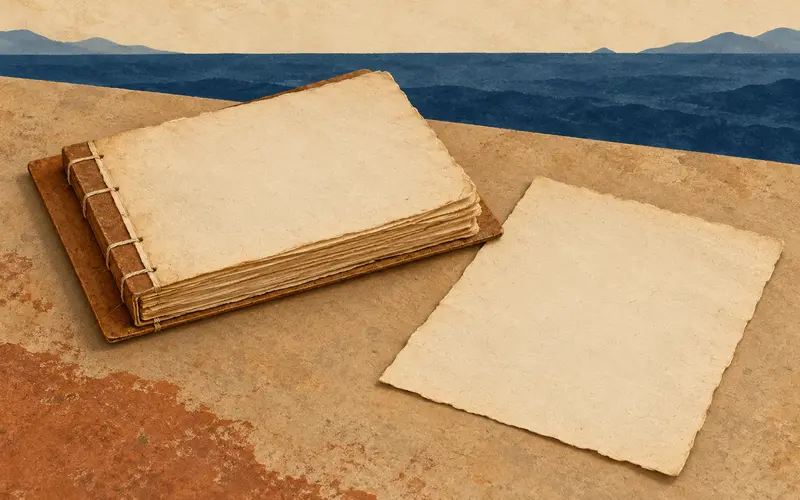
In a display, the text, copying record, paper, and later collection history can be read together. The pictured blank leaves are an interpretive illustration of manuscript materials; a digitised historical page is needed to examine actual Jawi spelling or handwriting.
Preservation also depends on local and international cooperation. Perpustakaan Nasional reports that Hikayat Aceh, jointly nominated with Leiden University Libraries, entered UNESCO’s Memory of the World Register in 2023. Perpustakaan Nasional. Jawi’s history becomes clearest through these individual witnesses: pages made, read, copied, and preserved by identifiable people and institutions.