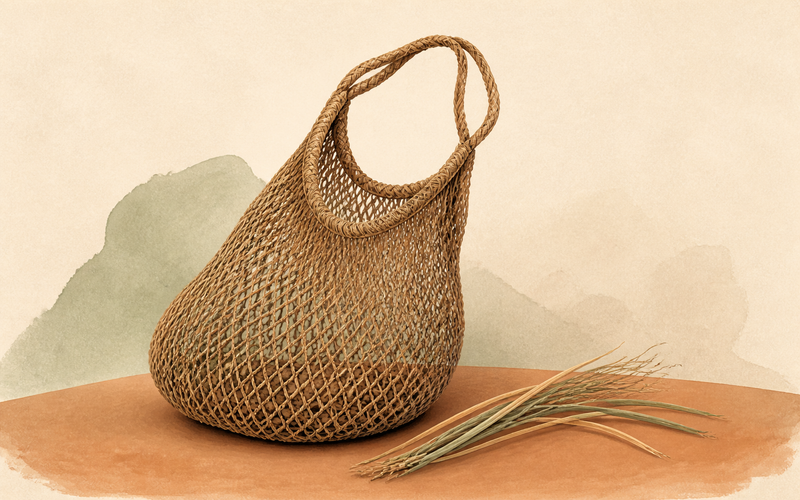
Noken is one of the most eloquent objects in Papuan material culture because it refuses to stay in a single museum category. It is a bag, but also a carrying system, a craft tradition, a marker of identity, a sign of care, and a record of plant knowledge. Made by knotting or weaving fibers into a flexible pouch, it belongs to daily work as much as to cultural memory.
For a museum, the noken offers a compact lesson in how useful objects can carry large histories. It can hold garden produce, market goods, firewood, personal belongings, gifts, or a child. It may be carried from the head, shoulder, or body depending on local habit, load, and setting. The object is humble in scale, yet it opens questions about environment, gender, labor, exchange, and the continuity of Papuan communities.
Fiber, Form, and Making
Traditional noken are closely tied to plant materials. Communities have used fibers from trees, bark, leaves, or other local sources, preparing them through gathering, stripping, twisting, drying, knotting, and weaving. The exact materials and methods differ across Papua, so a careful label should avoid presenting one form as the whole tradition.
The structure is usually open, flexible, and strong. A noken may look light when empty, but its strength appears when it stretches around a load. This elasticity is part of its intelligence. Unlike a rigid container, it adapts to irregular objects and to the movement of the carrier's body. The craft lies not only in pattern but in tension, spacing, fiber choice, and knowledge of use.
Because plant fibers are organic, they also remind museums that many important objects are vulnerable. A noken can wear out through honorable use, and older examples may become fragile in storage. Preservation is therefore not only a matter of keeping one bag behind glass. It also depends on sustaining the knowledge that allows people to make another one.
Carrying Work and Care
Noken is often described as multifunctional, and that word matters. It is not a ceremonial prop that only appears on special days. In many Papuan contexts it has belonged to walking, gardening, selling, visiting, studying, and caring for children. Its value comes from its ability to move with people through ordinary life.
The image of a noken carried from the head is especially memorable. A strap can rest across the forehead while the bag hangs down the back, distributing weight in a way suited to long movement and heavy loads. Other carrying styles may use the shoulder or hand. These choices show that the noken is part of bodily technique: people learn not only how to make it, but how to move with it.
Care is also part of the story. A noken may hold food harvested from a garden, goods taken to market, or small belongings needed during travel. In some contexts it can also carry a baby or young child. That use should not be romanticized as a simple symbol of motherhood, but it does show how the bag enters relationships of protection, mobility, and everyday responsibility.
Women, Knowledge, and Transmission
UNESCO's safeguarding description emphasizes that noken-making has traditionally been transmitted in Papuan communities, especially through women's knowledge. This does not mean every maker or user is identical, nor that men never carry noken. It does mean that the craft has often been taught through family, observation, practice, and shared labor rather than through formal written manuals.
Such transmission is easy to underestimate in a museum case. Visitors may see a finished net bag and miss the time required to know which fibers to gather, when to harvest them, how to process them, and how to judge strength by touch. A noken maker works with both memory and material. Skill appears in the evenness of knots, the control of tension, and the ability to make an object suited to real loads.
This is why documentation should include makers whenever possible. Names, communities, regions, material terms, and local uses help restore human knowledge to the object. Without that context, the noken risks becoming a generic "traditional bag." With it, the bag becomes evidence of careful teaching and inherited expertise.
Papuan Identity and Regional Diversity
Noken is widely recognized as Papuan, but Papua itself is culturally and linguistically diverse. Different highland, coastal, and island communities may use different materials, forms, sizes, colors, and carrying habits. Some noken are plain and practical; others are more decorative or publicly expressive. A museum should treat this diversity as central, not as minor variation.
In modern Indonesia, noken has also become a visible emblem of Papuan identity. It appears in cultural events, public ceremonies, educational programs, and heritage discussions. This broader recognition can be meaningful, because it gives visibility to Papuan craft within a national story often dominated by Java, Bali, and Sumatra.
At the same time, national recognition should not flatten local ownership. A noken is not simply an Indonesian symbol in general. It is rooted in Papuan communities whose histories, environments, and social lives give the object its meaning. Good interpretation keeps both scales in view: regional belonging and national heritage.
Safeguarding a Living Object
In 2012, UNESCO inscribed noken on the List of Intangible Cultural Heritage in Need of Urgent Safeguarding. That category is important. It does not treat noken only as an attractive artifact, but as a practice whose transmission faces pressure. Changes in materials, schooling, markets, labor patterns, and access to forests can all affect how craft knowledge continues.
One challenge is material change. Synthetic bags and commercial textiles can be cheaper, easier to obtain, and more durable in some everyday contexts. They may be useful, but they do not teach the same plant knowledge or hand techniques. If natural-fiber noken-making declines, communities lose more than one container form. They lose part of a chain connecting landscape, memory, and labor.
Safeguarding therefore has to support makers, not just collect finished objects. Workshops, local teaching, fair markets, community documentation, and respectful museum partnerships can all help. The aim should not be to freeze noken in one old form, but to keep the knowledge alive enough that communities can decide how it changes.
Displaying Noken in the Museum
A strong noken display begins with material clarity. Labels should identify the fiber when known, describe whether the structure is knotted or woven, and explain how the bag was carried. Showing an empty noken beside a photograph or drawing of one in use can help visitors understand why the flexible shape matters.
Sound and movement can deepen the interpretation. A short video of fiber preparation or carrying technique may explain more than a long technical label. Handling samples made for education can also help, if they are produced respectfully and not confused with collection objects. Visitors understand strength differently when they can feel tension and stretch.
The most responsible display also addresses contemporary life. Noken is not only a relic from a premodern past. It continues to appear in public culture, local economies, and identity work. Museums should therefore ask who made the displayed object, how it was acquired, whether makers benefit from its presentation, and how Papuan voices are included in the story.
Conclusion
Noken shows how a small, flexible object can hold a large cultural world. It connects plants, hands, walking paths, gardens, markets, children, memory, and identity. Its beauty is not separate from its usefulness; the two belong together.
For museums, noken is most powerful when presented as living heritage rather than as a silent curiosity. A bag can carry things, but it can also carry knowledge. In the Papuan noken, that knowledge stretches across generations, landscapes, and daily acts of care.