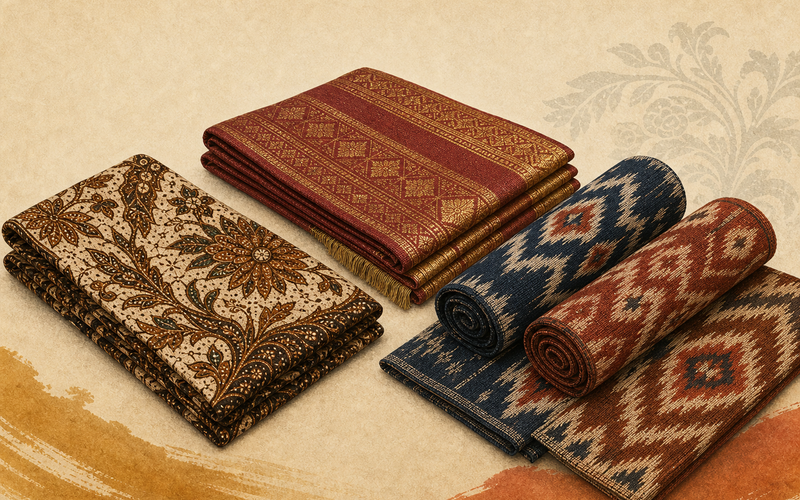
Batik is often introduced through the great textile centers of Java: Yogyakarta, Surakarta, Pekalongan, Cirebon, Lasem, and other places where wax-resist dyeing has long been tied to courts, ports, workshops, trade, and family labor. That focus is understandable. Java has shaped many of the techniques, vocabularies, and public images through which Indonesian batik became known nationally and internationally.
Yet Indonesian batik is not a single island story. Across Sumatra, Kalimantan, Sulawesi, Bali, Nusa Tenggara, Maluku, and Papua, batik has become a way to translate regional memory into cloth. Some traditions are old, others are more recent civic or educational projects, but all ask the same museum question: how does a textile become a place where people recognize themselves?
Batik as Technique and Cultural Language
At its most basic, batik is a resist-dye process. Wax is applied to cloth with tools such as the canting or a stamp, the cloth is dyed, and the waxed areas resist the color. Repeated waxing, dyeing, and removing of wax can produce layered patterns. UNESCO's description of Indonesian batik emphasizes not only technique but also symbolism, use in life-cycle events, and the transmission of knowledge within families and communities.
This distinction matters because batik is never only a method. A museum label that explains wax, dye, cotton, and silk has described the surface of the craft, but not the cultural work carried by the motif. A cloth may refer to a palace pattern, a coastal trade network, a local plant, a funeral practice, a sacred animal, a historic inscription, or a landscape feature. The textile becomes a language because makers and wearers learn to read those choices.
Regional batik beyond Java often makes that language especially visible. In many provinces, designers have selected motifs that announce local identity: architecture, flora, fauna, archaeological sites, oral traditions, scripts, musical instruments, boats, mountains, and sea life. These designs may be worn at ceremonies, in offices, at school events, or as formal dress for regional occasions. The cloth becomes both decoration and declaration.
Sumatra: Script, Trade, and Local Ornament
Sumatra's batik traditions show how regional cloth can absorb older symbols and newer public identity. In Bengkulu, batik besurek is known for designs associated with calligraphic forms and local decorative arrangements. The name is often linked with writing, and its visual language suggests how script-like ornament can become textile pattern even when the cloth is not read as a literal manuscript.
Other Sumatran batik traditions draw from local flora, architecture, and courtly or community symbols. In Jambi, motifs may be associated with plants, riverine life, and Malay ornamental traditions. In West Sumatra, textile identity is often discussed through songket, but batik designs can also borrow Minangkabau visual references, including forms connected to the rumah gadang roofline and local ceremonial life.
These examples remind museums not to isolate batik from other textile arts. Batik in Sumatra exists beside weaving, embroidery, songket, and imported cloth histories. Its meaning often depends on comparison. A regional batik may not replace older textiles; instead, it may offer another medium through which local symbols enter schools, tourism, civic uniforms, and contemporary fashion.
Kalimantan: Forest Worlds and Dayak Motifs
In Kalimantan, batik has often been connected with Dayak-inspired motifs, forest forms, river environments, and local emblems. Some designs refer to tendrils, hornbills, shields, longhouse forms, or other visual elements associated with inland communities. These motifs do not all have the same origin or ritual weight, so careful interpretation is needed. A museum should distinguish between sacred designs, community-owned symbols, commercial adaptations, and contemporary regional branding.
The island's geography also matters. Rivers, forests, and upland-lowland connections have shaped movement, trade, settlement, and cultural exchange. When batik patterns use vegetal curves, river imagery, or stylized animals, they may speak to an environment that is not a passive background but a central part of social life. Cloth becomes a compact map of ecological and cultural relationships.
Kalimantan batik is also a useful case for discussing modernity. Some regional batik production has grown through workshops, government encouragement, school programs, and local entrepreneurship. That does not make it less meaningful. Many heritage forms are actively made in the present. The key is to explain when a design is inherited, revived, adapted, or newly created for public identity.
Sulawesi: Ancestral Sites and Civic Motifs
Sulawesi offers strong examples of batik as a regional archive of symbols. In North Sulawesi, Minahasa batik motifs have drawn on local cultural references such as waruga stone graves, the Watu Pinawetengan site, dance, plants, and animals associated with regional identity. These motifs show how batik can carry memory from stone, performance, and landscape into textile form.
The translation from monument to cloth changes the object. A waruga grave is fixed in place and connected to ancestors, burial history, and local cosmology. A batik motif inspired by waruga circulates differently: it may be worn, gifted, sold, photographed, or taught as regional heritage. The textile does not replace the site, but it extends awareness of it into everyday and ceremonial settings.
Elsewhere in Sulawesi, regional batik may use maritime references, local scripts, flowers, houses, or ritual arts. The variety is important. Sulawesi is not a single cultural unit but a large island with many peoples, languages, and histories. Batik interpretation should therefore move from the province label to the specific motif, maker, and community context whenever possible.
Eastern Indonesia: From Islands to Motifs
In eastern Indonesia, batik often enters into conversation with powerful weaving traditions. Nusa Tenggara, Maluku, and Papua are widely known for ikat, barkcloth, carving, beadwork, and other media. Batik made or designed in these regions may borrow from local patterns, sacred forms, sea life, ancestral imagery, or natural dyes, while also adapting to markets that recognize batik as a national textile.
Papuan batik provides a clear example of regional translation. Motifs may draw from Asmat carving, Cenderawasih bird imagery, shields, boats, or earthy color palettes associated with land and wood. Such designs can introduce visitors to Papuan visual worlds, but they also require care. Motifs connected to specific communities should not be flattened into generic "Papua style" decoration.
In Maluku and Nusa Tenggara, maritime life, cloves and nutmeg histories, woven pattern structures, and island landscapes can inform batik design. These cloths show that batik beyond Java is sometimes less about direct continuity from an old local wax-resist tradition and more about a contemporary meeting between national craft, regional pride, and older visual systems.
Museums and the Ethics of Display
Displaying regional batik well requires more than arranging cloth by island. Museums should show technique, but also ask who chose the motif, who made the cloth, who wears it, and what older art forms it references. A batik inspired by a sacred site, a community emblem, or an ancestral design may need a different label from a commercial souvenir pattern.
Comparison can help visitors understand difference. A Javanese court-inspired pattern, a coastal batik with foreign floral influence, a Minahasa motif based on an ancestral stone site, and a Papuan motif adapted from carving all belong under the broad umbrella of Indonesian batik. They do not, however, carry meaning in the same way. Their histories, audiences, and authority are different.
Museums should also make room for makers' voices. Batik is an intangible heritage because knowledge is embodied in people: drawing wax, mixing color, remembering motif rules, teaching apprentices, selling cloth, and deciding when innovation is appropriate. Regional batik is strongest when it is interpreted as living practice rather than as a fixed catalog of designs.
Conclusion
Batik beyond Java expands the story of Indonesian textiles from a famous craft center into an archipelago of local interpretations. It shows how a shared technique can hold many histories at once: script in Sumatra, forest and river imagery in Kalimantan, ancestral sites in Sulawesi, island and carving traditions in eastern Indonesia, and countless contemporary experiments in between.
For museums, the lesson is not to reduce batik to national pattern or regional costume. The more rewarding view is slower and more attentive. Each cloth asks where its motifs came from, how its makers handled inherited symbols, and why wearers recognize it as meaningful. In that attention, batik becomes more than beautiful fabric. It becomes a map of Indonesia's regional imagination.