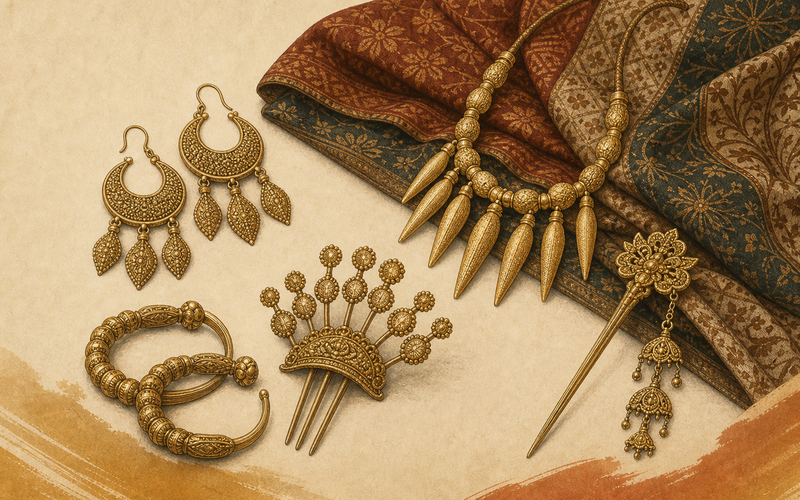
Indonesian traditional dress is often admired first for its richness of pattern, material, and color. In a museum gallery, a visitor may be drawn immediately to a deep indigo batik, a glowing soga-brown court cloth, or a textile from eastern Indonesia with strong red and yellow contrasts. Yet color in these garments is rarely only decorative. Across the archipelago, it helps communicate status, ritual appropriateness, locality, and inherited systems of meaning.
That meaning should be handled carefully. Indonesia is not a single dress tradition but a vast cultural landscape with many languages, courts, weaving communities, and ceremonial systems. A museum explanation of color therefore cannot claim that red, white, black, yellow, or blue mean exactly the same thing everywhere. What can be said with confidence is that color has long functioned as part of a visual language. It works together with motif, garment type, and context of use to shape how clothing is read by the community.
Color as Social Language
Traditional dress in Indonesia often communicates information before a wearer speaks. The cut of a garment, the textile wrapped around the body, and the placement of motifs all matter, but color is one of the clearest visual signals. It can suggest whether an outfit is meant for everyday life, a wedding, a court ceremony, mourning, or another important rite of passage. In this sense, color is part of etiquette as much as aesthetics.
UNESCO's description of Indonesian batik emphasizes that batik is woven into the life cycle, from infancy to funerary use, and that the symbolic meanings of colors and designs are central to its cultural life. This does not mean every cloth carries a universal code readable across the whole nation. Rather, it means communities recognize that colors are meaningful choices. A garment is culturally effective not only because it is beautiful, but because its colors are appropriate to the social and ritual situation.
Court Traditions and Hierarchy in Java
Javanese dress traditions provide some of the clearest evidence that color can express hierarchy. In courtly batik associated with Yogyakarta and Surakarta, dress was historically shaped by systems of rank, restraint, and regulation. The Metropolitan Museum notes that central Javanese batiks are often characterized by indigo and white tones and that certain designs once indicated social status, with some patterns restricted to noble or royal use. In such traditions, color was not fully separable from authority.
Official Indonesian heritage documentation on Yogyakarta batik adds another layer by linking black, soga brown, and white to a cosmological order. In that explanation, these colors are not casual preferences but part of a symbolic framework connecting the lower, middle, and upper worlds. Museum visitors should understand this as a tradition-specific interpretation rather than a rule for all Indonesian dress. Even so, it shows how color in court textiles could carry philosophical weight, joining garment, ritual, and worldview.
Regional Variation Across the Archipelago
Once we move beyond Java, color symbolism becomes even more regionally distinct. In eastern Indonesian textiles, strong red, yellow, black, and white contrasts are often visually prominent, but their meaning depends on the local weaving tradition and ceremonial use. The important museum lesson is that colors do not travel with stable meaning detached from place. A bright red field on one island may express vitality or ritual force, while elsewhere it may mark lineage, prestige, or another locally grounded value.
This is why broad statements about "Indonesian color symbolism" need caution. The archipelago contains court batik, ikat traditions, supplementary-weft ceremonial cloths, and many forms of local attire with different dye histories and social uses. Color meaning is produced within those systems. When museums flatten this diversity into a single chart of fixed meanings, they risk replacing cultural knowledge with attractive simplification.
Rank, Prestige, and Ceremonial Display
In many communities, color contributes to the display of rank and prestige. The Met's Sumba example of a woman's skirt, or lau pahudu, explains that bright yellow was used to imitate gilt and marked the original owner as a woman of particularly high rank. This is a valuable reminder that color can operate materially as well as symbolically. A yellow tone may evoke gold, wealth, or noble standing not only by abstract meaning, but by visual association with valued substances.
Prestige colors are especially important in ceremonial dress, where clothing must make social distinctions visible. Weddings, royal events, and formal community rituals often require garments that announce dignity and propriety at a glance. A museum label may focus on motifs, but the wearer and audience also respond to chromatic effect: dark authority, bright display, or carefully balanced combinations that fit a ritual role. Color therefore helps stage public identity.
Dyes, Materials, and the Making of Meaning
Color symbolism cannot be separated from the technologies that produce color. Indigo, soga browns, and other natural dyes are not neutral carriers of design. They come from learned processes, specialized materials, and regional histories of production. Indonesian heritage discussions of natural dyes in Java stress that dye knowledge was transmitted across generations and embedded in older textual traditions as well as workshop practice. The cultural value of color includes the knowledge required to create it.
This matters because the significance of a garment is shaped partly by labor. A cloth colored through repeated dyeing, waxing, or careful preparation of natural materials carries evidence of patience, skill, and lineage. Museums increasingly interpret dress through this lens, showing that color is both seen and made. To understand why a tone matters, one may need to ask who prepared it, what materials were available, and how communities judged the quality and appropriateness of the final result.
Color, Life Cycle, and Ritual Appropriateness
Indonesian traditional dress frequently appears in life-cycle ceremonies, and color helps indicate that a garment belongs to a particular ritual moment. Batik traditions in Java, for example, have been associated with birth, marriage, and death, and certain cloths are selected because their motifs and colors suit the moral or symbolic expectations of those events. The essential point is not that every community uses the same palette for the same rite, but that ceremonial dress is rarely arbitrary.
Because of this, the symbolism of color is often relational rather than isolated. A single color may matter less than how it appears with a certain motif, border arrangement, or garment form. It may also depend on who is allowed to wear it: a bride, a noblewoman, a ritual specialist, or a community elder. Museums do best when they present color as one part of a larger ceremonial system, rather than as a simple codebook in which each hue has one permanent definition.
Interpreting Color in Museums Today
For museums, the challenge is to explain color without freezing living traditions into rigid formulas. Visitors understandably ask what red or black "means," but a responsible answer often begins with region, community, and use. Curators can say that color in Indonesian traditional dress commonly signals social and ritual meaning, and then show how those meanings differ between Javanese court batik, Sumbanese ceremonial textiles, or other local dress traditions.
This approach produces a fuller understanding of dress as cultural knowledge. A garment is not only a surface of attractive color. It is a record of dye technology, social rules, inherited taste, and ceremonial memory. By preserving textiles alongside community interpretation, museums help audiences see that color in Indonesian traditional dress is powerful precisely because it is contextual. Its symbolism lives not in pigment alone, but in the societies that continue to read and remake it.
Conclusion
The symbolism of colors in Indonesian traditional dress is best understood as a set of regional visual languages rather than a single national code. Colors can mark hierarchy, ritual fitness, prestige, cosmology, and communal identity, but they do so differently across the archipelago. Their meaning becomes clear only when garments are read in relation to motif, technique, and ceremonial use.
For a museum audience, that complexity is not a problem but a strength. It reveals Indonesian dress as a living field of cultural interpretation, where color is both material practice and social meaning. Looking closely at color allows us to see traditional dress not merely as ornament, but as a thoughtful and historically layered form of communication.