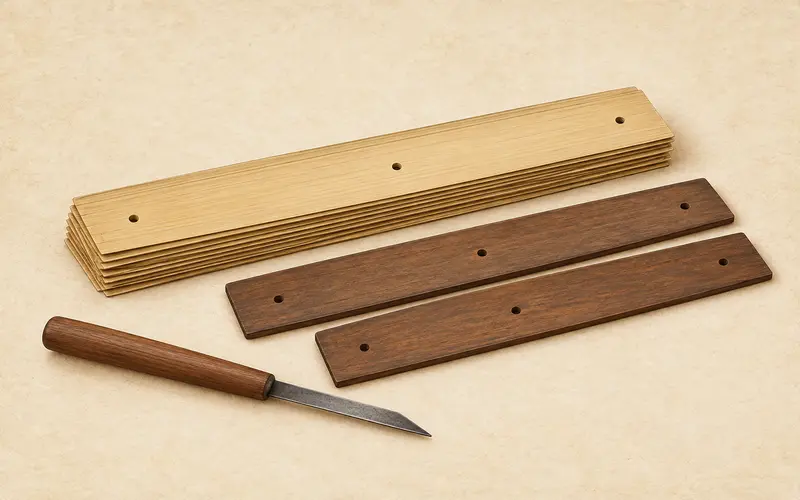
Lontar manuscripts are books made from prepared palm leaves, with a long, narrow format especially associated with the written traditions of Bali and Lombok. This article follows documented Balinese methods: how a leaf became a writing surface, how letters were cut and made visible, and how manuscripts were cared for after writing. The wider history of lontar in Bali and Lombok explains their literary and religious settings.
Selecting Leaves and Preparing the Surface
In their 2018 study, Nyoman Rema and Ida Bagus Rai Putra interviewed makers in Karangasem, including Ida I Dewa Gde Catra and I Ketut Sengod. They describe selecting leaves between youthful softness and excessive hardness, then drying, soaking, and boiling them with plant ingredients. Their account records a three-week soak and an eight-hour boil. Rema and Putra, pp. 7–9.
Preparation varied. A 2021 Directorate of Senior High Schools teaching guide describes soaking for three to four days, drying, brushing with coconut fibre, and boiling with ingredients including cloves, pepper, and coconut bark. Rice cooked alongside the leaves serves as a practical indicator of readiness. These different accounts show why a single processing timetable cannot represent every workshop. Direktorat SMA, pp. 50–51.
The Asia and Pacific Museum's account adds pressing, final trimming, polishing with pumice or abrasive paper, piercing, and ruling. These operations turn uneven plant material into aligned writing strips. The manuscript's neat rectangular appearance thus records work completed before the first letter. Asia and Pacific Museum, pp. 110–112.
Cutting Letters with a Pengrupak
The Balinese pengrupak, also spelled pengerupak, is a small writing knife. The Directorate SMA guide describes a steel implement with a triangular pointed end, distinguishing tools for writing from those for drawing. Writing begins by incising the leaf rather than depositing a line of liquid ink. Direktorat SMA, p. 50.
Rema and Putra describe the cooperation of both hands: one holds and moves the leaf while the other controls the knife, with the supporting thumb guiding its movement. They also stress command of the language, script, and spelling of the text being copied. The craft joins manual control with reading knowledge. Rema and Putra, p. 10.
For the distinction between a language and its written signs, see Kawi script and Old Javanese. Preparing a leaf, choosing a script, and composing or copying a work are different parts of manuscript production.
Making the Incisions Readable
Fresh incisions can be difficult to see. In observations at Jero Kanginan Sidemen and Pidpid, Abang, Rema and Putra documented finishing with roasted kemiri, or candlenut. Its dark material enters the cuts; the surface is then wiped. The visible letter follows the groove already made by the knife. Rema and Putra, pp. 9–10.
The museum account likewise describes candlenut darkening and wiping, followed by stacking the leaves between wooden covers and threading a cord through the central hole. Covers protect the bundle, while the loose-leaf arrangement makes order part of its care. Asia and Pacific Museum, pp. 111–112.
Care in a Community Collection
A 2013 Klungkung study by I Nyoman Sedana and colleagues documents storage in household or temple settings, offerings, cleaning of kropak containers and storage shrines at Saraswati, and treatment with lemongrass oil mixed with candlenut. It also records rewriting damaged leaves by people skilled in Balinese script. These are practices reported for the study's custodians, rather than a treatment recipe for every surviving manuscript. Sedana and colleagues.
Copying preserves access to a text through another physical witness. It does not preserve all the material evidence of the older leaf. Keeping track of which leaves belong together, what has been replaced, and who made a copy helps readers understand both the object and its transmission.
Digitization and What a Museum Can Show
DREAMSEA's report on I Wayan Wandra's collection in Sukawati, Gianyar, describes cleaning and sorting before photographing 68 manuscript bundles, producing more than 2,000 digital images. Udayana University students and Balinese language instructors assisted. The example makes preservation visible as work shared between custodians, manuscript specialists, photographers, and language communities. DREAMSEA.
Collection records also give visitors identifiable objects to investigate. The Library of Congress lists Fragmen kakawin Bharatayudha, manuscript MLCHE 2011/00024 SEA Cage, with an approximate date of 1900. Such a catalogue date concerns the manuscript witness, not necessarily the composition of its text. Library of Congress.
A display can place a prepared blank beside a written leaf and a writing knife, allowing visitors to follow the change from plant fibre to readable surface. A digital enlargement can then reveal individual grooves without repeated handling of the original. Explore the Manuscripts and Literature collection and the broader precolonial writing systems for other relationships between materials, scripts, and knowledge.