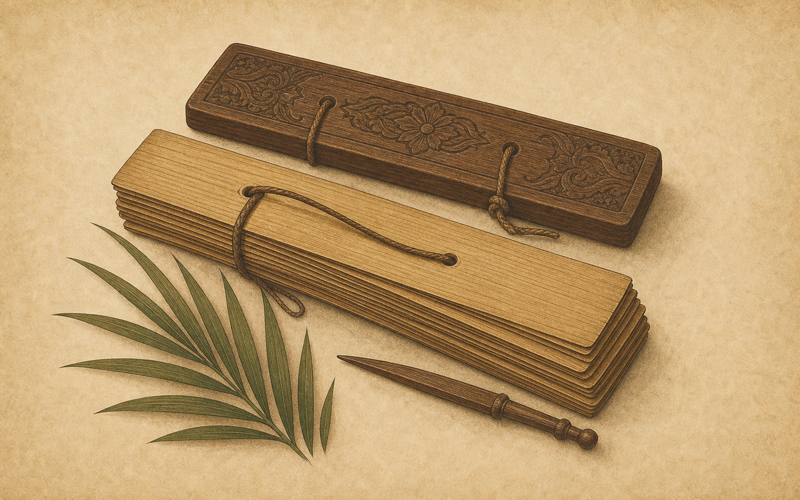
Lontar manuscripts are among the most recognizable objects of Indonesian written heritage. Long, narrow palm leaves, pierced and tied into bundles, carry lines of script that may contain poetry, ritual instructions, calendars, genealogies, medicine, mythology, or local history. Their format looks modest beside a printed book, yet each manuscript represents a chain of skilled work: selecting leaves, preparing surfaces, cutting letters, darkening the grooves, reading aloud, storing carefully, and passing knowledge between generations.
In Bali and Lombok, lontar history is not only the story of old texts. It is also a story of islands where writing, religion, performance, family memory, and local authority developed together. Bali is especially associated with Hindu-Balinese manuscript culture and Balinese script, while Lombok preserves important Sasak palm-leaf traditions, including materials shaped by Islam and local religious practice. A museum view of lontar must therefore treat them as both artifacts and active cultural instruments.
Palm Leaves as Writing Technology
Palm-leaf manuscripts were widespread across South and Southeast Asia before paper became dominant in many regions. The British Library notes that palm-leaf books were made from prepared leaves, cut into strips, and inscribed with a stylus rather than written with ink in the first instance. The writing was then made visible by rubbing pigment into the incised lines. This method produced a durable but vulnerable book form: strong enough to circulate, yet sensitive to humidity, insects, handling, and fire.
The Indonesian word lontar is often connected with the palmyra palm, known botanically as Borassus flabellifer. The manuscript leaf had to be processed before it could become a writing surface. While local techniques varied, the basic aim was to dry, clean, flatten, and strengthen the leaf so that it could receive fine incisions without tearing. Holes were usually made so leaves could be threaded together and protected by wooden or bamboo covers.
This material form shaped reading itself. A lontar is not opened like a codex book. The reader handles a sequence of leaves, often guided by memory, training, and knowledge of the text. Because the writing surface is narrow, composition and layout were disciplined by the leaf.
Bali's Manuscript World
In Bali, lontar manuscripts have been central to religious, literary, and intellectual life for centuries. Collections may include sacred texts, ritual manuals, calendrical works, medical knowledge, epic literature, moral instruction, genealogies, law, architecture, performing arts, and stories connected to wayang and courtly culture. Wikimedia's account of Balinese Wikisource describes lontar as a primary written medium in Bali and notes the wide range of genres preserved in Balinese palm-leaf collections.
The cultural role of Balinese lontar is inseparable from the people who read and maintain them. Priests, ritual specialists, healers, scholars, artists, and family custodians may all relate to manuscripts in different ways. Some texts support temple ritual, others guide auspicious timing, interpret illness, preserve literary refinement, or connect a household to ancestral knowledge. A single manuscript can therefore carry religious, practical, and social meanings at once.
Bali also reminds museums that manuscript culture is not simply elite culture. Some lontar were copied and studied in learned circles, but many were kept in households or local communities. Their authority could depend on lineage, place, teacher-student relationships, ritual legitimacy, or the reputation of a particular reader. The manuscript was a physical object, yet its meaning often emerged when someone knew how to activate it through recitation, explanation, or ritual use.
Lombok and Sasak Palm-Leaf Traditions
Lombok's lontar heritage is sometimes less visible in popular accounts than Bali's, but it is historically significant. The island has Sasak manuscript traditions as well as Balinese communities in the west, and its collections reflect varied religious and cultural settings. A 2022 study in the Journal of Islamic Manuscripts emphasizes that many Lombok manuscripts are written on palm leaves and that numerous texts are connected with Islamic learning, especially among communities associated with Waktu Telu practice.
This does not mean that every Lombok palm-leaf text fits neatly into one religious category. Manuscripts may mix local narrative, genealogy, ethics, divination, ritual knowledge, and Islamic themes. The religious background of some works can be complex, and scholars often approach them by studying language, script, material form, ownership, and performance context together. Lombok therefore offers a useful caution against treating manuscript labels as simple boxes.
The Sasak context also widens the museum story of Indonesian Islam. Written Islam in the archipelago did not appear only in Arabic-script paper books. In Lombok, Islamic ideas could be preserved, adapted, and transmitted through palm-leaf formats that also belonged to older regional technologies. This layered history shows how communities adopted religious knowledge without necessarily abandoning local media or inherited habits of textual care.
Making, Copying, and Caring for Texts
The making of a lontar manuscript required patience and specialized skill. Leaves had to be prepared, cut to size, smoothed, and kept suitable for inscription. Letters were incised with a sharp implement, and dark material was rubbed across the surface so pigment remained in the grooves. The leaves were then cleaned, ordered, tied, and often placed between protective boards. In many cases, the manuscript's survival depended on periodic attention rather than passive storage.
Copying was also a cultural act. A text might be copied because an older manuscript was damaged, because a student needed a copy, because a family wished to preserve inherited knowledge, or because a ritual specialist required access to a working text. Copying could introduce variation, correction, commentary, or local spelling habits. For historians, these small differences are not merely errors; they are evidence of living transmission.
Care had spiritual dimensions as well as practical ones. In Bali, manuscripts may be ritually honored in connection with Saraswati, the goddess associated with learning and knowledge. Such practices remind us that preservation is not only a modern conservation science. Communities have long maintained their own ethics of respect, restriction, purification, and appropriate handling. A museum can display a manuscript, but it should also explain the forms of care that made display possible.
Knowledge Preserved in Lontar
The contents of lontar manuscripts are remarkably varied. Some preserve kakawin and kidung literature, drawing on Old Javanese and later literary worlds. Others contain calendars, astrology, medicinal recipes, ritual procedures, architecture, ethics, histories, origin stories, genealogies, or instructions for performance. This range challenges the modern habit of separating religion, science, art, and social life into rigid categories.
Calendrical and ritual texts show how manuscripts helped organize time. A manuscript might guide the selection of auspicious days, temple activities, agricultural timing, or life-cycle ceremonies. Medical and healing texts show another form of applied knowledge, where plants, diagnosis, mantra, and embodied practice could belong to the same intellectual world. Literary texts, meanwhile, helped shape ideals of kingship, devotion, beauty, and moral conduct.
For museums, lontar are valuable because they connect intangible knowledge to a tangible object. Visitors can see the leaves, holes, cords, covers, and writing lines, but the deeper story lies in how those features supported memory and instruction. A palm-leaf bundle is not only a container of words. It is evidence of how a society organized learning before modern archives, classrooms, and printed libraries became common.
Preservation, Digitization, and Access
Palm-leaf manuscripts face serious preservation challenges. Tropical climates can accelerate decay, and manuscripts may be damaged by insects, moisture, brittle leaves, smoke, or repeated handling. At the same time, removing manuscripts from community life can create another kind of loss. Conservation must balance physical survival with cultural access, local authority, and respect for restricted or sacred materials.
Digitization has become an important response. The Balinese Digital Library and later Balinese Wikisource efforts have helped make many texts more visible to readers, researchers, and younger Balinese-language communities. Wikimedia's account notes the scale of digitized Balinese lontar and the difficulty of making handwritten Balinese-script materials searchable without reliable optical character recognition. Digital images preserve access, but they do not automatically solve reading, translation, or interpretation.
The future of lontar heritage therefore depends on collaboration. Conservators, local custodians, philologists, religious specialists, language activists, and museums each hold different parts of the work. A digital file can protect an image of a leaf, but people still need to know the script, language, ritual setting, and ethical boundaries of use.
Conclusion
The history of lontar manuscripts in Bali and Lombok shows how writing can be both fragile and enduring. Palm leaves decay, cords break, and scripts require trained eyes, yet the tradition has carried literature, ritual, healing, calendars, and local memory across centuries. These manuscripts ask museums to look beyond the page as a surface and toward the full cultural life of a text.
Seen in this way, lontar are not relics of a vanished world. They are witnesses to Indonesian systems of learning that joined material skill, religious imagination, regional language, and communal responsibility. Their preservation matters because they still teach how knowledge survives: through objects, certainly, but also through hands, voices, teachers, readers, and care.