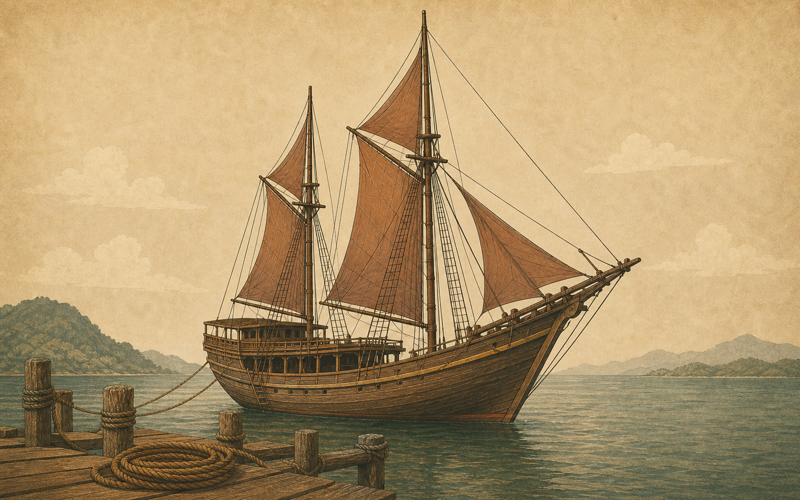
Srivijaya is one of the clearest examples of how power in early Indonesia could be made from water. Its story belongs to rivers, estuaries, straits, ships, monks, envoys, and merchants. Centered for much of its history around Palembang in southern Sumatra, Srivijaya became influential because it understood the sea not as an empty boundary, but as a political road.
For museums, Srivijaya is especially valuable because it connects different kinds of evidence. Inscriptions, foreign accounts, Buddhist images, ceramics, maps, and port landscapes all help visitors imagine a society whose authority was spread through movement. Srivijaya was not simply a trading state or a religious center. It was both, and the two roles strengthened each other.
A Maritime Power in the Straits
Srivijaya flourished from the seventh century and remained important for several centuries afterward. Its rise was closely tied to the Strait of Malacca and nearby sea passages linking the Indian Ocean with the South China Sea. Ships moving between India, China, mainland Southeast Asia, and the island world passed through this maritime corridor, making Sumatra's eastern coast strategically important.
This geography shaped Srivijaya's political form. It did not need to govern every inland area directly in order to matter. It needed to influence ports, river mouths, anchorage points, pilots, local chiefs, and the movement of goods. In this sense, its power was relational. It depended on persuading or compelling people to move through Srivijaya's network rather than around it.
Historians often describe Southeast Asian polities of this kind as mandala-like systems, where authority radiated outward from strong centers and became less direct at the edges. That model fits Srivijaya better than the image of a fixed modern state. Its borders were not drawn like lines on a contemporary map. Its strength was measured in routes, loyalties, tribute, reputation, and ritual prestige.
Palembang and the Musi River World
Palembang was more than a harbor. Located on the Musi River system, it connected maritime traffic with inland Sumatra. Forest products, resins, aromatic woods, and other valuable goods could move downriver toward ships, while imported ceramics, cloth, metal goods, religious texts, and prestige objects moved inland. The port was a meeting place between ecological zones as much as between foreign traders.
This river-sea relationship helps explain why Srivijaya could become powerful without resembling a large agricultural empire. Control over river access allowed rulers to draw wealth from interior communities while also serving merchants who needed safe passage, supplies, and political protection. A ship did not stop only for trade. It stopped for water, repairs, information, ritual offerings, and permission.
Museum displays can make this landscape visible by placing prestigious objects beside ordinary materials. A Buddhist image, a bead, a ceramic sherd, a model boat, and a map of the Musi River all belong to one historical field. Together they show that Srivijaya's maritime power was built from practical labor as well as royal ceremony.
Buddhist Learning on the Sea Route
Srivijaya's influence was not only commercial. It became known as an important Buddhist center, especially for travelers moving between China and India. The Chinese monk I-ching, often rendered Yijing, visited Srivijaya in the seventh century and described it as a place where monks could study before continuing to India. His account is one of the most important textual windows onto Srivijaya's religious world.
This role made Srivijaya part of a wider Buddhist geography. Monks, manuscripts, ritual practices, and philosophical traditions moved along the same sea lanes as merchants and envoys. A vessel carrying trade goods could also carry religious texts or travelers seeking teachers. In that setting, the port city became a temporary monastery, translation station, and diplomatic stage.
Srivijaya's Buddhism should not be imagined as a simple copy of Indian models. Like other parts of early Indonesia, it adapted foreign religious forms into local political and ritual life. Buddhist prestige could support royal authority, while royal patronage could support monasteries and teachers. Trade brought contact; local institutions gave that contact lasting shape.
Inscriptions, Language, and Authority
Srivijaya is also known through inscriptions, especially Old Malay inscriptions from the late seventh century. These texts are crucial because they show rulers using written language to assert loyalty, punishment, merit, and sacred authority. They are not neutral descriptions of everyday life, but they reveal how power wanted to be heard and remembered.
The language of these inscriptions is important for Indonesian cultural history. Old Malay appears as a language of political order and public command, long before modern Indonesian emerged. The inscriptions show that Malay was already useful in a connected maritime environment where messages needed to travel across communities. Language itself became part of Srivijaya's infrastructure.
In museum interpretation, inscriptions can be difficult because they are often fragmentary, formal, and unfamiliar to visitors. Their value becomes clearer when they are presented as political performances. A carved stone did not merely record authority. It helped produce authority by placing royal command into durable public form.
Diplomacy and the Asian Maritime World
Srivijaya's rulers participated in diplomatic relationships with powerful neighbors, including China. Tribute missions and official exchanges were not signs of weakness in the simple sense. They were part of an international language of recognition. By sending envoys and receiving titles or gifts, a ruler could strengthen his standing among merchants, rival ports, and local elites.
Diplomacy also helped Srivijaya manage commerce. Foreign merchants preferred ports where authority was predictable and protection could be negotiated. Recognition from distant courts made a port more legible within the wider Asian world. It signaled that Srivijaya was not an isolated harbor, but a participant in a larger order of ships, documents, gifts, and ceremonial obligations.
This diplomatic world was practical and symbolic at the same time. Goods moved with messages. Religious prestige moved with political status. A Buddhist teacher, a royal envoy, and a merchant might travel through the same port for different reasons, yet each helped make Srivijaya visible across Asia.
Srivijaya, Java, and Buddhist Monumentality
Srivijaya belonged to a broader early Indonesian Buddhist world that also included powerful Javanese traditions. The Borobudur Temple Compounds in Central Java, built in the eighth and ninth centuries under the Syailendra dynasty, show the scale and sophistication of Buddhist art in the region. Borobudur was not a Srivijayan monument, but it helps visitors understand the wider environment in which Buddhist ideas, artistic forms, and royal patronage circulated.
Connections between Sumatra, Java, India, and mainland Southeast Asia should be described carefully, because the evidence does not always allow simple political maps. Still, the shared Buddhist vocabulary of the period is unmistakable. Monumental architecture, inscriptions, pilgrimage, and court patronage all point to a world in which island Southeast Asia was deeply engaged with Asian religious currents.
Seen this way, Srivijaya was not an isolated Sumatra-based kingdom. It was one node in a wider Buddhist and maritime sphere. Its ports, teachers, and diplomatic missions helped link early Indonesia to movements of knowledge that crossed the Bay of Bengal and the South China Sea.
Remembering Srivijaya Today
Srivijaya matters today because it challenges narrow ideas of what political power looks like. Its authority was not built mainly from stone walls or a single palace complex. It was made through control of passage, skillful diplomacy, religious patronage, and relationships with communities along rivers and coasts. That makes it harder to display than a kingdom represented by one monumental capital, but also more rewarding.
A museum gallery on Srivijaya can teach visitors to read movement as evidence. Maps, ship routes, inscriptions, Buddhist objects, ceramics, and river landscapes each show part of the same system. They remind us that early Indonesian history was not peripheral to Asia. It was one of the places where Asia's maritime and religious worlds met.
Conclusion
Srivijaya's legacy lies in its ability to join commerce, Buddhism, and maritime authority. From Palembang and the Musi River region, it reached outward through straits, ports, diplomatic missions, and monastic travel. Its world was fluid, but not shapeless; it was organized by routes, obligations, sacred prestige, and political intelligence.
To understand Srivijaya is to understand early Indonesia as a crossroads of waterborne knowledge. The kingdom's history shows that ships could carry more than goods. They carried languages, rituals, manuscripts, reputations, and ideas of power that helped shape the Buddhist world of early Indonesia.