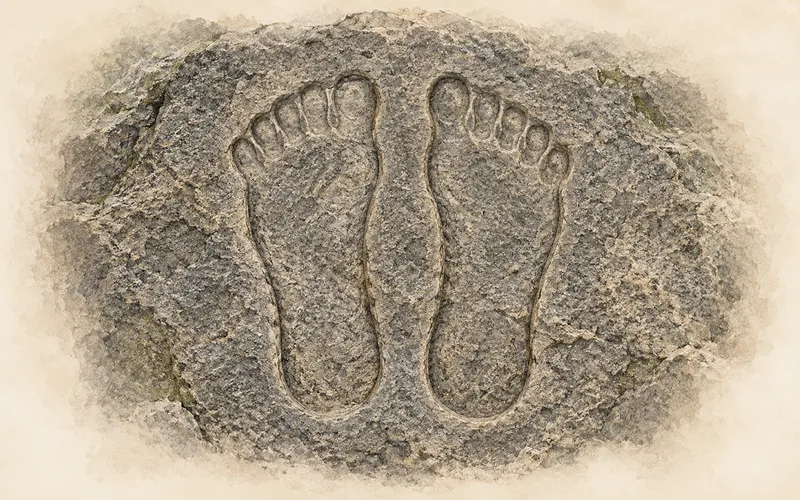
The Ciaruteun inscription is a stone monument associated with King Purnawarman of Tarumanagara in western Java. It combines a short Sanskrit text in Pallava script with carved human footprints. The monument belongs to the early written history of the region now known as Bogor, West Java, and is generally placed around the fifth century CE.
Its importance lies in the connection between image, words, and royal identity. Rather than offering a full history of a kingdom, the inscription makes a concentrated statement about a named ruler. Reading that statement closely reveals what the stone tells us directly, what scholars infer, and what remains beyond the evidence of this single object.
A Stone Monument in the Bogor River Landscape
Bogor's cultural office identifies the inscription's material as andesite and locates it in Cibungbulang, Bogor Regency. Its account describes a four-line verse in the Indian anustubh metre. The combination of a large natural stone, footprints, and a compact text makes the object different from a manuscript page or a freestanding statue. Bogor cultural office.
The regional cultural planning document records that the stone formerly lay in the Ciaruteun River. That setting matters to its object history: a river can connect places, but it can also move or damage a stone. The place where an inscription was documented, the position it occupied at that time, and its present display location should therefore be kept distinct. A landscape photograph alone cannot establish every stage of that history. Bogor cultural planning document.
Sanskrit Language and Pallava Script
Sanskrit is the language of the principal text; Pallava is the conventional name used for its script. These labels answer different questions: what language was written, and which forms of letters recorded it? Ciaruteun should not be described as a text in the “Pallava language,” nor should its lettering be casually relabelled Kawi. The museum's writing-systems overview introduces those distinctions in a broader Indonesian setting.
In paraphrase, the verse associates the pair of feet with Purnawarman, ruler of Taruma, praises his prowess, and compares them with Vishnu's feet. This is a summary of the reading published by the Bogor cultural office, rather than a new translation of the Sanskrit. The statement names a king and invokes a deity; it does not supply a complete genealogy, a map of the realm, or a narrative of its foundation. Published reading.
What the Carved Footprints Communicate
The footprints are representations carved into the stone. Their connection with Purnawarman is established through the accompanying words, not through proof that the king physically stepped into the rock. Image and text reinforce one another: the visible pair draws attention, while the verse explains whose presence and qualities the monument asks its audience to recognize.
Hariani Santiko interprets the religious language of Tarumanagara's inscriptions through Vedic ideas about Vishnu and royal power. Her discussion connects the language of strides with Vishnu's cosmic steps. This is a scholarly interpretation of the inscription's religious frame. It should remain distinguishable from the more immediate observation that the text explicitly compares the royal feet with those of Vishnu. Santiko, The Vedic Religion in Nusantara.
Dating Ciaruteun Without Inventing an Exact Year
The commonly used fifth-century date is an approximate historical attribution. Santiko notes that the relevant Tarumanagara inscriptions lack calendar-year dates and discusses dating from their letterforms, placing the group broadly in the fourth to fifth centuries. Palaeography, the study of historical writing forms, thus contributes to the chronology. An exact modern calendar year should not be presented as if it appeared on Ciaruteun itself. Santiko: dating the inscriptions.
Approximation does not make an object uninformative. It tells the reader what kind of chronological evidence is available. The date assigned to the carving, the date of a published reading, and the date of a conservation intervention are separate facts. A clear museum account can use a broad period confidently while leaving finer chronology open. This is more useful than attaching a precise year whose basis the visitor cannot inspect.
Tarumanagara Through More Than One Inscription
Other records broaden the picture beyond Ciaruteun's brief royal verse. A ministry account of the National Museum describes the Tugu inscription as a Sanskrit text in early Pallava script concerning the excavation of waterways associated with Purnawarman. Tugu therefore brings a different subject into discussion: works involving water, rather than the particular image-and-text arrangement of Ciaruteun. Ministry account: Tugu.
The heritage account of Pasir Awi describes another pair of carved footprints but also emphasizes that its additional pictographic marks lack a certain reading. Similar imagery does not justify supplying identical words or meanings to every stone. Comparing inscriptions means preserving their differences as well as their connections. The museum's Kingdoms and Courts collection places such individual records within wider questions about rulers, places, and historical evidence. Direktorat Pelindungan Kebudayaan: Pasir Awi.
Royal Religion and the Limits of a Single Voice
Ciaruteun records a royal statement. Its religious comparison is evidence for the terms in which authority was presented, but it cannot by itself describe every community's practices. A ruler's commemorative text is a particular voice, even when its language makes expansive claims. Asking who speaks through an inscription is as important as identifying the names it contains.
The Directorate of Cultural Protection's discussion of Batujaya identifies Buddhist evidence in that West Javanese archaeological complex. This offers a reminder that the region's religious history requires more than one category of source. It does not establish that every Batujaya structure was commissioned by Purnawarman or was contemporary with Ciaruteun. Architecture, excavation contexts, and inscriptions each need their own dating before they are combined into a historical reconstruction. Batujaya heritage discussion.
Relocation, Protection, and How to View the Stone
Bogor's cultural planning document records the removal of the inscription from the river in July 1981 after concerns about movement during floods and wear to its surface. The ministry heritage database lists Situs Prasasti Ciaruteun as a nationally ranked heritage site under decision 139/M/1998. These belong to the monument's modern preservation history, rather than to Purnawarman's reign. Bogor document; heritage record.
For readers encountering a photograph, replica, or illustration, the distinction should be explicit. A replica may clarify a shape, but it is not the original surface; an interpretive drawing may omit details and should say so. The most useful presentation pairs an identified view with a documented reading and an explanation of uncertainty. Looking at the footprints, then at the verse, helps recover the relationship between image and royal language without filling gaps with an invented story.
Conclusion
Ciaruteun preserves a concise association between Purnawarman, Taruma, and Vishnu expressed through carved footprints and Sanskrit verse. Its significance comes from that particular combination and from its place among other early records of western Java.
The stone rewards close attention rather than an enlarged legend. Its estimated age, river provenance, religious language, and modern protection each contribute to its history, while none alone provides a complete account of Tarumanagara or everyone who lived within its sphere.