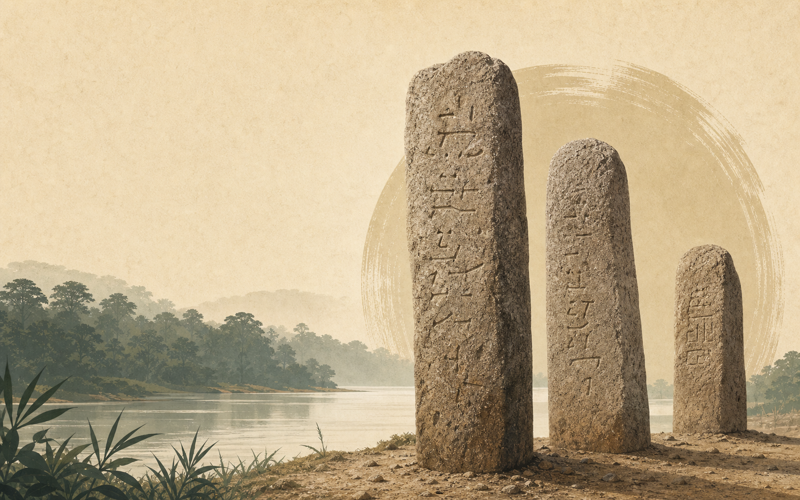
The history of early Indonesia often begins, quite literally, with stone. In eastern Kalimantan, near Muara Kaman in the Kutai region, a group of inscribed stone posts known as Yupa preserve some of the earliest written evidence yet known from the archipelago. They do not tell a complete story of a kingdom, and they were not written for modern historians. Even so, their carved Sanskrit words open an important window onto ritual life, political memory, and the early adoption of Indic forms of authority in Borneo.
For a museum, the Kutai Yupa inscriptions are powerful because they are both objects and texts. Their physical form points to ritual practice, while their language points to learned religious networks that reached far beyond Kalimantan. They show that early Indonesian history was never isolated. Local rulers, priests, donors, and communities were already participating in a wider cultural world, while reshaping that world in local terms.
Muara Kaman and the Earliest Written Evidence
The Yupa inscriptions are associated with Muara Kaman, an area in present-day East Kalimantan. Indonesian cultural heritage sources commonly identify them as evidence for one of the earliest known historical polities in the archipelago. Their usual dating to around the fourth century CE places them at a formative moment, when written records begin to supplement archaeology and oral memory.
This does not mean that history began only when writing appeared. Communities in Kalimantan had long histories before the Yupa were carved. What changes with inscriptions is the type of evidence available to scholars. A stone inscription can preserve names, titles, ritual actions, and political ideals in a durable public form. It gives historians a direct, though limited, voice from the past.
The inscriptions therefore mark a transition in evidence rather than a sudden beginning of civilization. They remind visitors that written history is uneven. Some communities left inscriptions; others preserved memory through objects, landscapes, ritual, and speech. Kutai matters because its stones allow one early ruling circle to be heard with unusual clarity.
What a Yupa Is
The word Yupa refers to a sacrificial post associated with Vedic ritual traditions. In the Kutai context, the stones are not ordinary boundary markers or simple memorial slabs. Their form and wording connect them to ritual acts, especially offerings and donations made in a setting where Brahmanical specialists held recognized authority.
This ritual character is central to their interpretation. The inscriptions praise royal generosity and commemorate gifts, including cattle, associated with King Mulawarman. Such statements were not neutral bookkeeping. They publicly linked the ruler with piety, wealth, legitimacy, and the religious specialists who could authorize and remember those acts.
Museum interpretation should avoid reducing the Yupa to "old writing" alone. Their shape, placement, and ceremonial associations mattered. They were material witnesses to a ritual world in which power was performed through sacrifice, public praise, and durable memory.
Sanskrit, Script, and Cultural Exchange
The language of the Kutai inscriptions is Sanskrit, written in a script related to early South Indian Pallava writing. This combination immediately places Kutai within a broad cultural zone. Sanskrit was not simply a spoken local language. Across much of South and Southeast Asia, it served as a prestigious language of ritual, learning, poetry, and kingship.
Its use in Kalimantan suggests the presence of people trained in Brahmanical forms of expression, whether local specialists, visiting priests, or communities shaped by long-distance exchange. The inscriptions show that foreign cultural forms did not arrive as finished packages. They were selected, translated into local politics, and made meaningful in specific places.
The names preserved in the inscriptions are especially revealing. Kundungga, often presented as the ancestor of the ruling line, appears to have a non-Sanskritic name, while Aswawarman and Mulawarman bear names shaped by Sanskritic vocabulary. Historians often treat this contrast carefully as evidence of cultural transformation across generations, not as proof of a simple replacement of one identity by another.
Mulawarman and Royal Memory
Mulawarman is the central royal figure remembered in the Yupa inscriptions. The texts present him as a generous and powerful ruler, descended from Aswawarman and linked further back to Kundungga. This genealogy matters because it gives royal authority a lineage. A ruler was not praised only for his own gifts, but also placed within a remembered family line.
The inscriptions are formal praise, so they must be read with caution. They emphasize what the ruling circle wanted to make permanent: generosity, ritual merit, noble descent, and relationship with Brahmanical authority. They do not describe taxation, farming, household life, ordinary religious practice, or the full political geography of the region.
Yet this selectiveness does not make them less valuable. It tells us what mattered in public royal representation. Mulawarman's authority was made visible through donation, ritual language, and the presence of specialists who could frame his actions in Sanskrit. The inscriptions are therefore both evidence of a ruler and evidence of how rulership wanted to be remembered.
Kalimantan in Wider Maritime Asia
Kutai's location in eastern Borneo should not be imagined as remote from early Asian exchange. Kalimantan's rivers, forests, and coasts were part of wider networks that moved forest products, metals, ritual knowledge, stories, and prestige goods. Even when the precise routes behind the Yupa inscriptions remain difficult to reconstruct, the inscriptions themselves show contact with a larger intellectual and religious world.
This wider setting helps explain why Sanskrit inscriptional culture could take root far from India. Across Southeast Asia, local rulers adapted Indic religious vocabulary to express authority. The process was not uniform. In some places it produced monumental temples; in others, inscriptions, ritual titles, or courtly practices. Kutai's Yupa belong to this broader pattern while remaining distinctly tied to the landscape of Muara Kaman.
For visitors, this is a useful way to think about early Indonesian history. Cultural exchange was not passive imitation. Local elites used imported forms to solve local problems of status, memory, alliance, and sacred legitimacy. The stones show both connection and agency.
Reading the Stones Responsibly
Because the Yupa inscriptions are so important, they are sometimes asked to carry more historical weight than they can bear. They do not provide a detailed map of the Kutai polity, a complete list of rulers, or a full account of social life in fourth-century Kalimantan. They are ritual inscriptions, shaped by praise and formal convention.
Responsible interpretation begins by respecting their limits. The inscriptions can tell us about Sanskritic royal language, genealogy, ritual donations, and the presence of Brahmanical religious authority. They cannot, by themselves, answer every question about ethnicity, economy, administration, or everyday belief. Those questions require archaeology, comparative history, environmental study, and careful attention to later traditions.
In a museum setting, the uncertainty can be productive. Visitors can learn how historians work: not by turning one object into a complete story, but by asking what kind of evidence it is, who made it, what it emphasizes, and what it leaves unsaid.
Why Kutai Matters Today
Kutai matters because it pushes Indonesian historical imagination eastward. Many famous early monuments are associated with Java or Sumatra, but the Yupa inscriptions remind us that Kalimantan also stands at the beginning of the archipelago's written record. They make eastern Borneo central to the story of early Indonesian cultural formation.
They also show that Indonesian heritage is multilingual and layered. A local Kalimantan ruling line used Sanskrit, a language of transregional prestige, to express authority in a Bornean setting. That combination complicates modern categories. The inscriptions are not simply Indian, not simply local, and not merely decorative. They are Indonesian heritage precisely because they reveal how local societies transformed outside influences into their own historical forms.
For the public, the Yupa can become a bridge between material culture and historical thought. A visitor sees stone, then learns to see writing, ritual, genealogy, exchange, and memory. Few objects demonstrate so clearly how a small group of inscriptions can reshape the scale of a national story.
Conclusion
The Kutai Yupa inscriptions are modest in number, but immense in historical significance. They preserve early Sanskrit writing in Kalimantan, name a remembered ruling line, and commemorate ritual generosity associated with Mulawarman. Their value lies not in providing a complete chronicle, but in revealing how local authority entered a wider world of script, ritual, and royal memory.
Seen carefully, the stones do more than announce the antiquity of Kutai. They show early Indonesia as a place of adaptation and choice, where communities engaged with distant traditions while grounding them in local landscapes. In that sense, the Yupa remain among the most eloquent witnesses to the beginning of Indonesia's written historical record.