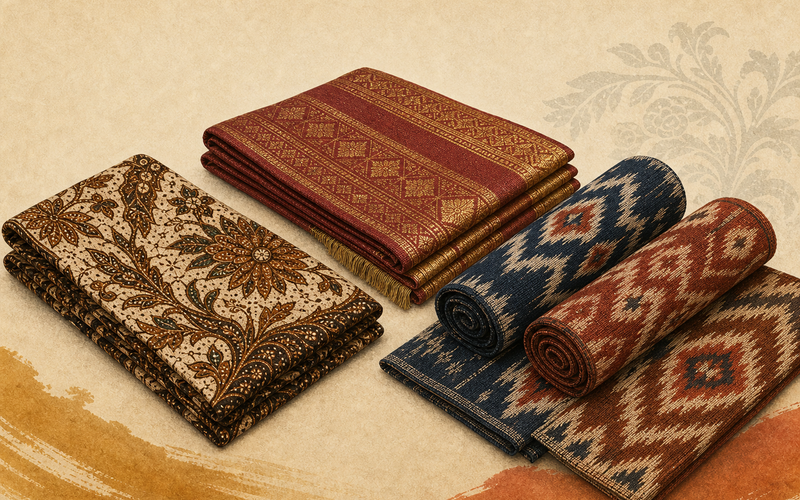
Songket is often introduced to visitors as a beautiful textile distinguished by shimmering motifs that seem to float on the cloth surface. In museum galleries, this first impression is understandable: the reflective threads and dense patterning immediately communicate prestige. Yet in Sumatra, songket has long functioned as more than ornament. It has been part of court culture, ritual exchange, and social communication, linking textiles to questions of rank, morality, kinship, and memory.
A museum approach to songket therefore begins with context. Textiles are never only technical products. They are worn, displayed, inherited, gifted, and interpreted in specific social settings. In many Sumatran regions, especially in areas associated with Palembang and Minangkabau traditions, songket is tied to ceremonial life and to systems of local knowledge transmitted across generations. Understanding its cultural meaning requires attention not only to motifs and materials, but also to the communities that sustain weaving practice.
What Makes Songket Distinct
Songket is generally defined as a handwoven textile made with a supplementary weft technique in which metallic threads, historically including gold or gold-colored yarns, are inserted to form decorative motifs. This method creates the luminous surface that gives songket its recognizable appearance. Unlike printed or mechanically repeated patterns, handwoven songket displays slight variation in rhythm and texture, features that many curators and collectors treat as signs of skilled labor.
The word "songket" is often linked in public explanations to the act of "hooking" or lifting threads during weaving, although etymological interpretations vary. What matters for cultural history is that technique and meaning remain inseparable. The brilliance of the cloth is not an added decoration placed on top of a neutral base. It is produced through decisions about structure, timing, and motif placement made by weavers who work within inherited design vocabularies. In that sense, songket should be read as a technical art with social intention, not just as luxury fabric.
Courtly Prestige and Historical Networks
In Sumatra, songket has strong associations with aristocratic and courtly worlds, particularly in historical narratives connected to Palembang. Metallic thread textiles could signify authority, dignity, and access to resources. Their use in formal attire reflected hierarchies within royal courts and elite households. When museums classify songket as a prestige textile, they are drawing on this long history of connection between cloth and power.
At the same time, songket was shaped by wider maritime exchange networks. Sumatra was integrated into trading systems that circulated silk yarns, metallic threads, dyes, and aesthetic influences across Southeast Asia and beyond. This does not mean songket was merely imported taste. Local communities selected, adapted, and reinterpreted available materials within their own social frameworks. The result was a textile tradition that can be both transregional and deeply local. For museum interpretation, this is important: songket embodies Sumatra’s participation in connected histories without erasing regional identity.
Ritual Life, Marriage, and Social Belonging
The cultural meaning of songket becomes especially visible in ceremonial contexts. In many Sumatran communities, songket appears in weddings, life-cycle rituals, and other formal events where clothing must communicate propriety and belonging. Wearing particular textiles can signal respect for customary law, family lineage, and community expectations. A cloth is therefore not only chosen for beauty; it is selected for its social appropriateness in a given rite.
In marriage settings, songket often participates in exchange systems between families and may become part of heirloom circulation. This circulation gives the textile biographical depth. A piece may be remembered as the cloth worn by a grandmother, the gift offered during a key alliance, or the garment associated with a specific ritual role. Museums increasingly document this dimension through oral testimony and provenance work, because the meaning of the object cannot be reduced to date and material alone.
Women’s Knowledge and the Ethics of Transmission
Although men and women both participate in textile economies, songket weaving in many Sumatran settings has been strongly associated with women’s skill, discipline, and social responsibility. Learning to weave often involves gradual apprenticeship: observing elders, practicing basic structures, then mastering complex motifs and thread control. This process transmits more than technique. It teaches patience, precision, and normative ideas about proper conduct within household and community life.
From a heritage perspective, this intergenerational transmission is central. If a museum preserves an old songket cloth but local weaving knowledge declines, an essential part of the heritage is lost. The object survives, but the living system that gave it meaning becomes fragile. That is why contemporary cultural programs increasingly support artisans, workshops, and community-based training rather than focusing only on collecting historical examples. Songket preservation is most effective when it includes makers, not only masterpieces.
Motifs, Symbolism, and Regional Diversity
Visitors sometimes ask whether songket motifs have fixed universal meanings. The careful answer is no. Some motifs are widely recognized and carry recurring associations, but interpretation varies by region, family tradition, and ceremonial context. A motif understood as auspicious in one locality may not function identically elsewhere. Museum labels that present a single rigid meaning for every pattern risk oversimplifying living traditions.
What can be stated with confidence is that motifs are culturally coded. They are selected and combined according to conventions learned within weaving communities. Geometric forms, floral references, and repeated structural patterns can indicate regional style, social taste, or ritual suitability. In this sense, songket works as a visual language whose grammar is locally maintained. Curatorial practice benefits from collaborative interpretation with weavers and community historians so that symbolic readings remain grounded rather than speculative.
Songket in Contemporary Heritage and Museum Practice
Today, songket occupies a dynamic space between ceremonial continuity, cultural tourism, fashion markets, and heritage policy. This can create productive visibility, but also tension. Increased demand may provide income for artisans, yet market pressure can encourage faster production, synthetic substitution, or motif simplification detached from ritual context. Museums and cultural institutions therefore face a double task: celebrate creativity while clarifying historical depth and social meaning.
A responsible museum strategy treats songket as living heritage. Exhibitions can connect historical cloths to present-day makers, show variations across Sumatran regions, and explain how textiles function in ceremonies rather than displaying them as isolated luxury objects. Documentation can combine fiber analysis, weaving diagrams, oral histories, and community co-curation. Such approaches allow audiences to see songket not as a static relic of the past, but as an evolving cultural practice that still organizes identity and memory.
Conclusion
Songket weaving in Sumatra is culturally significant because it joins beauty, technique, and social life in one medium. Its gold-thread surfaces communicate prestige, but its deeper meaning lies in how communities use cloth to express hierarchy, ritual propriety, kinship ties, and historical continuity. A songket textile is both material artifact and social text.
For museums, the key lesson is clear: preserving songket requires preserving relationships as well as objects. The cloth matters, the motifs matter, and the historical record matters, but so do the weavers, ceremonies, and interpretive traditions that keep the practice meaningful. Seen in this fuller frame, songket is not merely decorative heritage. It is a living archive of Sumatran cultural knowledge.