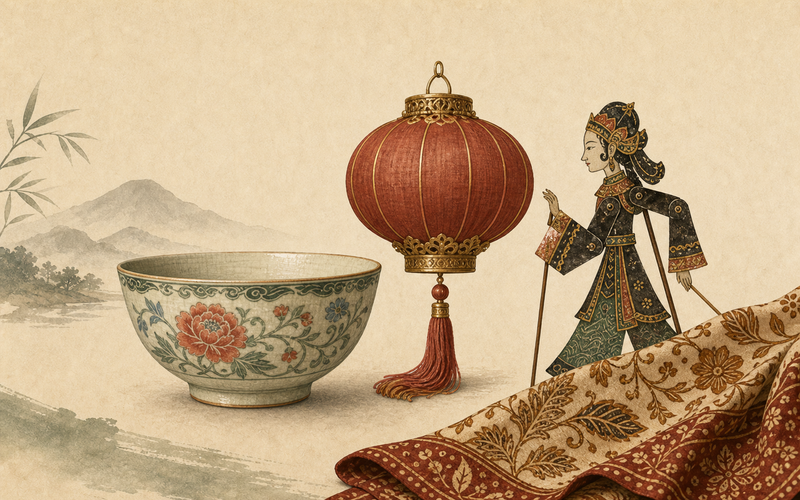
The influence of Chinese culture on Indonesian traditions is neither marginal nor uniform. It emerged over centuries through trade, settlement, intermarriage, and everyday contact in ports, market towns, and urban neighborhoods across the archipelago. A museum perspective is especially helpful because it reveals this influence not as a simple story of origins, but as a process of adaptation. Chinese-derived forms entered Indonesian life through specific communities and historical conditions, then took on local meanings within Javanese, Sumatran, Balinese, and other social worlds.
For that reason, the subject is best approached through cultural exchange rather than cultural replacement. Chinese influence did not erase existing Indonesian traditions. Instead, it interacted with them. The result can be seen in ritual objects, temple architecture, culinary practices, vocabulary, festival life, and performance traditions. These traces are especially visible in communities often described as Peranakan, whose history demonstrates how cultural forms can become deeply localized while still preserving memories of transregional connection.
Long Histories of Contact
Chinese cultural influence in Indonesia developed through long-distance trade networks that connected the archipelago to wider Asian maritime routes. Merchants, artisans, and settlers moved through these networks over many centuries, and their presence became especially important in commercial centers. Such contact created conditions for the circulation not only of goods, but also of tastes, rituals, decorative forms, and social practices. Museums should emphasize this duration because it helps explain why Chinese influence appears in so many ordinary parts of Indonesian life.
This history was never a single, unified movement. Different regions encountered Chinese communities in different ways and at different times. In some places the relationship was shaped mainly by commerce, while in others it was also shaped by residence, intermarriage, and neighborhood formation. The diversity of these encounters matters. It prevents us from treating "Chinese influence" as one static package and instead encourages a historically grounded reading of local exchange.
Peranakan Communities and Cultural Blending
The most important framework for understanding Chinese influence in Indonesian traditions is the history of Peranakan communities. Britannica describes Peranakans in Indonesia as native-born people of mixed local and foreign ancestry, and notes that Peranakan Chinese formed the most significant such group. Over generations, these communities partly adopted local ways of life, often spoke local languages or Malay rather than Chinese, and developed customs that were neither entirely imported nor entirely separate from their Indonesian surroundings.
This makes Peranakan culture central to museum interpretation. It shows that influence does not always operate through direct preservation of an original form. It may also work through blending, translation, and everyday domestic life. Clothing styles, household decoration, foodways, naming practices, and communal celebrations all became sites where Chinese and local elements were recombined. The result was not a loss of identity, but the creation of new cultural forms that belonged specifically to the Indonesian archipelago.
Ritual Life, Temples, and Public Memory
One of the clearest traces of Chinese influence appears in ritual spaces and public religious life. Klenteng, or Chinese temples, remain visible landmarks in many Indonesian towns and port settlements. Heritage documentation from the Ministry of Culture shows that such sites are treated as important cultural properties as well as living religious spaces. Their architecture, ornament, color schemes, and iconography preserve links to Chinese traditions while also reflecting local histories of settlement and worship in Indonesia.
These temple environments also illustrate how cultural influence becomes embedded in public memory. A klenteng is not simply an imported building type placed unchanged into a new landscape. It becomes part of a local urban history, tied to trade routes, community organization, and annual rituals. In that sense, temple heritage can be read as evidence of long coexistence. It shows how Indonesian towns incorporated Chinese religious and visual forms into their own historical texture.
Food as a Form of Acculturation
Culinary traditions offer some of the most accessible evidence of Chinese influence in Indonesian culture. The Directorate General of Culture explicitly describes kecap as a product of cultural acculturation linked to Peranakan Chinese history. The account is important because it shows that food history is not only about ingredients, but also about adaptation to local taste. Soy sauce entered Indonesian settings through Chinese culinary practice, yet the development of kecap manis reflected accommodation to Javanese preferences for sweeter flavors.
This example illustrates a broader pattern. Chinese influence in Indonesian food often became durable precisely because it was localized. Techniques, ingredients, and seasonings were not merely copied; they were transformed. Museum audiences can understand this process readily because food demonstrates cultural exchange in material, everyday terms. It shows how global movement and local preference meet at the level of the household meal, turning migration history into living tradition.
Performance, Language, and Urban Culture
Chinese influence also entered Indonesian traditions through performance. Wayang potehi, for example, is described by the Ministry of Culture as a traditional art of Chinese origin that has become an inseparable part of Indonesian cultural life. Historically associated with temple environments and Chinese communities, it later developed through local adaptation, including performance in Indonesian rather than only in Hokkien. This change is significant because it shows a tradition becoming intelligible to wider publics without losing its earlier ritual associations.
Urban performing arts offer similar evidence of cultural blending. In some cities, mixed performance traditions drew from Chinese, Malay, and local Indonesian forms at once. These arts remind us that influence is not limited to objects or buildings. It also works through sound, gesture, repertoire, and language. When museums interpret such traditions, they can show how city life in Indonesia became a laboratory of exchange in which Chinese cultural forms were translated into locally meaningful entertainment and ceremony.
Indonesian Heritage, Not an External Addition
It is important to avoid treating Chinese influence in Indonesia as if it were permanently external to Indonesian culture. Many communities of Chinese descent have lived in Indonesia for generations, and Britannica notes that a large part of the Chinese population has long been of mixed, Peranakan heritage. Traditions shaped through these histories are therefore not best understood as foreign fragments sitting beside an untouched indigenous culture. They are part of Indonesia's own historical development.
This point matters especially in museums, where categories can unintentionally harden social boundaries. A stronger interpretation presents Chinese influence as one strand within Indonesia's plural heritage. That approach allows viewers to understand how traditions are formed through contact and coexistence. It also respects the fact that many practices associated with Chinese Indonesian communities have long been woven into local identities, neighborhood histories, and shared civic memory.
Continuity and Change in Modern Indonesia
In modern Indonesia, traditions shaped by Chinese influence continue to change. Some have experienced revival after periods of restriction, while others now circulate more openly through heritage tourism, festivals, museums, and digital media. At the same time, urban redevelopment and generational change can place pressure on older neighborhoods, temple spaces, or artisanal knowledge. The present condition of these traditions is therefore a matter of both continuity and vulnerability.
That tension makes them especially important for documentation and exhibition. A museum can help audiences see that hybrid traditions are not minor curiosities. They are records of how Indonesian society has negotiated diversity over time. By tracing the influence of Chinese culture on food, ritual, performance, and urban life, museums reveal the archipelago not as a collection of sealed identities, but as a place shaped by long histories of encounter.
Related Reading
This history connects with ancient trade routes and their impact on Indonesian culture, the history of Indonesian shadow puppet storytelling, and batik beyond Java, which also explores regional and cross-cultural adaptation.
Conclusion
The influence of Chinese culture on Indonesian traditions is best understood through adaptation, not imitation. Across centuries of contact, communities in the archipelago incorporated Chinese-derived forms into local practices of worship, cuisine, performance, and public life. These influences became meaningful because they were localized, translated, and woven into everyday social experience.
From a museum perspective, this history shows how plural heritage is made. Chinese influence in Indonesia is not a footnote to national culture, nor a simple sign of outside presence. It is part of the historical fabric of Indonesian tradition itself, visible wherever exchange produced new and durable forms of cultural life.