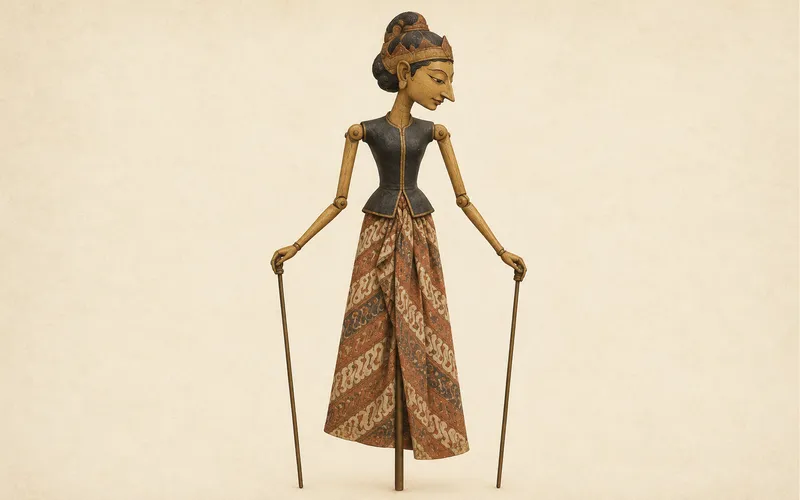
Wayang golek is theatre performed with three-dimensional wooden rod puppets. In the Sundanese traditions of West Java, a dalang animates the figures, supplies their voices, and shapes a story with musicians and singers. The puppets are seen directly, rather than primarily as shadows projected onto a screen. This article focuses on Sundanese wayang golek purwa, whose repertoire draws on the Ramayana and Mahabharata.
A puppet in a museum shows only part of that art. Its carved face, jointed arms, and cloth costume were designed for movement and recognition. To understand the object, we also need to listen for the dialogue, musical responses, and changing relationships between performers and their audience.
A Sundanese Tradition within the Wayang Family
Wayang names a family of performance traditions, not one uniform kind of puppet. Indonesia's cultural heritage directorate distinguishes wooden, three-dimensional golek from leather forms and identifies western Java as a major setting for its development. Within golek, repertoire and regional practice matter: a label that simply says “Indonesian puppet” leaves much unexplained. Indonesian cultural heritage directorate.
The Smithsonian's 2014 programme, prepared with Indonesian arts specialists, differentiates Sundanese golek purwa from wayang cepak traditions with other narrative repertoires. It places the current form of golek purwa in the nineteenth century, while recording older coastal connections and legends about Islamic saints. These are different kinds of evidence; a saint's founding legend should not become an exact invention date. Smithsonian: Performing Indonesia.
Wood, Cloth, and Control Rods
Reading Museum describes a central rod passing through the body to the head, with additional rods attached to the hands. The figure is operated from below. Jointed arms allow gestures while the carved head establishes a recognizable presence above the textile costume. This construction differs from the flat leather figures discussed in our article on wayang kulit and the Javanese worldview. Reading Museum: puppet construction.
A documented example at the Spencer Museum of Art makes these materials concrete. Accession 2007.1537 combines wood, cloth, ribbon, wire, and paint. Its costume includes a black velvet upper garment and a patterned batik skirt; dowels attached to the hands provided control. Such details remind us to look beyond carving alone: costume-making, painting, and assembly all contribute to the finished theatrical object. Spencer Museum collection record.
Recognizing a Character in Motion
Faces are part of a theatrical vocabulary. Reading Museum's teaching resource contrasts refined figures with narrow eyes and a lowered gaze against more forceful figures with broader features and a direct stare. These conventions help communicate a role before the dialogue develops it. They should be understood within the performance tradition, rather than turned into judgments about the appearance or character of real people. Reading Museum: character types.
For a museum visitor, a useful exercise is to follow the relationship between face, hand, and posture. What might change when the head turns away, when an arm rises, or when a pause interrupts a gesture? These questions do not identify a character by themselves. They help recover the object's capacity for action, which a still photograph or upright display can make easy to overlook.
The Dalang and the Musical Ensemble
The dalang's work brings several skills together: manipulation, dialogue, song, and coordination. Yet the performance is a collaboration. The cultural heritage directorate identifies Sundanese gamelan in salendro tuning as accompaniment and lists instruments including kendang, gong, saron, gambang, and rebab. The sounding ensemble gives the dramatic action a musical setting; it is more than background decoration. Indonesian cultural heritage directorate: accompaniment.
Named performance credits make that collaboration visible. The Smithsonian's 2014 presentation listed Kathy Foley as dalang, musicians from STSI Bandung, Masyuning as pasinden, and Undang Sumarna on kendang. Recognizing these separate contributions prevents the carved puppet or the puppeteer from eclipsing everyone else. The shared attention required offers a useful comparison with angklung ensemble practice in West Java, although the instruments and performance methods differ. Smithsonian programme and credits.
Epic Stories and Creative Retelling
The Ramayana and Mahabharata provide important narrative worlds, but a performance need not retell an entire epic. A particular lakon, or play, selects an episode and develops its encounters. Indonesian cultural documentation distinguishes galur stories and carangan, creative stories developed within the wayang world. This distinction gives space to the dalang's invention without suggesting that every performance abandons inherited characters and relationships. Indonesian cultural heritage directorate: repertoire.
For someone meeting these stories for the first time, it helps to ask smaller questions than “What does the whole epic mean?” Who is speaking, what do they want, and how does another character answer? Listening to one exchange makes room for ambiguity. A tale can invite reflection on loyalty, power, or responsibility without becoming a single moral slogan imposed on every scene.
Gatherings, Ritual, and Entertainment
Wayang golek can belong to social occasions as well as dedicated theatrical presentations. Reading Museum records performances at weddings, circumcision celebrations, and other gatherings, describing audiences who may move around while listening and watching. The event therefore includes more than the story: hosts, guests, food sellers, and musicians help make the occasion. This is a different viewing environment from silently facing a display case. Reading Museum: performance setting.
Some performances also have ritual purposes. The Smithsonian programme discusses ruwatan, intended to release people or places from harmful influences, alongside entertainment. That context should be stated for the particular performance concerned; it does not make every golek show a ritual of the same kind. Spiritual purpose, pleasure, and public gathering can overlap without becoming interchangeable descriptions. Smithsonian: ceremonial contexts.
Reading a Puppet in a Museum
An object record can establish materials and a collecting history while leaving important questions open. The Spencer Museum attributes its puppet to an unknown maker and gives a broad date range ending in 1979. That is more honest than supplying an unsupported artist's name or precise date. A responsible interpretation retains those limits while explaining what the visible materials and mechanisms can actually show. Spencer Museum: attribution and dating.
Visitors can ask whether a displayed figure has documented performance use, who made or collected it, and whether a character identification comes from a performer or a later catalogue. These questions need not diminish enjoyment of the carving. They connect appreciation with evidence and keep the people who made, handled, repaired, and voiced the object within the museum's account.
Conclusion
Sundanese wayang golek joins material craft with the changing decisions of live storytelling. A wooden head and articulated arms become a dramatic presence through voices, music, and movement. West Java's regional context gives those elements specificity, even when the narrative travels across languages or appears in a museum far from its original audience.
Explore the museum's Performance and Storytelling collection for related traditions. When returning to a golek figure, begin with its construction, then imagine the coordination needed to animate it. The object rewards close looking, but its fullest interpretation also makes room for the performers and listeners around it.