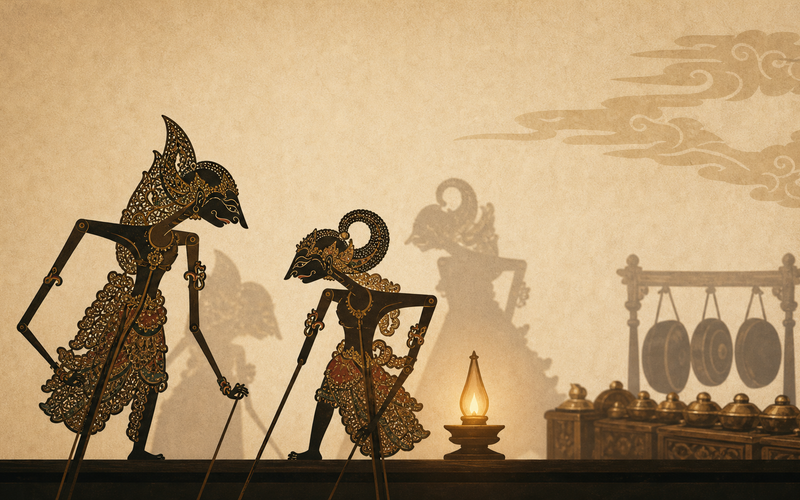
Wayang kulit is usually introduced as a shadow-puppet theatre from Java, yet its importance in Javanese culture lies in more than its theatrical technique. A performance joins carved leather figures, lamplight, a white screen, the sound world of the gamelan, and the literary skill of the dalang into a single environment of attention. UNESCO describes wayang as an ancient storytelling tradition that has flourished for centuries in both courts and rural communities. That long social life helps explain why many viewers understand it not simply as entertainment, but as a medium for reflecting on human conduct, social order, and the unseen dimensions of existence.
When scholars and museums connect wayang kulit to a Javanese worldview, they are usually pointing to that larger interpretive role. The performance does not present a single formal doctrine, and meanings vary by locality and occasion. Even so, wayang repeatedly stages a world in which outward appearance, inner character, and cosmic suggestion are woven together. Stories, puppet forms, and performance conventions together encourage audiences to consider how people should act, how power should be used, and how visible life relates to deeper forms of order.
Performance as a Model of Order
One reason wayang kulit is so often linked to worldview is that it organizes many elements into a disciplined whole. The dalang manipulates dozens of figures, controls pacing, recites dialogue and narration, cues the musicians, and moves between elevated and comic registers. UNESCO emphasizes the exceptional breadth of knowledge expected from master puppeteers, who must memorize a large repertory and handle ancient narrative passages creatively. This makes the performance itself an image of ordered coordination rather than a loose sequence of scenes.
That sense of order matters in Javanese cultural interpretation because social and moral life are often valued through discipline, measure, and proper relation. A wayang performance is full of conflict, but conflict is never presented as random noise. It is shaped, timed, and interpreted. For audiences, this can make the theatre feel like a small model of the world: many voices, many ranks, and many desires held within a framework that seeks balance rather than chaos.
In West Java, Sundanese wayang golek offers a different performance format: the dalang animates three-dimensional wooden rod puppets viewed directly. The comparison connects storytelling and musical collaboration while keeping golek distinct from leather shadow-puppet theatre. Smithsonian: Sundanese puppet theatre.
Symbolism in Form, Shadow, and the Gunungan
Wayang kulit invites symbolic reading through its very materials. The puppets are crafted objects of leather, pigment, and horn, but in performance they appear most powerfully as shadows. Britannica notes that shadow theatre has often encouraged cosmological interpretations, with the screen and the moving figures understood as more than a simple stage device. In Java, this makes wayang especially suited to thinking about the relationship between outward form and inner meaning, because the audience sees both material object and projected image at once.
The gunungan, also called kayon, is one of the clearest examples of this symbolic logic. The British Museum describes a Javanese gunungan as representing the tree of life or cosmic mountain, while also noting that it can signify a wide range of scenes and transitions. Its role at openings, closings, and scene changes gives it both practical and metaphysical force. It is a stage marker, but it is also a visual reminder that the dramatic world unfolds within a larger cosmos. Through such objects, wayang suggests that movement between one condition and another is never merely technical; it is part of a patterned universe.
Character Types and Moral Legibility
Moral meaning in wayang kulit is carried not only by plot, but by the design of characters themselves. Museum catalogues for Javanese puppets frequently describe facial angle, body posture, color, and eye shape as indicators of temperament and rank. The British Museum, for example, identifies downcast faces and slim figures with refined and noble qualities, while more upright faces and stronger visual features can signal a more forceful disposition. These conventions help make character legible before a figure even speaks.
Because of that system, wayang teaches moral perception through style. Audiences learn to notice restraint, refinement, impulsiveness, or aggression as embodied visual qualities. The ethical lesson is not simply announced in words. It is staged through a language of posture, movement, and voice. In worldview terms, this is significant because it treats morality as something visible in conduct and self-presentation. Goodness is not only belief; it is disciplined bearing, controlled speech, and the capacity to act in proportion to one's place and responsibilities.
Epic Narratives and the Question of Right Conduct
Wayang stories draw on several narrative sources, including the Mahabharata, the Ramayana, local hero cycles, and later courtly developments. UNESCO notes that the repertory also incorporates indigenous myths and figures from Persian tale traditions. This layered inheritance matters because wayang is not a closed scriptural system. It is a flexible narrative world in which inherited stories are continuously reinterpreted for new audiences and new social concerns.
That flexibility is central to its moral role. Characters are placed in situations involving loyalty, obligation, anger, kinship, duty, and the abuse of power. The point is not only to show who wins, but to make audiences reflect on how choices are made. Comic servants can speak in a more ordinary social voice, while noble heroes are held to ideals of control and responsibility. In this way, wayang offers a theatre of ethical comparison. It helps people think about what proper action looks like when desire, rank, and conflict press against one another.
The Dalang as Interpreter Between Worlds
No element of wayang better expresses its moral and spiritual authority than the role of the dalang. UNESCO describes the puppeteer as a literary expert and transmitter of moral and aesthetic values. That description is important because it places the dalang beyond the category of entertainer alone. He is the voice that animates the story world, selects emphasis, sharpens the humor, and ties inherited forms to present concerns.
This mediating position gives the dalang a special kind of authority. In many performances, he stands between noble and ordinary speech, between old literature and current reality, and between visible action on the screen and the meanings audiences draw from it. That is why wayang often feels spiritually charged even when not staged as a formal ritual. The dalang turns crafted objects into a living moral conversation, and the performance becomes a place where social criticism, instruction, and cosmological suggestion can coexist.
Spirit, Community, and the Enduring Javanese Reading
The spiritual dimension of wayang kulit should not be reduced to a single religious formula. Some performances are commissioned for ceremonies with strong ritual associations, while others are staged for public entertainment, education, or cultural display. Britannica notes that Javanese wayang can carry religious and mystical connotations, but not every event is interpreted in exactly the same way. A careful museum reading therefore avoids claiming that all audiences experience identical meanings.
Yet the spiritual reading remains important because wayang consistently invites reflection on realities larger than immediate action. It places human conflict inside a symbolic frame, gives moral qualities visible form, and relies on an expert performer whose task is interpretive as much as technical. In that sense, it expresses a worldview in which visible life is only part of a greater pattern. The theatre becomes a shared space for thinking about balance, inward discipline, and the possibility that human affairs are answerable to more than personal desire.
Conclusion
Wayang kulit continues to matter because it condenses Javanese ideas about symbolism, morality, and spirit into a performance that is both public and reflective. Puppets, music, comic speech, noble characters, and the guiding intelligence of the dalang all work together to make ethical and cosmological questions visible.
Its meanings are never frozen, and different communities emphasize different aspects of the tradition. Even so, wayang kulit endures as one of Java's most powerful cultural forms because it stages the world as a place where character, order, and unseen significance remain deeply connected.