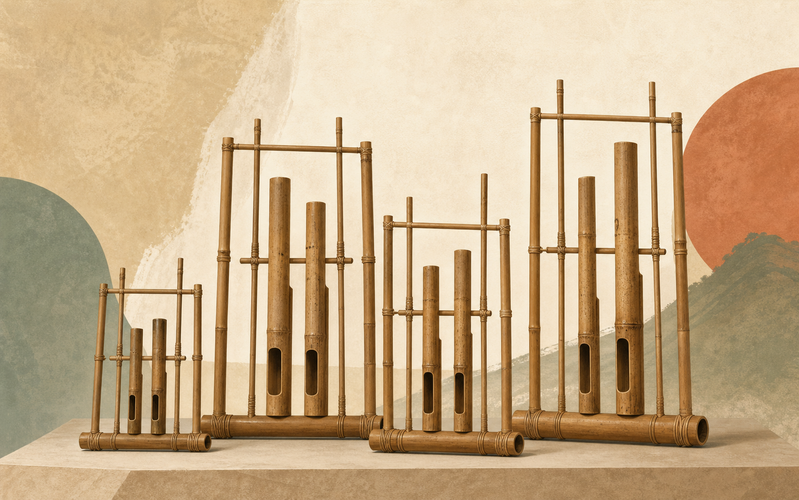
Angklung is one of Indonesia's most approachable musical traditions because its first lesson is simple: a single sound becomes meaningful when it joins other sounds. The instrument is made from bamboo tubes mounted in a frame and shaken so that the tubes strike and resonate. In West Java, where angklung is especially associated with Sundanese cultural life, that modest motion can become melody, rhythm, and a public display of shared attention.
For museum interpretation, angklung is valuable because it crosses several categories at once. It is a crafted object made from a local plant. It is a musical instrument with a clear acoustic principle. It is a teaching tool that invites beginners to participate quickly. It is also a social form, because many angklung performances depend on players taking responsibility for small parts of a larger whole. The museum story is therefore not only about bamboo, but about cooperation made audible.
Bamboo, Sound, and Making
Angklung begins with bamboo, a material that is light, resonant, flexible, and deeply familiar in many parts of Indonesia. Makers select and shape bamboo tubes so that each instrument produces a particular pitch. The tubes are suspended inside a frame, and the player shakes the frame from side to side. The sound comes from movement, contact, and the natural resonance of the bamboo itself.
This construction gives angklung a visual clarity that works well in a gallery. Visitors can see the tubes, frame, knots, cuts, and binding. They can understand that the sound is not hidden inside a complex mechanism. At the same time, the apparent simplicity should not obscure skill. Cutting bamboo to pitch, assembling stable frames, and balancing tone require careful knowledge of material and use.
Because bamboo changes with age, humidity, and handling, angklung also reminds museums that instruments are living objects even when they sit still. They were made to be touched, shaken, heard, repaired, and replaced. A silent display can show form, but audio or demonstration helps visitors understand why that form matters.
West Java and Sundanese Cultural Life
Angklung is widely recognized as part of Indonesian heritage, but its strongest historical association is with Sundanese communities in West Java. In this region, music, dance, agricultural memory, local ceremony, and public education have shaped how angklung is understood. The instrument is not only a regional marker; it is also a way of organizing people around shared sound.
Older angklung practices have been linked by scholars and cultural institutions to village life, ritual occasions, and seasonal observances. Modern public forms have also developed through schools, cultural centers, festivals, and staged performances. These histories should be presented carefully, because angklung is not one frozen tradition. It includes local forms, educational arrangements, and national heritage presentations that have changed over time.
This combination of regional identity and national visibility is important. Angklung can represent West Java specifically, while also speaking to a broader Indonesian language of cultural diversity. In that sense, it is similar to other regional arts that become national symbols without losing their local roots.
Cooperation as Musical Structure
One reason angklung is so memorable is that it often distributes a melody across many people. Instead of one musician playing every note, each participant may be responsible for one pitch or a small set of pitches. A conductor, teacher, or group leader cues the players, and the melody appears only when everyone enters at the right time.
This structure makes cooperation more than a moral slogan. It is built into the musical result. If one player ignores the group, a note may be missing or arrive late. If everyone watches, listens, and responds, the separate bamboo frames become a single musical line. Angklung therefore offers a direct experience of interdependence.
In Indonesian public culture, this has often made angklung useful for education and mass participation. Beginners can join without years of technical training, yet the ensemble still teaches discipline, attention, and responsibility. A museum workshop can make this point quickly: give each visitor a tone, teach a simple cue system, and the room hears how community is built from small acts of timing.
From Village Practice to Public Heritage
The public history of angklung includes a movement from local practice into schools, cultural diplomacy, tourism, and heritage programming. Indonesian angklung was inscribed by UNESCO on the Representative List of the Intangible Cultural Heritage of Humanity in 2010, a recognition that emphasized transmission, community values, and education. That listing did not create angklung's value, but it did make the tradition more visible internationally.
One well-known institution in this modern story is Saung Angklung Udjo in Bandung, founded in the twentieth century as a center for performance, education, and bamboo arts. Such institutions show how heritage can be actively taught and staged without being merely invented for visitors. They also raise useful questions for museums: who teaches the tradition, who performs it, and how does public presentation affect local meaning?
Heritage recognition can sometimes make traditions appear neat and official. Angklung is better understood as a field of practice. It includes village histories, makers, teachers, schoolchildren, professional performers, tourists, and international audiences. Its modern visibility is part of the story, but it should be connected back to people, places, and everyday training.
Angklung in the Museum
An angklung display can begin with material evidence: bamboo tubes, frame construction, tuning labels, wear marks, and the relationship between size and pitch. These details help visitors see the instrument as a designed object. A large frame may produce a lower sound, while smaller tubes may produce higher pitches. The gallery can use this physical relationship to explain acoustics without turning the display into a technical lecture.
Yet interpretation should quickly move from object to ensemble. A single angklung may be beautiful, but a set carries the musical system. Labels, diagrams, recordings, and participatory programs can show how each instrument contributes to the whole. Museums can also compare angklung with other Indonesian ensemble traditions, such as gamelan, while noting that bamboo resonance creates a very different texture from bronze.
Ethical interpretation matters as well. Angklung should not be reduced to a cheerful symbol of national culture or a tourist performance detached from community knowledge. The best displays credit makers, teachers, regional histories, and living performers. They also recognize that cultural heritage survives through practice, not simply through preservation in storage.
Education, Participation, and Memory
Angklung's educational strength lies in its balance of accessibility and depth. A first-time player can learn to shake the instrument almost immediately, but musical coordination takes attention. Players must watch cues, feel the pulse, control motion, and trust the group. That makes angklung especially effective in schools and public workshops, where music becomes a shared exercise rather than a private display of virtuosity.
Participation also creates memory. Visitors who hear a recording may remember the sound, but visitors who play one note in a group often remember the responsibility of waiting for their moment. This kind of embodied learning is valuable for museums because it changes heritage from information into experience. The object is no longer only something seen behind glass; it becomes part of a remembered action.
At the same time, participation should be framed with respect. A short workshop cannot replace long training or local cultural authority. It can, however, introduce the principles of listening, cooperation, and bamboo sound that make angklung meaningful. Done carefully, it opens a door rather than pretending to contain the whole house.
The collaboration between performers takes another form in Sundanese wayang golek, where a dalang, musicians, and singers work together to bring puppet stories to life.
Conclusion
Angklung shows how a simple material form can carry complex cultural meaning. Bamboo tubes in a frame become music through movement, tuning, and collective discipline. In West Java, that music is tied to Sundanese identity, education, public performance, and changing forms of heritage transmission.
For museums, angklung is most powerful when it is presented as a living ensemble tradition. Its lesson is not only that bamboo can sing. It is that a community can make melody when many people accept small responsibilities and listen for the larger sound.