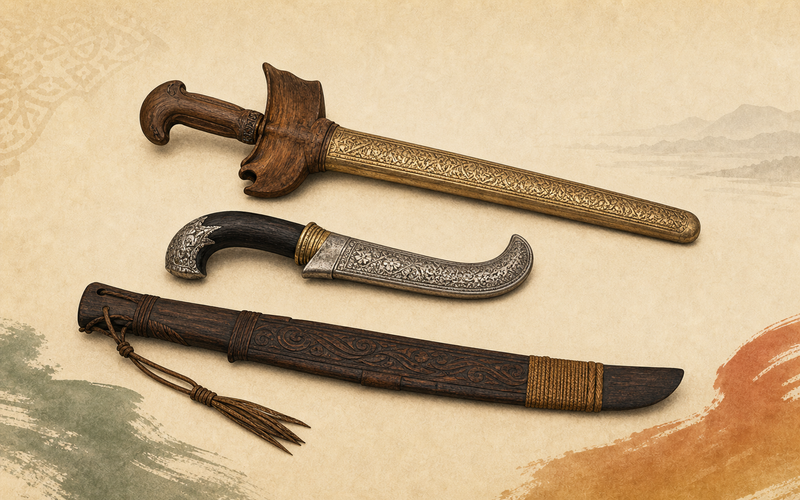
Weapons in precolonial Indonesia were never only tools of combat. In courts across the archipelago, selected blades also appeared in formal dress, palace ritual, diplomatic exchange, and inherited regalia. Their significance depended not merely on sharpness or battlefield utility, but on who had the right to wear them, how they were mounted, and in what ceremonial setting they became visible. A museum display that treats these objects only as arms misses much of their historical role.
That broader reading is especially important for courtly material culture. Palaces organized status through clothing, gesture, seating, language, and objects carried on the body. Within that system, a blade could communicate refinement, office, seniority, or proximity to royal authority. Evidence is richest for the keris and for Javanese court traditions, though similar questions of rank and display likely mattered elsewhere as well. What the surviving record allows us to say with confidence is that some weapons in precolonial Indonesian courts were social signs before they were ever drawn.
Courtly Weapons as Signs of Order
Court culture depends on visible order. In precolonial polities, rank was made legible through carefully managed appearances, and weapons participated in that visual language. A blade worn at the waist or carried in procession could announce that the bearer belonged to a palace world governed by etiquette. The object did not need to be used in violence to matter. Its presence within formal dress already placed it inside a hierarchy of rights, duties, and recognition.
This is why museum viewers should pay attention to context as much as to form. A court weapon was meaningful because it appeared in relation to textiles, jewelry, headdresses, attendants, and ritual movement. The social message often lay in composure and placement rather than action. To carry a distinguished blade in the correct way was to inhabit a role. The weapon became part of court choreography, helping transform rank from an abstract idea into something materially and publicly seen.
The Keris and the Language of Rank
The keris is the clearest example because the documentary record describes it as more than a weapon. UNESCO identifies the Indonesian kris or keris as both a weapon and a spiritual object, and notes its use in ceremonial dress, inheritance, and status marking. Those points are crucial for the study of courts. A blade that can be worn ceremonially, transmitted across generations, and interpreted through specialized categories of form and metal patterning belongs fully to the world of rank and lineage.
British Museum catalog notes also hint at court regulation around bladed objects. One collection entry describes a wedung associated with nobles who were not of royal blood in the presence of the sultan. Even this brief curatorial note is revealing. It suggests that blade type and social position could be linked, and that carrying the appropriate weapon formed part of palace etiquette. In such a setting, weapons were not interchangeable. They helped define who one was allowed to be within a courtly order.
Materials, Ornament, and Prestige
Courtly display rarely depends on the blade alone. Hilts, sheaths, metal mounts, carved figures, and precious fittings all help explain why a weapon could serve as regalia. Metropolitan Museum objects from Java, Bali, and other Indonesian regions show how kris examples were mounted in wood, ivory, gold, and other costly materials. Such details matter because ornament made social value visible. A lavishly finished weapon announced that it belonged to a world of connoisseurship, wealth, and cultivated taste.
This decorative richness should not be dismissed as secondary embellishment. In many court settings, refinement itself was political. A finely mounted blade signaled disciplined patronage, access to skilled makers, and familiarity with accepted standards of prestige. Museum interpretation works best when it treats the whole object, not just the steel, as evidence. The sheath, the carving, and the surface pattern are part of the historical message. They show how martial objects became suitable for elite display without losing their aura of force.
Heirlooms, Regalia, and Dynastic Memory
Once a weapon enters a palace treasury or passes through noble inheritance, it acquires another layer of meaning. UNESCO's discussion of the keris emphasizes hereditary transmission, while palace traditions in Java preserve the idea of pusaka, valued heirlooms linked to ancestry and legitimacy. In this context, a blade is not important only because it was once used. It matters because it embodies continuity. The object ties present authority to remembered predecessors, making political memory tangible.
Contemporary Yogyakarta palace practice offers a useful echo of that older logic. Public descriptions of siraman or ritual cleaning ceremonies show that palace heirlooms still include weapons among other sacred objects of rule. This does not allow a simple projection of the modern court back onto every precolonial kingdom. It does, however, illustrate the long-standing pattern by which weapons could survive as regalia within a palace environment. Their meaning lay in preservation, curation, and ritual care as much as in martial readiness.
Display, Restraint, and Ceremonial Authority
One of the most striking features of court weapons is that they often conveyed power through restraint. A blade worn but not drawn could be more politically charged than one used in combat. It signaled that authority was present, ordered, and under control. Court ceremonial thrives on this kind of disciplined display. The object is there to be seen, recognized, and interpreted, not necessarily to be activated. In that sense, the weapon becomes a medium of authority rather than a simple instrument.
This helps explain why museums should resist reducing palace blades to military history alone. Precolonial courts used material display to stage sovereignty, and weapons participated in that staging alongside thrones, textiles, standards, and vehicles. A court blade could stand at the intersection of force, legitimacy, and aesthetics. Its effectiveness as a symbol depended precisely on the fact that everyone understood its latent power. Ceremony transformed that latent power into visible authority.
Limits of the Record and the Value of Careful Interpretation
Not every Indonesian court is equally documented, and historians should be careful not to generalize too quickly from Java to the whole archipelago. The surviving museum and heritage record is uneven. Some palaces are better represented in collections than others, and some objects reached museums stripped of the social context that once made them legible. For that reason, broad claims about one universal "Indonesian court weapon system" would go too far.
Yet the available evidence is still meaningful. It shows that at least some precolonial Indonesian courts treated selected weapons as rank-bearing objects embedded in dress, etiquette, inheritance, and ritual display. Even when details differ by dynasty or region, the broader museum lesson remains strong: these blades belong to political and ceremonial history as much as to martial history. Reading them carefully restores the social worlds that once surrounded them.
Conclusion
Weapons in precolonial Indonesian courts were not merely reserved violence at the edge of ceremony. They were part of the ceremony itself. Through regulated carrying, elaborate ornament, inherited prestige, and palace display, certain blades helped make hierarchy visible and authority believable. The keris offers the clearest documented example, but it points toward a wider pattern in which material culture organized courtly life.
For museums, the implication is straightforward. Palace weapons should be interpreted not only by blade type or probable use, but by how they participated in rank, regalia, and dynastic memory. Once that context is restored, these objects reveal a history of Indonesian courts in which force, beauty, and legitimacy were deliberately bound together.