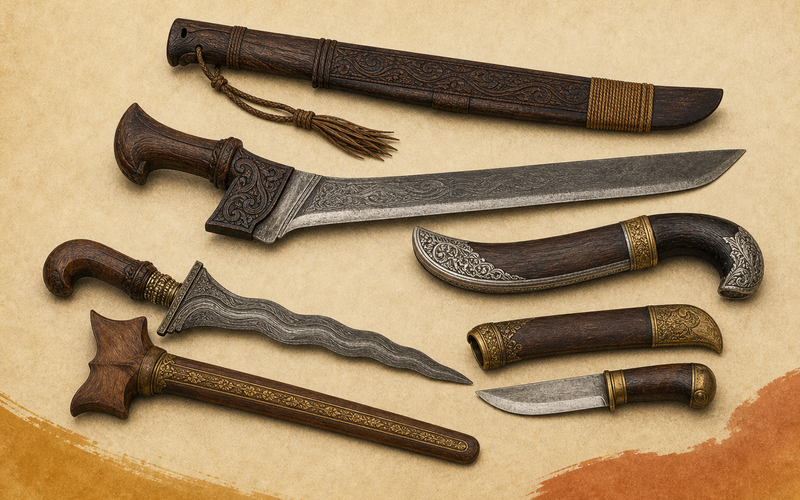
Regional bladed weapons in Indonesia are often introduced as battlefield tools, but museum evidence gives a broader picture. Across the archipelago, blades could also mark office, accompany ceremonial dress, represent regional identity, or remain in families as valued heirlooms. When they enter a museum collection, they bring those social meanings with them. A dagger or sword on display may therefore tell us as much about rank, memory, and belief as it does about combat.
This is especially important in Indonesia, where a single label such as "traditional weapon" can hide major regional differences. A keris from Java or Sulawesi, a mandau from Borneo, and a rencong from Aceh do not belong to one uniform cultural system. Their shapes, materials, and associated customs differ. The most careful museum reading begins by treating each blade as a local cultural object. At the same time, collection records do show one shared pattern: some blades acquired social lives that extended far beyond fighting.
Reading Blades as Social Objects
Museums preserve weapons because they are material evidence, but the evidence is not only technical. Scabbards, hilts, decorative metals, and the circumstances of use can indicate who wore a blade, when it was displayed, and what kind of authority it conveyed. In that sense, bladed weapons belong to the study of dress, diplomacy, ritual, and social hierarchy as much as to the study of arms. Their meaning often lies in context rather than in blade geometry alone.
This is why regional interpretation matters. A museum visitor may notice steel, wood, horn, gold, or rattan before they notice social history, yet those materials are already clues. Elaborate fittings can suggest prestige. Wear marks can imply long use or inheritance. A blade associated with courtly dress communicates differently from one associated with hunting or local defense. Even when museums describe a weapon in short catalog language, the object still points toward a larger network of makers, owners, and ceremonies.
The Keris and Layered Status
The keris is the clearest example of an Indonesian blade with layered social meaning because it is documented by UNESCO as both a weapon and a spiritual object. UNESCO also notes that keris were worn in daily life and at special ceremonies, passed down across generations, and understood through a specialized vocabulary of form, metal patterning, and attributed origin. Those details show that the keris cannot be reduced to utility. It was judged aesthetically, socially, and spiritually at the same time.
Museum collections reinforce that point. The British Museum describes a Bugis keris from Sulawesi as a ceremonial dagger and states that its elaborate hilt and sheath act as markers of regional identity. The object is not important only because it is sharp or old. It is important because it locates the blade within a community and a style of public display. A weapon becomes socially legible when materials, workmanship, and regional form allow viewers to read status and belonging from the object itself.
Diplomacy, Rank, and Public Display
The social life of blades becomes even more visible when they appear in diplomatic exchange. Rijksmuseum records for the kris presented to Governor-General J. C. Baud in 1834 explain that it was given during an inspection tour and that such exchanges helped maintain political relations. The museum adds that the kris was an appropriate gift because it symbolized power and protected its wearer from evil. That description matters because it links the object directly to diplomacy, authority, and public symbolism.
A blade used in this way functions as regalia as much as weaponry. It can be worn, presented, inherited, or displayed as a sign that the owner occupies a certain place in a political order. This does not erase the violence attached to colonial settings, and modern museums should be careful about that history. Even so, the object record is clear that blades could operate in formal public language. They were part of how status was shown, negotiated, and materialized in elite settings.
Regional Difference Beyond the Keris
Although the keris has the richest international documentation, other regional blades also carried social meaning. The Indonesian museum registration system describes a mandau from West Kalimantan with a carved wooden sheath, rattan bindings, and hanging decoration made from animal bone and bird feathers. The same record states that the object was used for self-defense and also in customary dance. That combination is significant. It shows a blade moving between practical and performative settings rather than staying within one narrow military role.
Examples like the mandau remind us that regional blades should not be arranged along a single ladder from "practical" to "ceremonial." Many objects occupied several worlds at once. A weapon could defend, signify, decorate, or accompany performance depending on context. For museum interpretation, this means that local histories are essential. A Dayak-associated blade from Borneo should not be explained with exactly the same language used for a courtly keris from Java or Madura. The social meaning of the object is regional before it becomes national.
Craftsmanship and Recognition
The social authority of many blades was strengthened by the work of specialist makers. UNESCO emphasizes the role of the empu, the bladesmith associated with keris manufacture, and describes the prestige attached to technical knowledge of form, pamor patterning, and origin. This tells us that meaning was built during production, not added only after the object left the workshop. A blade recognized as distinguished carried visible evidence of skilled labor, cultural rules, and accepted aesthetic standards.
That insight helps explain why museum viewers are often drawn to fittings and surface detail. Decorative richness is not merely ornamental excess. It is one way social value becomes visible. Gold mountings, carved ivory, patterned metal, or carefully made wooden sheaths can all announce that an object belongs to ceremony, rank, or inherited memory. When museums interpret such details well, they show that craftsmanship itself participates in social meaning. The blade is not only a tool; it is also a condensed statement about expertise and legitimacy.
Why Museums Still Need Local Context
Modern collections make these blades accessible to new audiences, but display can flatten difference if curators rely on generic labels. A room of "Indonesian weapons" may be visually impressive while still obscuring the fact that objects emerged from different islands, courts, ethnic communities, and historical situations. The best curatorial approach keeps the regional context close to the object. That means naming makers when possible, preserving local terminology, and explaining whether a blade was linked to attire, performance, diplomacy, or household inheritance.
Seen in that way, regional bladed weapons become powerful teaching objects. They let museums discuss masculinity, prestige, spirituality, colonial encounter, and local identity through a single category of artifact. They also remind viewers that Indonesian material culture is not uniform. Each blade belongs to a particular social world, even when later exhibitions place many worlds side by side. That tension between regional specificity and national display is part of what makes these objects so valuable in museum interpretation.
Conclusion
Regional bladed weapons in Indonesia are best understood as social objects with martial histories, not as simple instruments of violence. Collection records show blades serving as ceremonial dress accessories, diplomatic gifts, inherited heirlooms, markers of rank, and components of regional performance. The keris provides the strongest documentary case, but it is not the only example that points beyond combat.
For museums, the central task is to preserve both the object and the context that made it meaningful. Once regional blades are read through local history, craft practice, and social use, they reveal a layered history of Indonesian life. Their sharp edges matter, but so do the identities, relationships, and forms of recognition carried in the blade, the sheath, and the act of display.