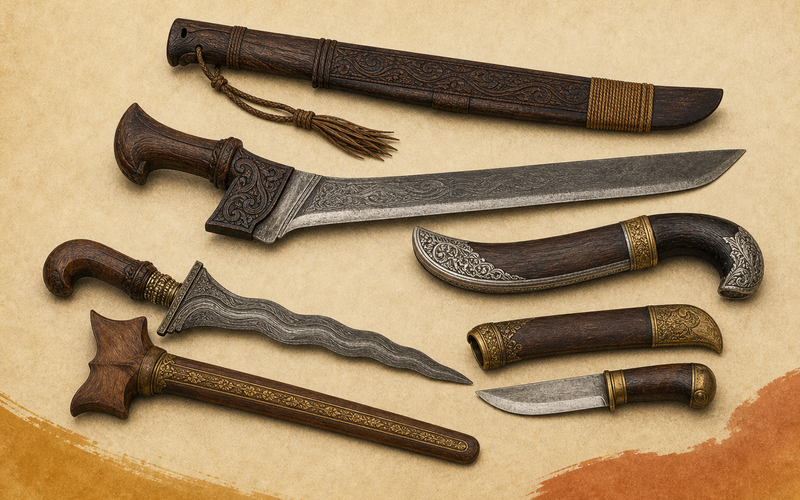
Traditional weapons in Indonesia are often introduced through their blades, shapes, and regional names. Yet museum collections and cultural documentation show that many of these objects mattered for more than combat. They could be worn in formal dress, exchanged in diplomacy, kept as heirlooms, or interpreted as objects of spiritual significance. Seen this way, a weapon is not only a tool of force. It is also part of a language of status, memory, and belonging.
This article approaches Indonesian traditional weapons through that broader cultural lens. It focuses especially on the keris because the keris is the most thoroughly documented example of a blade that moved across practical, ceremonial, and symbolic worlds. By following the keris through court life, family inheritance, craftsmanship, and museum display, we can better understand how weapons in Indonesia came to express power, honor, and identity.
Weapons as More Than Instruments of Combat
In many societies, weapons are preserved because they once served in war. In Indonesia, however, certain traditional weapons also acquired social meanings that cannot be reduced to military use. Official Indonesian cultural writing on the keris describes it not only as a weapon but also as an object connected to offerings, formal clothing, social prestige, and artistic value. UNESCO similarly presents the Indonesian kris as both weapon and spiritual object. These descriptions immediately expand the way museums must interpret such objects.
That shift matters because an object's meaning changes with context. A blade worn in a court ceremony communicates something very different from a blade carried in battle. A weapon inherited through generations is not merely an old piece of metal; it is also a material link between ancestors and descendants. In a museum gallery, these distinctions help visitors see that traditional weapons can embody political authority, family honor, and systems of belief all at once.
The Keris and the Idea of Power
The keris occupies a distinctive place in Indonesian material culture because it has long been associated with authority. Rijksmuseum records for the kris presented to Governor-General J. C. Baud in 1834 explain that the exchange of gifts helped maintain diplomatic relations and that a kris was an appropriate gift because it symbolized power and protected its wearer from evil. This example is especially valuable because it shows symbolic meaning in a historical encounter that joined local rule, diplomacy, and display.
Power, in this setting, should not be understood only as coercion. It also includes legitimacy, ceremonial visibility, and the right to represent office. Indonesian cultural documentation notes that the keris could function as a sign of rank or position. When a weapon becomes part of regalia, it enters a different category of social life. Its value lies not only in what it can do physically, but in what it declares publicly about the standing of the person who wears or receives it.
Honor, Lineage, and the Heirloom Blade
The symbolism of honor appears most clearly when the keris is treated as pusaka, or heirloom. UNESCO notes that heirloom blades are handed down through successive generations. That transmission gives the object a moral and genealogical dimension. A family blade is not simply inherited property; it can be understood as a sign of continuity, respect for forebears, and responsibility toward inherited tradition. Honor therefore attaches not just to possession, but to stewardship.
This heirloom status also helps explain why some weapons are preserved with forms of reverence that differ from the treatment of ordinary tools. Official Indonesian writing describes the keris as becoming, over time, not only a weapon but also a sacred object, a family bond, a sign of service, and an art object. For museums, this layered status is crucial. A blade in a display case may have belonged to a world in which ethical reputation, family dignity, and ritual care were inseparable from material ownership.
Identity in Dress, Region, and Story
Traditional weapons can also express identity by showing where a person belongs and which aesthetic world they inhabit. Indonesian cultural sources describe the keris as part of ceremonial dress in multiple regions and note that forms, terms, and functions vary across the archipelago. The object therefore participates in identity at two levels: it can mark the bearer's formal role in a specific event, and it can reflect regional traditions in hilt shape, sheath design, decorative patterning, and style of wear.
Museum collections reinforce this point by preserving keris from different places and periods rather than a single standardized type. The Metropolitan Museum of Art's Balinese kris highlights how carved figural hilts in Bali draw on Hindu visual traditions and literary culture. Even when the object remains recognizably a kris, its local form can carry different references and ideals. Identity, then, is not abstract. It is built into materials, iconography, craftsmanship, and the social settings in which the weapon appears.
Craftsmanship as a Source of Meaning
The symbolic life of Indonesian traditional weapons depends heavily on craft. UNESCO emphasizes the importance of blade form, pamor patterning, and recognized knowledge about age and origin, while also stressing the respected role of the empu, or bladesmith. Indonesian cultural publications likewise present the keris as a union of forging, carving, design, and symbolism. These details matter because prestige is often made visible through workmanship. A ceremonial object must convince viewers through material refinement as well as inherited meaning.
Craftsmanship also ties the weapon to specialized knowledge rather than anonymous production. The maker's expertise can include technical skill, aesthetic judgment, and familiarity with established forms. That is one reason the loss of craft transmission matters so deeply. If museums preserve blades without explaining the knowledge systems behind them, they preserve only part of the heritage. The object's meaning is fuller when visitors understand that power and honor were expressed not only by owners, but by artisans who shaped metal into culturally legible form.
Interpreting Traditional Weapons in Museums Today
Modern museums face a curatorial challenge when displaying traditional weapons from Indonesia. If the interpretation is limited to shape, date, and region, visitors may assume that the object's history is primarily violent. Yet the documentary record around the keris suggests a more complex story. These weapons participated in ceremonial dress, diplomacy, hereditary transmission, and ideas of protection, prestige, and personhood. A museum label that omits those dimensions risks flattening the object into a stereotype.
A better approach places the weapon within a network of relationships. The blade can be linked to the wearer, the maker, the court, the family, and the ritual or formal setting in which it appeared. It can also be connected to present-day safeguarding efforts. UNESCO's records on the Indonesian kris and on the Sekretariat Nasional Perkerisan Indonesia show that the culture surrounding the keris is still being documented, taught, and revitalized. Museums therefore have an opportunity not only to preserve historical objects, but also to explain living traditions of interpretation and care.
Conclusion
Indonesian traditional weapons reveal how material culture can carry meanings far beyond practical use. In the clearest documented cases, especially that of the keris, a blade could symbolize power, embody family honor, and express regional or courtly identity. Its significance rested not simply in metal and edge, but in diplomacy, dress, inheritance, and belief.
For that reason, museums should read these objects as cultural documents as much as arms. When interpreted through craftsmanship, ceremonial use, and historical context, Indonesian traditional weapons show how societies turn instruments of force into bearers of memory, legitimacy, and identity. That transformation is what makes them so compelling in the museum setting.