Topics

Environment and Landscape

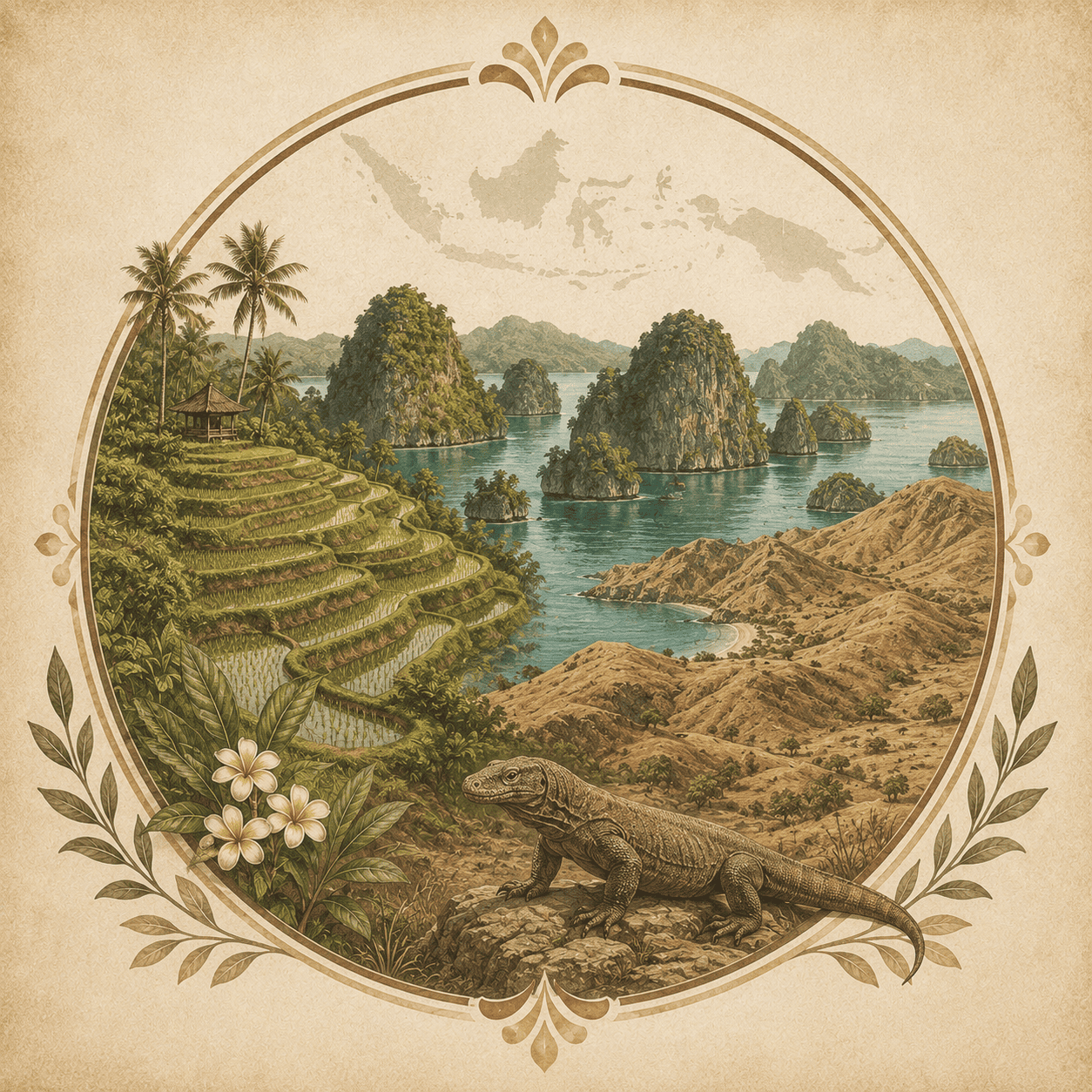
Sacred geography, forests, volcanoes, and ecological knowledge in Indonesian heritage.

Environment and Landscape is designed as an editorial pathway for slow reading about sacred mountains, forests, volcanoes, ecological memory, customary conservation, and the cultural reading of Indonesian landscapes, not simply a list of articles. This page helps readers trace how objects, practices, and historical interpretation connect across time. Sacred geography, forests, volcanoes, and ecological knowledge in Indonesian heritage. Framed this way, each article becomes part of a wider conversation about memory, identity, technique, belief, and the changing meanings attached to Indonesian heritage in museums, local communities, and public history.

The topic currently includes 3 articles, including Volcanoes, Memory, and Sacred Geography in Java and Bali, Sacred Forests and Community Conservation in Indonesian Tradition and Indigenous Environmental Wisdom in Indonesian Communities. It will continue to grow as new objects, references, and comparative sources are added. Each entry is prepared with attention to source transparency: what can be documented, what remains interpretive, and how an object or practice can be read in relation to the people who made, used, inherited, collected, or described it. When sources disagree or leave gaps, those limits are treated as part of the historical record rather than hidden behind a smooth summary.

The distinctive focus here is sacred mountain veneration, forest protection, community conservation, volcano memory, agricultural ethics, and landscape-based ritual practice. A museum approach matters because material culture rarely carries only one meaning. One object may be a practical tool, a marker of rank, a ritual instrument, evidence of exchange, or a vessel of family memory. The purpose of this Environment and Landscape page is to make those layers visible without forcing them into a single fixed explanation.

In practical terms, this landing page works as a map. Readers can begin with one article, then compare terms, materials, regions, visual styles, social functions, and historical sources across the rest of the section. The goal is not just to deliver isolated facts, but to build cumulative understanding from one article to the next. In that sense, the topic becomes a living archive: open to refinement, correction, and new research as the collection develops.
Key Traditions

The key traditions connected with Environment and Landscape include sacred mountain veneration, forest protection, community conservation, volcano memory, agricultural ethics, and landscape-based ritual practice. They should be read as living practices shaped by inherited knowledge, historical pressure, and social need. This range means the topic cannot be reduced to one neat definition. It is better understood as a field of practices through which people give form to memory, obligation, beauty, identity, and authority.

In a museum context, tradition is not only about continuity. It is also about documentation. Colonial accounts, local manuscripts, oral histories, photographs, surviving objects, and community knowledge may preserve different sides of the same practice. The articles in this topic therefore ask readers to notice both evidence and uncertainty. A tradition that appears stable can contain debate over origin, proper use, ownership, sacred status, regional variation, or modern revival. That complexity is not a weakness; it is the reason the topic deserves sustained reading.

Objects and Performance Context

Objects and performance context are central to understanding Environment and Landscape. The material field includes offerings, forest boundaries, ritual paths, maps, shrine markers, agricultural tools, and images or stories tied to mountains and protected places. An object cannot be explained only by its material, date, or form. Readers also need to ask who made it, who used it, who was allowed to see or handle it, where it was stored, and what social situation made it meaningful.

Many articles in this section place objects back into their social environment. Details such as technique, scale, motif, material source, sound, movement, dress, inscription, or handling become stronger when connected to place, event, and community. Reading articles such as Volcanoes, Memory, and Sacred Geography in Java and Bali, Sacred Forests and Community Conservation in Indonesian Tradition and Indigenous Environmental Wisdom in Indonesian Communities shows that museum collections are not simply groups of things. They are traces of human relationships: between makers and users, local traditions and wider historical change, inherited knowledge and modern interpretation, and the object itself and the reader trying to understand it responsibly.

Regional Patterns

Regional patterns in Environment and Landscape are especially visible across Java, Bali, Kalimantan, volcanic landscapes, sacred forests, highlands, and communities whose heritage is inseparable from ecology. Indonesia has never been a single uniform cultural field. Islands, coastlines, highlands, port cities, court centers, and customary villages can produce different forms even when they share related terms, materials, or religious references. Those differences are evidence of adaptation to environment, trade, language, ritual authority, political history, and local systems of knowledge.

Comparing regions also protects readers from overly broad claims. A motif in Java, Sumatra, Bali, Sulawesi, Kalimantan, Maluku, Papua, or Nusa Tenggara may be historically connected to another region, but it does not automatically mean the same thing everywhere. This page encourages comparison without flattening difference. As new articles are added, the regional pattern will become clearer: which features spread through exchange, which emerged from local practice, and which remain uncertain because the available sources are still uneven.

How to Read These Articles

The best way to read these articles is to begin with questions such as how landscape becomes ancestral memory, how ecological practice is organized through custom, and how museums can present nature as cultural evidence. Notice the title, date, sources, local terms, and the way each article separates documented information from interpretation. If an object is described as sacred, prestigious, inherited, or tied to identity, ask what kind of evidence supports that claim.

Readers can also compare the articles with one another. Look for repeated materials, colors, places, figures, techniques, forms, and social functions. Notice what is missing as well: communities not yet represented, regions that need more documentation, or terms that still require explanation. With this method, reading Environment and Landscape becomes a small curatorial exercise. The reader is not only receiving information, but arranging relationships among objects, stories, sources, and research questions.

Related Topics

Environment and Landscape connects naturally with several other reading paths in the museum. Related topics help widen the frame without losing the main focus. An article about technique may lead toward questions of status and identity; an article about ritual may open toward landscape, music, performance, or heirloom objects; and an article about social change may connect to courts, language, trade, or colonial documentation.

Use the related links as a guided way to move through the collection. If one article feels very specific, a related topic can supply broader context. If a topic feels broad, individual articles return the discussion to concrete objects and documented examples. The structure is meant to build layered understanding: from object to practice, from practice to region, and from region to the larger history of Indonesian cultural heritage.