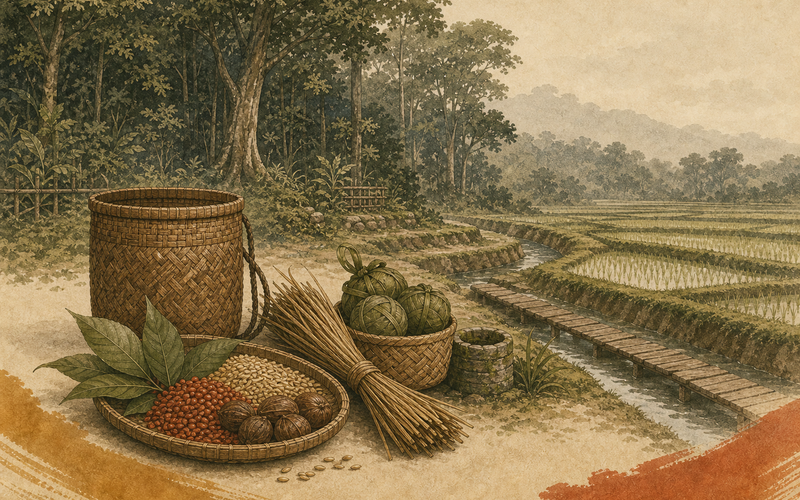
In Indonesia, environmental knowledge has often been preserved not only in written instruction but also in customary life. Communities have long organized farming, fishing, forest use, and settlement through inherited rules that connect practical observation with moral responsibility. For a museum, this subject is important because tools, ritual objects, and agricultural landscapes do not stand alone. They belong to systems of thought in which land and water are understood through memory, kinship, and obligation.
Indigenous environmental wisdom should therefore be approached as a living body of knowledge rather than as a romantic image of the past. Across the archipelago, local communities have developed ways of regulating access to resources, interpreting seasonal change, and limiting extraction through shared institutions. These institutions differ from region to region, yet they often reveal a comparable principle: the environment is not treated as an unlimited storehouse, but as a domain that requires restraint, reciprocity, and social consent.
Knowledge, Obligation, and Place
Environmental wisdom in Indonesian communities is not simply a collection of useful techniques. It is usually embedded in adat, or customary norms, that define who may use a place, at what time, and under what conditions. This matters because ecological practice becomes durable when it is reinforced by social expectation. Rules about forests, rivers, gardens, or coasts are remembered more effectively when they are attached to ceremonies, lineage authority, or communal deliberation.
From a museum perspective, this means that heritage objects linked to subsistence or ritual should be interpreted within a larger cultural framework. A fishing implement, irrigation feature, or heirloom farming tool gains fuller meaning when it is connected to the rules and values that governed its use. Indigenous environmental wisdom is thus not only about sustainability in the abstract. It is about the relationship between community order and environmental care in particular landscapes.
Water Management and Ritual Order in Bali
One of the clearest documented examples is Bali's subak system. The UNESCO World Heritage Centre describes subak as a cooperative water management system centered on canals, weirs, rice terraces, villages, and water temples, with roots going back to the 9th century. UNESCO also explains that the system reflects the Balinese philosophical concept of Tri Hita Karana, which joins the realms of spirit, human society, and nature. In this case, irrigation is not only technical infrastructure. It is part of a cultural landscape shaped by ritual and collective coordination.
The significance of subak lies in the fact that environmental management is distributed through social institutions rather than left to isolated individuals. UNESCO notes that Bali has about 1,200 water collectives, and the functioning landscape depends on cooperation across watersheds. The point is not merely that rice can be grown productively. The more important lesson is that the use of water is framed as a shared ethical task. For museums, subak demonstrates that environmental wisdom can be visible in landscape form, ceremonial architecture, and agricultural rhythm all at once.
Coastal Restraint and the Practice of Sasi
In Maluku, the practice commonly known as sasi offers another important example. A study published by Jurnal Perikanan Universitas Gadjah Mada describes sasi in Kei as a traditional resource management system involving temporal and spatial prohibitions on harvesting. Such rules place limits on when certain resources may be taken, thereby linking livelihood to restraint. This is significant because it shows that conservation is not always expressed through modern bureaucratic language. It may also be articulated through customary timing, communal authority, and inherited sanctions.
Sasi is especially meaningful in museum interpretation because it reveals how environmental wisdom can be organized through social memory. A prohibition period is not simply an absence of use. It is a culturally recognized interval during which communities affirm that extraction must pause so regeneration can occur and collective fairness can be maintained. When museums display coastal tools or discuss island economies, this context helps visitors understand that marine life was often governed by norms of waiting, permission, and accountability rather than by continuous harvest alone.
Forest Stewardship and Customary Territory
Environmental wisdom is equally visible in Indonesia's forest regions. UNDP Indonesia describes customary forests as places where local wisdom appears through customary rules, ecological knowledge, and cultural rituals intended to preserve the forest and sustain its benefits for the community. This description is valuable because it avoids treating forest knowledge as separate from social life. The forest is not only a stock of timber or habitat. It is also a lived environment bound to belief, inheritance, and everyday subsistence.
Such stewardship traditions remind us that indigenous communities often maintain categories of use that are more nuanced than simple exploitation or preservation. Certain zones may be cultivated, others protected, and others approached with ritual caution. The language used by institutions such as UNDP also underscores that customary forests remain contemporary, not merely historical. For museums, this is an important distinction. Exhibitions about forest peoples should not imply that ecological wisdom belongs only to a distant premodern era when many communities continue to defend and practice it in the present.
Reading Seasons, Soils, and Ecological Signs
Indigenous environmental wisdom also depends on close observation. Research on Dayak communities in East Borneo, published in the International Journal of Biodiversity Science, Ecosystem Services and Management, describes traditional ecological knowledge related to shifting cultivation, forest succession, soil classification, and what the authors call culturally embedded signs of nature. The value of this example lies in its detail. It shows that local knowledge includes practical interpretation of soils, plant growth, and seasonal indicators rather than broad symbolic reverence alone.
This point helps museums avoid a common simplification. Indigenous knowledge is sometimes discussed only in spiritual or moral terms, as if it were detached from empirical experience. In reality, many local systems combine observation with ritual obligation. Communities watch water flow, soil quality, crop timing, and signs in the environment while also situating those observations inside inherited norms. When displayed carefully, agricultural tools, seed varieties, or field patterns can therefore be read as evidence of disciplined ecological attention as much as cultural identity.
Why These Traditions Matter Now
Today, these knowledge systems are often discussed in relation to sustainability, biodiversity, and climate resilience. That contemporary language can be useful, but museums should be cautious not to flatten local traditions into policy slogans. Indigenous environmental wisdom did not arise as a modern development framework. It developed because communities needed durable ways to live within particular watersheds, coasts, and forests. Its significance lies in its local grounding and in the institutional forms that carried it across generations.
The article's examples also show that there is no single Indonesian model. Bali's water temples, Maluku's harvesting restrictions, and customary forest stewardship elsewhere in the archipelago each organize environmental care differently. What links them is not uniform method but a shared refusal to separate resource use from collective responsibility. Museums can make this visible by connecting objects and landscapes to governance, ritual time, and practical ecological knowledge rather than presenting them only as aesthetic heritage.
Indigenous environmental wisdom in Indonesian communities deserves attention because it reveals how culture and ecology are intertwined. These traditions show that environmental management can be social, ceremonial, and observational at the same time. For museums, they offer a strong interpretive lesson: the most meaningful way to present environmental heritage is to show how communities created systems of balance, restraint, and stewardship that are still relevant to understanding Indonesia today.