A Balinese Influenced Wooden Carved Box from Lombok: Iconography, Construction, and Cultural Context
The wooden box presents a compelling example of regional Indonesian carving traditions shaped by centuries of cultural exchange. Although acquired in Lombok, the decorative language strongly reflects Balinese Hindu artistic influence rather than Islamic Sasak tradition. Careful visual analysis of the front, back, lid, and side carvings, combined with construction details such as the presence of small nails, helps situate the object within a likely late nineteenth or twentieth century workshop context.
Construction and Material Evidence
The box appears to be made from a relatively light colored hardwood. Rather than being hollowed from a single block, it is constructed from separate panels joined together with small metal nails. This detail is significant. The use of nails indicates a relatively recent production period, as earlier ritual containers in Indonesia were often assembled using wooden pegs or carved from single pieces of wood.
The presence of nails suggests workshop production intended for domestic use or the regional art market rather than an ancient temple or court artifact. The structure is rectilinear and practical, with a lift off lid. This reinforces the interpretation of the object as a storage container rather than a purely ceremonial sculpture.
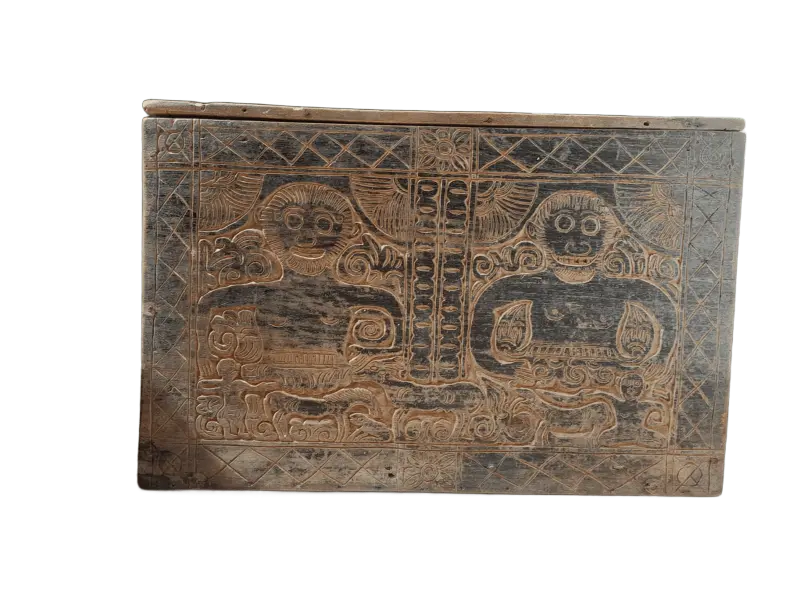
Front and Back Panels: Guardian Figures
The front and back panels display seated anthropomorphic figures framed within decorative borders. These figures are characterized by bulging eyes, wide open mouths, and stylized hair radiating outward in symmetrical curves. Their posture is frontal and formal, with legs bent and hands positioned before the torso.
Such features are typical of protective or liminal beings in Balinese art. The exaggerated facial expressions are not intended to represent naturalistic humans but rather spiritually charged guardians. In Balinese temple and palace architecture, fierce faces and guardian beings are commonly carved to ward off negative forces.
Although Lombok is predominantly associated with the Muslim Sasak population, western Lombok was historically under Balinese political influence, especially during the rule of the Karangasem kingdom from Bali. This long period of cultural interaction explains why Balinese mythological vocabulary appears in Lombok carving traditions.
The framing motifs around the figures, including geometric borders and vegetal scrolls, further align with Balinese woodcarving aesthetics.
Side Panel: The Gecko Motif
One of the side panels features a carved gecko. In Indonesian visual culture, geckos and lizards appear frequently in both decorative and symbolic contexts. In Bali, reptiles are often associated with the natural and spiritual worlds. While not necessarily divine figures, they can serve as protective or transitional symbols between spaces.
The inclusion of a gecko carving on a storage container does not automatically indicate ritual use, but it does reinforce the object’s alignment with Balinese inspired symbolic decoration.
Lid Carving: Dragon Like Creature
The lid is carved with a long, sinuous dragon like creature whose tail displays clearly defined scales. This imagery strongly evokes the naga motif found throughout Hindu Buddhist influenced Southeast Asia. In Balinese and Javanese art, naga figures symbolize protection, fertility, water, and cosmic balance.
The elongated body, dynamic posture, and scaled tail are consistent with decorative interpretations of naga imagery used in architectural ornament, temple gates, and ritual objects. However, the carving style here appears more decorative than liturgically formal. It suggests adaptation of sacred iconography into domestic or semi ritual craft production.
Possible Function
Given its size, construction method, and enclosed design, the box was likely used for storage. Common possibilities in the region include:
- Tobacco storage
- Betel and lime accessories
- Personal valuables
- Small offering implements
There is no direct evidence that it functioned as a temple ritual container. Instead, it appears to be a domestic object incorporating protective and mythological imagery into everyday life. This blending of the sacred and practical is characteristic of Balinese influenced material culture.
Cultural Context and Interpretation
Lombok’s history of interaction with Bali created a layered artistic environment. Even after shifts in political power, Balinese carving styles remained influential in certain regions. Workshops continued producing objects that blended functional design with mythological motifs.
The small nails, plank construction, and decorative style indicate that the box is not an ancient Hindu Buddhist relic but rather a product of regional carving traditions that draw upon established iconographic vocabulary.
The combination of guardian figures, a gecko motif, and a naga like dragon on the lid creates a coherent protective visual program. Such imagery would have symbolically safeguarded the contents while simultaneously demonstrating the carver’s skill and connection to a broader artistic heritage.
In conclusion, this wooden box from Lombok represents a Balinese influenced domestic storage container that integrates mythological and protective imagery into functional design. Its construction methods and stylistic features suggest a relatively recent origin within the ongoing tradition of Indonesian woodcarving shaped by centuries of cultural exchange.
Note: The object illustrated in this article is part of the author's private collection.