Description of the Object
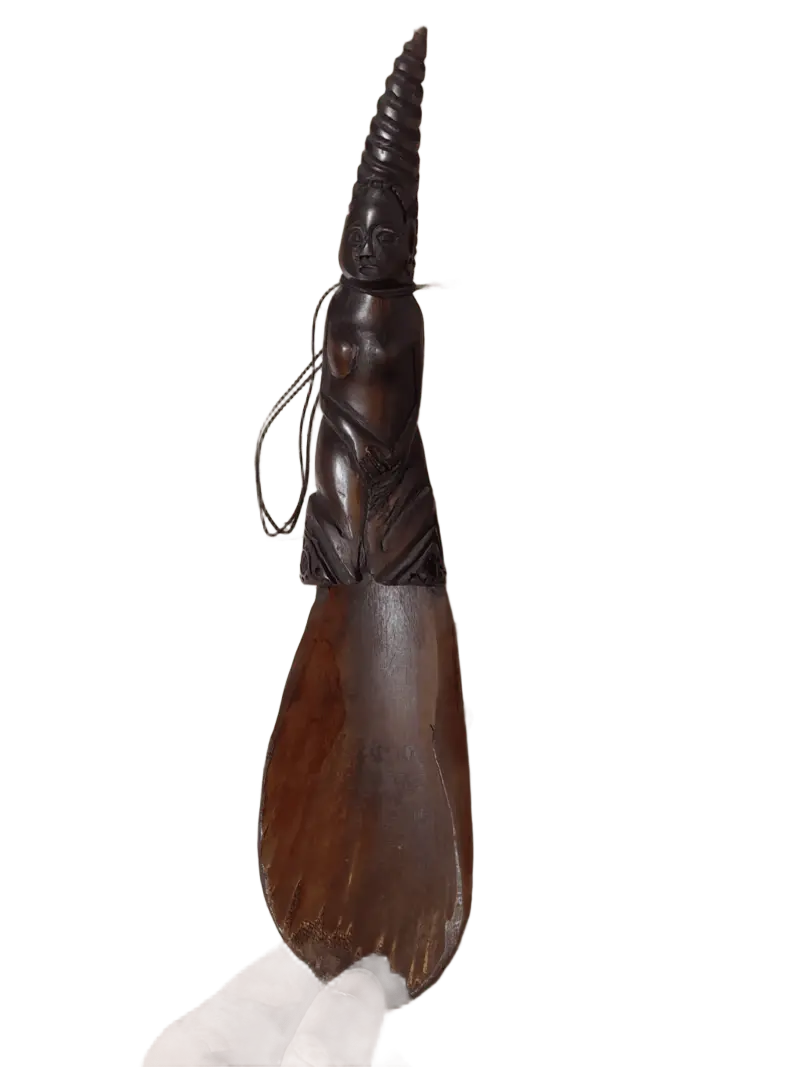
The object discussed here is carved from water buffalo horn and was acquired in Lombok. Its form suggests that it was likely used as a rice scooper. The lower portion forms a functional scoop, while the upper section is carved into a stylized female figure. Above the figure’s head, the carving extends into a spiral that continues to the top end of the object, creating a visually continuous and carefully composed handle.
The horn has been shaped and polished, preserving the natural qualities of the material while transforming it into a refined domestic implement. The female figure is rendered in a simplified, elongated style rather than strict naturalism, emphasizing contour and silhouette. The spiral extension above the head appears integrated into the structure rather than added, suggesting that the design was conceived as a unified whole.
Material and Craft Tradition
Water buffalo have long held economic and cultural importance in many parts of Indonesia, including Lombok. They are valued for agricultural labor, particularly in wet rice cultivation, as well as for meat and hide. Horn, as a byproduct, has been used for centuries in the production of tools, utensils, ornaments, and ritual items. Its strength and relative flexibility make it suitable for carving, and its surface can be polished to achieve a smooth finish.
Across the Indonesian archipelago, horn has been fashioned into combs, containers, handles, and various domestic implements. In some regions, artisans exploited the natural curvature of horn to shape functional objects that required both strength and aesthetic appeal. A rice scooper carved from horn would fit within this broader material tradition, especially in communities where rice is central to daily subsistence and ritual life.
Rice and Cultural Context
Rice has long been a staple food throughout Indonesia and carries deep social and symbolic importance. In many communities, rice is associated not only with sustenance but also with ideas of prosperity, fertility, and continuity. Domestic tools related to the preparation and serving of rice therefore occupy an important place within the household.
While rice scoops are often made from wood or metal, horn examples are not unknown in parts of Southeast Asia where horn carving traditions exist. A rice scooper with a carved anthropomorphic handle combines utility with visual expression, elevating a daily object into something that reflects craftsmanship and possibly local aesthetic conventions.
It would be speculative to attribute specific symbolic meaning to the female figure without documented provenance or comparative analysis. However, female imagery in Indonesian art is sometimes connected to themes of fertility or domestic life, particularly in agrarian settings. In the absence of direct evidence, it is more cautious to note that anthropomorphic decoration appears in a wide range of everyday objects across the archipelago.
Spiral Motif and Form
The spiral element extending from the head to the top of the object contributes to both structure and ornament. Spiral forms are widespread decorative motifs in many artistic traditions worldwide, including in Southeast Asia. They may arise from technical considerations, from the natural shape of materials, or from established ornamental vocabulary.
In this case, the spiral also follows the natural taper of the horn, suggesting that the artisan worked with the material’s inherent form. The integration of the female figure and the spiral into the handle creates a vertical emphasis that contrasts with the horizontal function of the scoop, balancing practicality and decoration.
Without specific documentation linking this piece to a particular workshop or regional style within Lombok, it is not possible to assign it to a defined carving tradition. Nevertheless, the object aligns with known practices of transforming horn into carved domestic implements.
Lombok and Regional Exchange
Lombok has historically participated in regional exchange networks that connected it to Bali, Java, and other islands in eastern Indonesia. Artistic forms and craft techniques circulated through trade, migration, and inter-island contact. The presence of carved horn objects in Lombok reflects both local resource availability and participation in broader Indonesian craft traditions.
The Sasak population of Lombok has maintained agricultural practices centered on rice cultivation, making rice-related implements integral to daily life. An elaborately carved rice scooper would have functioned within this domestic environment while also demonstrating the skill of the artisan who produced it.
Conclusion
This carved water buffalo horn object from Lombok, likely used as a rice scooper, exemplifies the intersection of material resource, domestic function, and artistic expression. The sculpted female figure and spiral extension transform a utilitarian implement into a carefully composed work of craft.
Although detailed historical attribution remains uncertain without further comparative research, the object can be situated within the well-documented Indonesian tradition of horn carving and the central cultural role of rice. As part of a private collection, it offers insight into how everyday tools in Indonesian households were sometimes shaped with aesthetic intention and cultural resonance.
Note: The object illustrated in this article is part of the author's private collection.