Standing Ancestor Figure with Staff: A Papuan Woodcarving from Eastern Indonesia
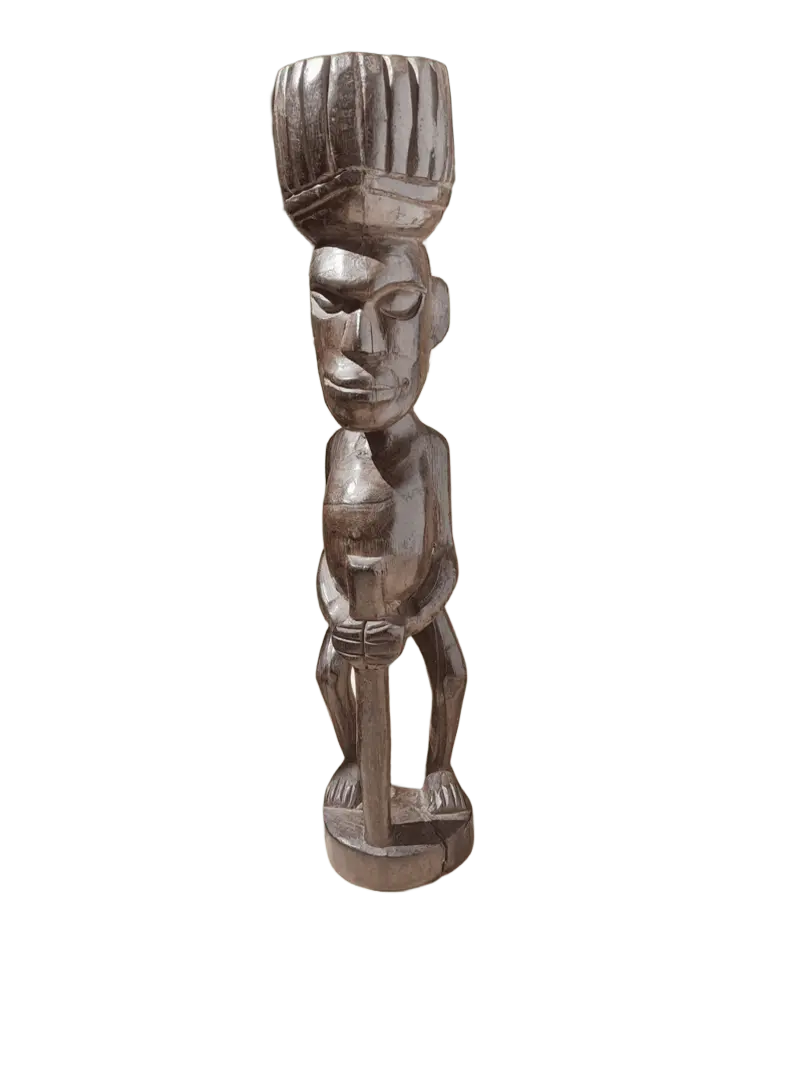
The wooden statue under consideration depicts a standing male figure gripping a vertical staff positioned between his legs. The composition is strongly vertical, with an elongated head crowned by a tall cylindrical headdress. The figure’s knees are slightly bent, feet planted firmly on a rounded base, and both hands grasp the staff in a gesture that suggests authority and ritual significance rather than mere physical support.
Based on stylistic and structural features, this sculpture most plausibly belongs to the carving traditions of Papua in eastern Indonesia, particularly the cultural sphere of West Papua and the broader Melanesian region.
Formal Characteristics and Symbolism
The statue emphasizes verticality. The tall headdress, elongated head, straight staff, and narrow legs all reinforce an upward directional movement. This vertical emphasis is characteristic of many Papuan carvings, where figures often serve as mediators between the human and spirit realms.
The facial features are stylized rather than naturalistic. Heavy eyelids, a composed mouth, and simplified anatomical modeling suggest symbolic intent over portrait realism. In Papuan traditions, ancestor figures are not meant to replicate individual likeness but to embody presence, lineage, and spiritual potency.
The hands tightly gripping the staff are particularly significant. In many eastern Indonesian and Melanesian contexts, a staff or spear is not only a weapon but also a marker of ritual power, masculinity, and clan authority. It may symbolize protection, leadership, or a link between ancestral and earthly domains.
Cultural Context: Papua and Ancestor Veneration
Papua, located in the easternmost part of Indonesia, encompasses a wide diversity of Indigenous cultures, languages, and artistic traditions. Many Papuan societies place strong emphasis on ancestral presence, ritual cycles, and the visible expression of spiritual power through carved forms.
Among the most internationally recognized Papuan carving traditions are those of the Asmat people of southwestern Papua. Asmat woodcarvers are known for monumental ancestor poles, often multi figure compositions used in commemorative rituals. While the figure discussed here is more compact and singular, certain stylistic parallels can be observed, particularly in the elongated proportions and symbolic abstraction.
In Papuan cosmology, ancestors are not distant historical figures. They remain active participants in community life. Carved figures can serve as:
- Memorials to deceased clan members
- Spiritual guardians
- Ritual intermediaries
- Objects that temporarily house ancestral force
Wood carving is deeply embedded in ritual practice. Trees are not chosen randomly. Selection, cutting, carving, and installation may all carry ceremonial dimensions.
Headdress and Status
The tall cylindrical headdress carved on this figure is unlikely to represent ordinary daily attire. In many Papuan communities, elaborate headgear signifies status, warrior identity, or ritual leadership. It may symbolize ceremonial adornment worn during initiation rites, feasts, or commemorative gatherings.
The structured vertical incisions on the headdress suggest stylization rather than realism. Such abstraction is common in Papuan carving, where symbolic exaggeration reinforces authority.
Distinction from Western Indonesian Traditions
Although Indonesia contains many carving traditions, this sculpture does not align strongly with western Indonesian styles such as Batak carving from North Sumatra. Batak figures often emphasize seated posture, pronounced elongated ears, and compact composition. The strong vertical staff motif and upright stance seen here are more consistent with eastern Indonesian and Papuan visual language.
The figure’s simplified torso, narrow limbs, and deliberate rigidity are hallmarks of Melanesian sculptural aesthetics rather than the more curvilinear ornamentation typical of western Indonesian carving.
Material and Production
The wood appears dense and smoothly finished. Throughout the twentieth century, Papuan carving traditions adapted in response to outside collectors, missionaries, and tourism.
Authentic ritual pieces often show evidence of smoke darkening, ritual application of pigments, or residue from ceremonial use. Market oriented carvings may display cleaner finishes and balanced symmetry intended for display.
Nevertheless, even contemporary pieces frequently maintain traditional symbolic forms. Carving remains an important medium of cultural continuity in Papua.
Conclusion
The standing male ancestor figure holding a vertical staff most likely originates from Papua in eastern Indonesia, within the broader Melanesian carving tradition. Its vertical emphasis, stylized facial treatment, and staff symbolism strongly support this attribution.
More than a decorative object, such a sculpture reflects a worldview in which ancestors remain present, protective, and powerful. Whether created for ritual or later artistic purposes, the form embodies central Papuan themes of lineage, authority, and spiritual mediation. It stands as a testament to the enduring vitality of woodcarving traditions in Papua and the cultural depth they continue to represent.
Note: The object illustrated in this article is part of the author's private collection.