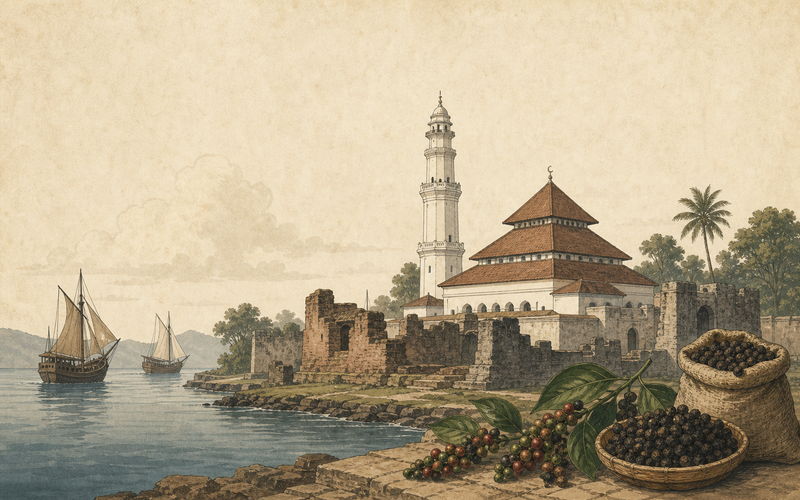
On the northwestern coast of Java, Banten grew from a coastal settlement into one of the most important Islamic port kingdoms of early modern Indonesia. Its history belongs to the world of the Sunda Strait, where ships moved between the Indian Ocean, the Java Sea, Sumatra, and the wider Malay world. In this setting, pepper gardens, harbor dues, court ceremony, and religious institutions were not separate stories. They formed the working life of a sultanate.
For a museum, Banten is especially useful because its past can still be read through landscape and remains. Old Banten, or Banten Lama, holds mosque architecture, palace ruins, fortifications, graves, and memories of a harbor that once drew Asian and European merchants. The sultanate's history reminds us that western Java was not a quiet edge of the archipelago, but a political and commercial threshold.
From Sundanese Coast to Islamic Sultanate
Banten's rise followed major changes in western Java during the sixteenth century. Older Sundanese authority, associated with Pajajaran in the interior, faced pressure from expanding Muslim powers along Java's north coast. Banten became linked to the Islamic political world of Demak and Cirebon, and local traditions remember Maulana Hasanuddin as a founding figure in the new sultanate.
This transition should not be imagined as a single moment in which one culture simply replaced another. Coastal communities had long been connected to trade, migration, and religious exchange. Islamization involved rulers, teachers, merchants, marriage alliances, and local communities gradually remaking public authority. The result was a court that spoke in the language of Islamic kingship while still standing within Javanese, Sundanese, and maritime patterns of power.
The new sultanate also looked outward. Banten's rulers extended influence into parts of western Java and across the Sunda Strait zone. Political power depended on territory, but also on access: access to pepper-producing regions, to ships, to brokers, and to the symbolic prestige that came from controlling a recognized port.
The Sunda Strait as a Political Landscape
Banten's geography shaped nearly every part of its history. The city stood near the route between Java and Sumatra, close to waters used by ships moving between the Indian Ocean and the Java Sea. This made the port attractive to merchants who wanted alternatives to other regional centers and to rulers who understood that shipping lanes could become sources of revenue.
The Sunda Strait was not simply a blue space on a map. It was a political landscape filled with pilots, sailors, fishing communities, tolls, military patrols, storms, and rival ports. Control was never absolute. A sultanate could encourage ships to anchor, offer protection, levy duties, and punish enemies, but it had to keep merchants willing to return.
This balance gave Banten a distinctive character. Its court was rooted in land, kinship, and ritual, yet its prosperity depended on mobility. Goods moved through warehouses and markets. News arrived with sailors. Diplomatic opportunities appeared when foreign vessels entered the bay. In Banten, maritime traffic became court politics.
Pepper, Merchants, and Urban Life
Pepper made Banten famous. The crop connected inland growers, local chiefs, port officials, Asian traders, and European companies into a chain of production and exchange. In the sixteenth and seventeenth centuries, pepper was not just a seasoning for distant tables. It was a commodity that could finance armies, attract ships, and shape the fortunes of kingdoms.
Banten's port society was therefore diverse and negotiated. Merchants from different parts of Asia traded alongside Europeans who came seeking direct access to spice commerce. Portuguese, Dutch, and English visitors described Banten as a place of commercial opportunity, though their records must be read with caution because they often viewed the city through the interests of trade and competition.
Urban life around the harbor would have been noisy and layered: markets, warehouses, boat landings, religious buildings, official compounds, and residential quarters all connected by paths of work and obligation. The sultanate's authority passed through officials who collected duties, managed access, and represented the court. Commercial life was not outside royal power. It was one of the main ways royal power was made visible.
Islamic Institutions and Court Authority
Banten was not only a trading port. It was also an Islamic court, and its religious institutions helped define political legitimacy. Mosques, judges, teachers, pesantren networks, and Sufi orders all belonged to the social world of the sultanate. The court needed religious knowledge to guide law, ceremony, education, and the moral language of rule.
The Banten Grand Mosque, traditionally associated with the sixteenth century and still prominent at Old Banten, gives this history a visible form. Its survival matters because it links architecture to memory. Visitors can see that Islamic authority was built into the city, not added as a footnote to trade. Worship, learning, and royal prestige shared the same urban landscape.
Scholarly research on Banten's shari'a court, tarekat, and pesantren reminds us that religious life had institutions, not only symbols. These institutions connected local society to wider Islamic networks across Java, Sumatra, the Malay world, Arabia, and South Asia. Through texts, teachers, and students, Banten participated in conversations much larger than the city itself.
Diplomacy and Rivalry in the Age of Companies
Banten's prosperity drew European attention during an age when chartered companies tried to control Asian trade. Dutch and English merchants arrived with ships, weapons, letters, and demands for privileges. They did not enter an empty field. They encountered an established court with its own rules, rivalries, and strategies.
Relations with European powers were often tense because trade access carried political consequences. A commercial agreement could strengthen one party and weaken another. A fort, warehouse, or favored merchant community could become a symbol of influence. Banten's rulers had to manage opportunity and danger at the same time, using foreign competition where possible while resisting domination.
The Dutch East India Company eventually built power in Batavia to the east, and the balance of western Java changed. Conflict between Banten, Batavia, and internal court factions weakened the sultanate's independence. Yet this later pressure should not erase the earlier achievement. For generations, Banten was not a passive victim of European expansion. It was an active port kingdom dealing with difficult rivals.
Old Banten as an Archaeological Memory
Old Banten preserves a landscape of ruins and continuities. Britannica notes that the former port city is now largely in ruins and that its harbor silted, leaving the old site inland from the present shoreline. This environmental change is important. It shows that maritime history is also ecological history: coastlines shift, rivers carry sediment, and harbors can lose the conditions that once made them powerful.
The remains of Surosowan palace, the Banten Grand Mosque, Fort Speelwijk, royal graves, and other traces allow visitors to imagine the layered city. Each kind of remain asks a different question. A palace ruin asks how authority was staged. A mosque asks how religious community and kingship met. A fort asks how European military presence changed the port world. A silted harbor asks how nature and politics interacted.
Museum interpretation can bring these traces together without turning Banten into a simple golden age. The sultanate was wealthy and cosmopolitan, but also shaped by hierarchy, conflict, forced labor, taxation, and rivalry. Its remains are powerful because they show achievement and vulnerability in the same place.
Manuscripts, Regalia, and the Work of Remembering
Banten's history also survives in manuscripts, royal traditions, and objects connected to court culture. Chronicles such as the Banten historical tradition, diplomatic letters, religious texts, and later scholarship preserve fragments of how people remembered authority, genealogy, conflict, and devotion. These sources are valuable, but they require careful reading because they were produced for particular audiences and purposes.
Courtly objects can make this world more tangible. Regalia, weapons, ceramics, seals, textiles, and manuscript pages help visitors understand that a sultanate was not only a line of rulers. It was a system of presentation. Power had to be seen, touched, worn, written, guarded, and repeated through ceremony.
Remembering Banten today also means recognizing its place in Indonesian cultural heritage. The old port connects local Banten identity to national history and to larger Indian Ocean and Southeast Asian narratives. It gives western Java a strong maritime past, one in which Islam, commerce, and diplomacy met in a visible urban landscape.
Conclusion
The Banten Sultanate mattered because it turned a strategic corner of western Java into a center of Islamic kingship and maritime exchange. Its rulers used pepper commerce, port administration, religious institutions, and diplomacy to build authority in a competitive world. The sultanate's story links the Sunda Strait to Java's north coast, Sumatra, the Malay world, and European company expansion.
Seen through a museum lens, Banten is a place where ruins still speak. Its mosque, palace remains, fortifications, graves, manuscripts, and memory of a silted harbor reveal a port kingdom that was both local and international. Banten's legacy lies in that meeting point: a western Javanese court facing the sea, shaping and being shaped by the Islamic port world around it.