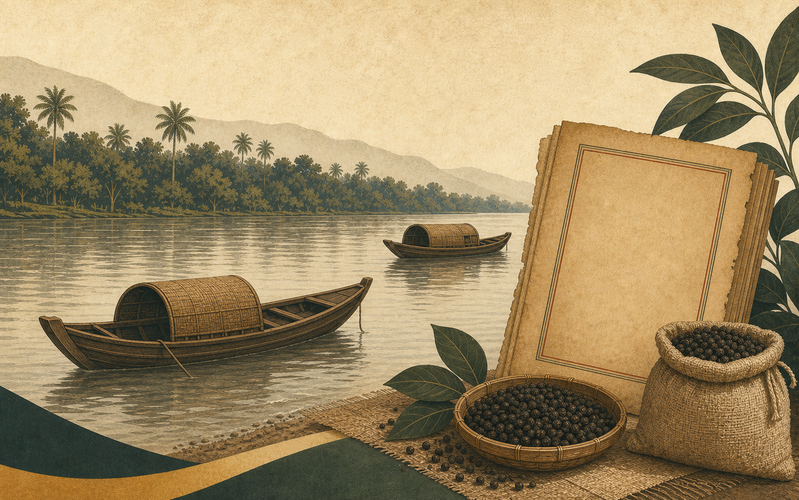
In South Kalimantan, rivers are not background scenery. They are roads, markets, boundaries, memories, and archives of movement. The Banjar Sultanate developed in this watery landscape, where the Barito and Martapura river systems helped connect inland communities with coastal trade. Its history cannot be understood only through palace names or lists of rulers. It must be read through boats, river mouths, pepper routes, Islamic teachers, manuscripts, and the everyday skill of living with water.
The sultanate emerged in the early modern period as one of southern Borneo's important Muslim polities. Banjarmasin became closely associated with its history, and Britannica notes that the city was the site of a sultanate from the early sixteenth century. For a museum, Banjar history is especially valuable because it joins material culture with landscape. River houses, markets, manuscripts, weapons, ceramics, and oral memory all help explain how authority worked in a place where power moved by water.
A Kingdom Shaped by Water
South Kalimantan's river systems made political life possible. The Barito River and its branches reached deep into Borneo, while the Martapura River connected settlements, markets, and courtly spaces around Banjarmasin and Martapura. These waterways carried forest products, agricultural goods, people, news, and ritual obligations. A ruler who wished to command the region had to understand river movement as much as land territory.
Riverine power was practical before it was symbolic. Boats could move where roads were difficult, and river mouths could become points of taxation and negotiation. Communities along the water were not isolated subjects waiting for orders. They were producers, traders, pilots, brokers, and local leaders whose cooperation mattered. Authority therefore depended on relationships along the waterways.
This made the Banjar Sultanate different from a court imagined as a fixed center ruling evenly outward. Its influence followed channels, bends, landing places, and tributaries. The river was a political map. Control over traffic, access, and alliances mattered as much as control over fields or walls.
From Earlier Polities to Islamic Kingship
Banjar traditions connect the sultanate with earlier political worlds in southern Borneo, including memories of Hindu-Buddhist or Indic-influenced courts such as Negara Dipa and Negara Daha. These traditions appear in later narratives and should be read carefully, because chronicles often combine memory, genealogy, political legitimacy, and religious meaning. Still, they show that Banjar kingship did not present itself as beginning from nothing.
The rise of an Islamic court is often associated with Pangeran Samudra, remembered after conversion as Sultan Suriansyah or Sultan Suryanullah. Local cultural accounts describe him as a foundational ruler of the Banjar kingdom. His story links dynastic conflict, coastal support, conversion, and new forms of legitimacy. Islamization in this context was not only a private matter of belief. It reshaped public authority, diplomacy, law, and court identity.
This process connected Banjar with wider Islamic and Malay worlds. Teachers, traders, texts, and political titles moved through maritime Southeast Asia, while local communities adapted them to South Kalimantan's river landscape. The result was neither a simple copy of Java nor an isolated Bornean court, but a Banjar political culture made through exchange.
Pepper, Ports, and the River Market
Commerce gave the sultanate much of its regional importance. Southern Borneo was linked to trade in pepper and other goods that could move from inland production zones toward river ports and then into broader maritime networks. Banjarmasin's position near river and sea made it a place where inland resources met foreign and inter-island merchants.
Markets in such a landscape were not only places of buying and selling. They were points where royal authority became visible. Duties could be collected, disputes could be settled, foreign traders could be received, and local leaders could demonstrate loyalty or resistance. Commercial exchange therefore helped build the court's political life.
The river market also produced cultural mixture. Banjar society interacted with Dayak communities, Malay-speaking traders, Javanese connections, Chinese merchants, and other groups moving through the region. Museum objects such as ceramics, metalwork, textiles, manuscripts, and tools can reveal these contacts without reducing them to a single trade story.
Manuscripts and the Work of Memory
The Hikayat Banjar is one of the most important textual traditions for understanding how Banjar history was remembered. Kompas describes the manuscript tradition as evidence for the spread of Islam in Kalimantan and notes that copies are found in European collections, including Leiden. Such manuscripts are not modern history books in a narrow sense. They are literary and political works that preserve origin stories, genealogies, religious claims, and court memory.
For museum interpretation, this is a strength rather than a weakness. A manuscript shows how a society wanted to explain itself. It can reveal what kinds of ancestry mattered, how conversion was remembered, which places were important, and how rulers placed themselves within sacred and political time. Reading it alongside archaeology, colonial records, oral traditions, and local scholarship gives a richer picture.
Manuscript culture also reminds visitors that river kingdoms produced intellectual life. Writing, copying, reciting, and preserving texts were forms of power. They helped link court memory to Islamic learning and to the Malay literary world beyond South Kalimantan.
Colonial Pressure and Banjar Resistance
The Banjar Sultanate's relationship with European power changed over time. Trade agreements with the Dutch East India Company in the eighteenth century did not end local authority, but they drew the sultanate into a harder field of commercial pressure and political intervention. Britannica notes that Banjarmasin was a center of resistance against Dutch government for much of the nineteenth century.
The Banjar War of the nineteenth century belongs to this longer struggle over sovereignty, resources, succession, and colonial control. It should not be treated as a simple clash between tradition and modernity. Local politics, court factions, religious leaders, mining interests, and Dutch ambitions all shaped the conflict. Resistance figures such as Prince Antasari remain central to regional memory because they represent the refusal to accept colonial authority as legitimate.
Colonial pressure transformed the political landscape, but it did not erase Banjar identity. Instead, memories of resistance became part of how South Kalimantan understood its past. The sultanate's history survived in family traditions, place names, manuscripts, museum collections, and public commemorations.
Museum Traces in South Kalimantan
Today, the Banjar Sultanate can be approached through institutions such as Museum Lambung Mangkurat in Banjarbaru, which presents itself as a center for preserving the history, culture, and local wisdom of Banjar society and other ethnic communities in Kalimantan. A museum setting helps visitors move from abstract political history to objects that can be seen and compared.
The most effective interpretation begins with the river. Boats, trade goods, weapons, manuscripts, textiles, household objects, and photographs of river life can be arranged as evidence of a water-based society. They show how governance, commerce, religion, and domestic life shared the same environment.
This approach also avoids treating the sultanate only as a lost palace. Banjar heritage remains active in language, Islamic practice, market life, architecture, foodways, and regional identity. The river still carries memory, even when political institutions have changed.
Related Reading
For nearby political histories, see the Aceh Sultanate, early maritime kingdoms, and Kingdoms and Courts. For river and maritime settings, explore Architecture and Maritime Culture.
Conclusion
The Banjar Sultanate mattered because it turned South Kalimantan's waterways into a political and cultural world. Its rulers drew authority from river access, commerce, Islamic legitimacy, manuscript memory, and alliances with communities along the Barito and Martapura systems. Its history shows that power in the Indonesian archipelago was often mobile, negotiated, and tied to environmental knowledge.
Seen through a museum lens, Banjar history is not only the story of a former sultanate. It is the story of how people used rivers to build society, remember origins, practice faith, resist outside pressure, and connect southern Borneo to the wider maritime world. The river remains the clearest guide to that legacy.