Demak occupies a powerful place in the history of Java because it stands at a turning point. In the late fifteenth and early sixteenth centuries, Muslim port polities on the north coast were becoming increasingly important, while older Hindu-Buddhist court traditions associated with Majapahit were losing political dominance. Demak emerged in this changing world as a Muslim kingdom with maritime connections, religious authority, and an ambition to rule in recognizably Javanese ways.
For a museum visitor, Demak is best understood not as a clean break between two civilizations, but as a place where forms of rule were rearranged. Islam gave new language to kingship, legitimacy, and sacred patronage. At the same time, courtly conduct, genealogy, architecture, ceremonial objects, and ideas of refinement continued to matter. The rise of Demak therefore helps explain how Islamic court culture in Java became both new and deeply local.
A North-Coast Setting
Demak's location on Java's north coast was essential to its historical role. The coast connected Javanese communities to merchants, scholars, diplomats, and pilgrims moving through the wider Indian Ocean and Southeast Asian trading world. Britannica notes that by the fifteenth century several harbour kingdoms had appeared along the main trade route, including Demak, Cirebon, Japara, and Gresik. These places were not peripheral to history. They were points where commerce, language, law, and religion met.
This maritime setting made political change possible. Coastal rulers could draw wealth from trade and prestige from Muslim networks that linked Java with other regions of the archipelago and beyond. Islam was not simply an imported doctrine carried in one direction. It moved through relationships: merchants marrying locally, teachers gaining students, rulers building alliances, and communities adapting new practices to existing social worlds. Demak's court culture grew from that layered environment.
From Majapahit Memory to Muslim Rule
The transition from Majapahit to Demak is surrounded by chronicles, legends, and later court traditions, so it must be handled carefully. Some narratives connect Demak's first rulers to Majapahit lineage, a claim that would have helped a new Muslim court speak in an older Javanese language of legitimacy. Whether every detail of those genealogies can be verified is less important than the cultural work they performed. They made political change appear continuous rather than rootless.
This continuity mattered because courts depended on recognition. A ruler needed more than military strength or commercial wealth; he needed a story of rightful authority. Demak's Islamic identity did not require abandoning all inherited Javanese concepts of prestige. Instead, the court could combine Muslim titles, mosque patronage, and religious learning with older expectations about noble descent, refined conduct, and ceremonial dignity. The result was a courtly Islam shaped by Java's own political memory.
The Great Mosque as Courtly Center
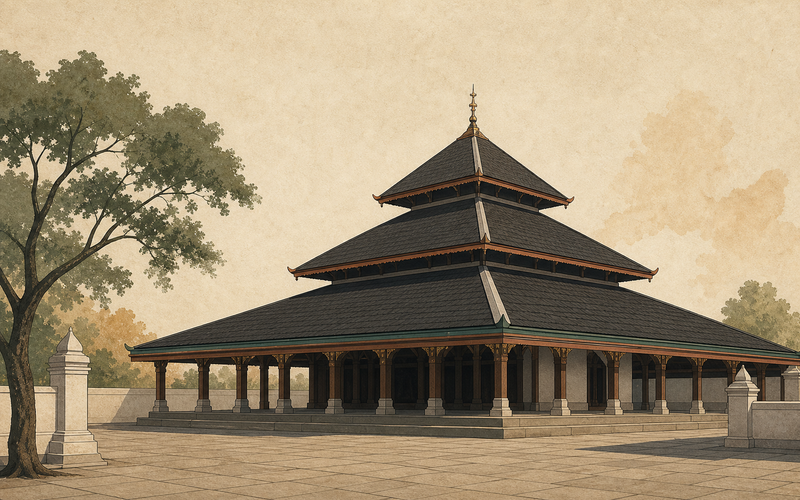
The Great Mosque of Demak is the most visible heritage anchor of this story. The mosque's own profile identifies the site as a National Cultural Heritage property and emphasizes its importance for the development of Islam in the archipelago. It is associated in public memory with the Wali Songo, the revered nine saints credited in Javanese tradition with spreading Islam. As with many sacred heritage sites, history, devotion, and later memory are intertwined.
Architecturally, the mosque also shows why Demak cannot be understood through a simple imported-versus-local contrast. Its layered roof and timber construction belong to an Indonesian and Javanese architectural vocabulary rather than to a Middle Eastern dome-centered model. This does not make the building less Islamic. It shows how Islamic worship could be housed in forms already meaningful in Java. The mosque was not only a place of prayer; it was a statement that Muslim kingship could inhabit Javanese space.
Wali Songo Memory and Religious Authority
The memory of the Wali Songo is central to Demak's cultural presence. These saintly figures appear in Javanese Islamic tradition as teachers, advisors, and mediators who helped embed Islam in local society. Their stories often combine historical persons, devotional memory, and symbolic teaching. A cautious museum interpretation does not need to flatten these traditions into either pure fact or pure legend. It can treat them as evidence of how communities understood religious authority.
For Demak, this authority was politically important. A court connected to respected religious teachers could claim a form of legitimacy different from older Hindu-Buddhist models yet still compatible with courtly patronage. Mosque building, support for scholars, and participation in sacred memory helped place the ruler inside an Islamic moral order. Court culture was therefore not limited to palace etiquette. It extended into religious institutions, public ritual, and the preservation of revered places.
Court Culture, Objects, and Ceremony
Islamic court culture in Java was expressed through objects as well as buildings. Textiles, weapons, manuscripts, seals, processional items, and grave markers all helped make authority visible. Demak's surviving material record is not as complete as a museum might wish, but the broader pattern of Javanese courts suggests that legitimacy was performed through carefully chosen forms. A court did not simply announce power; it staged power through space, dress, ritual, language, and patronage.
This is where Demak belongs in a larger museum narrative. The emergence of Muslim rule did not make visual culture disappear. It redirected it. Arabic script, Qur'anic learning, mosque furniture, and Islamic grave forms could stand beside Javanese ideas of hierarchy and refinement. Even when particular objects cannot be assigned securely to Demak, the court's historical importance lies in this transformation: Islamic political authority became materially and ceremonially legible in Javanese terms.
Expansion, Conflict, and Limits of Power
Demak was not only a sacred memory. It was also a political power involved in expansion and conflict. Britannica describes the sultanate of Demak in the first half of the sixteenth century as seeking to rule over a great Javanese kingdom, before its inland expansion was checked and later power shifted toward other centers. This reminder is important because court culture was never detached from strategy. Religious legitimacy, port wealth, and military ambition belonged to the same historical world.
The limits of Demak's power also help explain why its legacy became larger than its direct rule. Later Javanese Islamic courts, including inland powers, inherited and reshaped elements of the world that Demak helped make possible. The political center moved, but the problem Demak had addressed remained: how could a Javanese ruler be both recognizably Muslim and recognizably Javanese? That question continued to shape courtly life long after Demak's own dominance faded.
Reading Demak in the Museum
A museum reading of Demak should hold together three kinds of evidence. The first is historical documentation: trade routes, political conflict, references to harbour kingdoms, and the broad chronology of Islam's spread. The second is built heritage, especially the Great Mosque, which gives visitors a concrete place where religious and courtly histories meet. The third is cultural memory: Wali Songo stories, genealogical claims, and sacred associations that shaped how later communities remembered the sultanate.
These forms of evidence do not all behave in the same way. A mosque inscription, a colonial-era chronicle, a pilgrimage story, and a modern heritage designation each answer different questions. Used carefully, however, they reveal why Demak matters. It was not simply a capital on a map. It was a workshop of political imagination, where rulers, scholars, builders, and communities tested how Islamic authority could become part of Javanese public life.
Conclusion
Demak's rise marks one of the most important transformations in Javanese history. From a north-coast setting shaped by trade and Muslim networks, it developed a court culture that joined Islamic legitimacy with Javanese ideas of ancestry, ceremony, and refined rule. The Great Mosque remains the clearest material symbol of that synthesis, while Wali Songo memory continues to give the place devotional meaning.
For museums, Demak offers a valuable lesson in cultural change. Islamization in Java was not a simple replacement of one world by another. It was a long process of adaptation, negotiation, and creative courtly expression. In Demak, a new Muslim political order learned to speak through Javanese forms, and Java's later Islamic courts would continue that conversation for centuries.