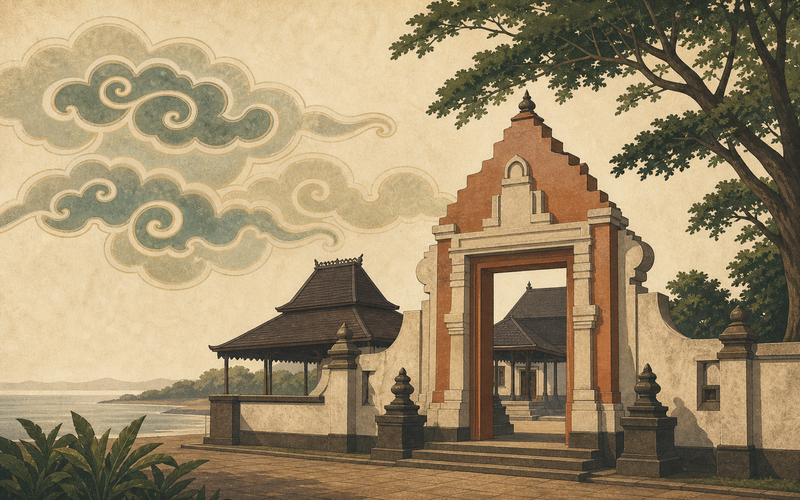
Cirebon stands on Java's north coast, facing the sea routes that connected the island to Sumatra, the Malay world, China, South Asia, Arabia, and Europe. Its sultanate is often remembered through royal genealogy and Islamic teaching, but its cultural importance is broader than a list of rulers. Cirebon was a port court: a place where harbor traffic, pilgrimage, language, craft, ceremony, and political authority shaped one another.
This history matters because Cirebon does not fit neatly into a single cultural box. It lies near the meeting zone of Javanese and Sundanese worlds, while its court traditions also carry the marks of Islam and maritime exchange. In museum terms, Cirebon is best approached as a layered cultural landscape. Palaces, mosques, batik, carriages, stories of saints, and court ceremonies all preserve traces of a society that learned to turn mixture into identity.
A Port Court on Java's North Coast
Cirebon's location helps explain its character. The city developed on the north coast of Java, a coastline known for ports that linked inland rice regions with long-distance commerce. Merchants, sailors, religious teachers, artisans, and envoys passed through such places, carrying goods and ideas together. A court that grew in this setting could not depend only on landholding. It also needed to manage movement.
The term "coastal" should not imply a thin edge of culture. Java's pasisir, or north coast zone, produced its own forms of authority and creativity. Courts and towns along this coast were often more exposed to travel and trade than inland centers, but they were not merely open doors. They selected, adapted, and formalized outside influences through local institutions.
For Cirebon, this meant that maritime exchange became part of royal culture. Court prestige could be expressed through buildings, heirlooms, processions, and Islamic learning, while the wider port world supplied materials, contacts, and imagination. The sultanate's identity was therefore both rooted and mobile: attached to place, but formed by routes.
Between Javanese and Sundanese Worlds
Cirebon occupies a cultural borderland in western Java. To the west and inland lay Sundanese political and linguistic traditions; to the east and along the coast lay Javanese networks connected to other pasisir courts. This position gave Cirebon a distinctive voice. Its heritage cannot be understood only as an extension of central Javanese court culture or only as a Sundanese inheritance.
Borderlands are often creative because they make translation necessary. People in Cirebon negotiated names, languages, kinship memories, ritual forms, and artistic signs across more than one cultural horizon. Local traditions remember figures such as Pangeran Cakrabuana and Sunan Gunung Jati in ways that connect political foundation with religious authority. Historians treat such traditions carefully, because court chronicles and oral memory mix history, legitimacy, and sacred narrative.
For a museum visitor, the important point is not to flatten those stories into simple dates. The stories show how Cirebon understood itself: as a place where royal descent, Islamic charisma, and regional belonging supported one another. The sultanate's cultural blending was not accidental decoration. It was a way of making authority persuasive.
Islam and Local Forms of Authority
Islam was central to Cirebon's courtly identity. The city is associated with Sunan Gunung Jati, one of the revered Wali Songo in Javanese Islamic tradition. In local memory, religious teaching and political leadership are closely connected, and the court's sacred geography includes graves, mosques, and ritual obligations that continue to structure cultural life.
At the same time, Cirebon shows that Islamization in Java was not a simple replacement of older forms. Islamic language, law, devotion, and scholarship entered a society with existing ideas of kingship, ancestry, etiquette, and sacred space. The result was a local Islamic court culture in which Arabic-derived titles and ritual practices could coexist with Javanese and Sundanese modes of respect.
Anthropological studies of Cirebon emphasize this interaction between ibadat, formal religious devotion, and adat, inherited custom. That pairing is useful because it avoids the false choice between religion and culture. In Cirebon, religious life became visible through public ceremonies, palace etiquette, mosque-centered memory, and the everyday practices of communities around the court.
Palaces, Mosques, and Courtly Memory
The palaces of Cirebon are among the most visible remains of the sultanate's cultural world. Keraton Kasepuhan, associated with the older Pakungwati palace tradition, preserves buildings, courtyards, heirlooms, and a setting in which royal memory is still performed. Keraton Kanoman and other court compounds also form part of this wider landscape of dynastic heritage.
These palaces are not simply residences. They are archives in architectural form. Gateways, audience spaces, walls, carriage collections, ceramics, and ceremonial routes all communicate ideas about rank, protection, hospitality, and sacred legitimacy. Some objects point toward overseas exchange; others belong to local court forms. Together they make Cirebon's blended identity visible without needing to reduce it to a single symbol.
Mosque architecture and royal ritual deepen this memory. The Great Mosque of Cirebon and the court's ceremonial calendar show that worship, kingship, and community gathering were intertwined. When people visit court compounds during major commemorations, they are not only looking at old buildings. They are entering a living system of remembrance.
Craft, Motif, and Maritime Imagination
Cirebon's cultural blending is especially clear in its arts. Batik from Cirebon is famous for motifs associated with the coast, including the cloudlike mega mendung pattern. The motif is often discussed as evidence of Chinese visual influence adapted into local batik language, though precise origin stories vary and should be treated cautiously. What matters is the pattern's enduring place in Cirebon identity.
Court objects also carry layered meanings. Royal carriages, decorative woodwork, imported ceramics, and palace ornaments show a taste for composite forms. A single object may suggest court hierarchy, protective symbolism, religious imagination, and the cosmopolitan tastes of a trading town. Cirebon's art often feels neither purely inland nor purely foreign; it is coastal in the strongest sense, shaped by contact and disciplined by local taste.
This maritime imagination did not require every object to depict the sea. Rather, the port world gave Cirebon access to materials, motifs, and stories that could be transformed inside courtly and religious frameworks. The result was not a random mixture, but a recognizable style: refined, layered, and open to movement.
Living Heritage and Careful Interpretation
Modern Cirebon still carries this heritage through palaces, pilgrimage, ceremonies, craft workshops, and public memory. Events connected with the court calendar, including commemorations around the Prophet's birthday, continue to draw communities toward palace spaces. These practices remind us that heritage is not only preserved in glass cases. It is also maintained by repetition, responsibility, and social trust.
Careful interpretation is necessary because Cirebon's past is partly recorded through court chronicles, sacred genealogy, and later historical writing. These sources are valuable, but they do not always answer modern historical questions in the same way as inscriptions, archives, or archaeology. A museum approach should therefore distinguish between documented evidence, local tradition, and scholarly debate without dismissing any of them.
Cirebon's greatest lesson may be that cultural identity can be composite without being confused. The sultanate drew from Javanese, Sundanese, Islamic, Chinese, and maritime worlds, yet it became something recognizably its own. Its heritage invites us to see Indonesian history not as a row of isolated traditions, but as a long practice of meeting, adapting, and remembering.
Conclusion
The Cirebon Sultanate offers a vivid example of coastal Indonesian history. It was a court, a religious center, a port society, and a borderland community at once. Its palaces, mosques, crafts, and ceremonies show how cultural blending can become an enduring form of authority and beauty. For Nusantara Museum, Cirebon belongs among the clearest reminders that Indonesia's heritage was made not only by kingdoms on land, but also by routes across water.