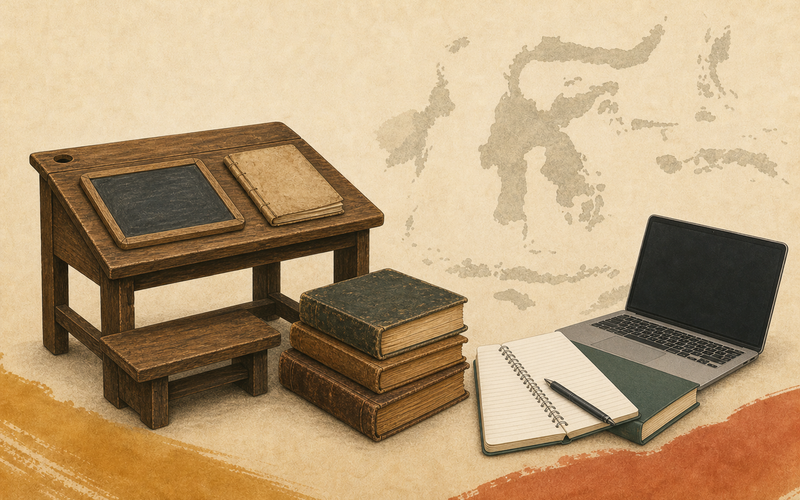
Sulawesi is too large and varied for a single school story. Education in Minahasa, Makassar, Palu, Gorontalo, Toraja, Buton, and smaller coastal or highland communities followed different routes into the modern era. Some areas encountered mission schools early. Others were drawn more slowly into colonial administration, plantation labor, port commerce, or state schooling.
For that reason, a comparison between colonial and modern education in Sulawesi must avoid the idea of one simple transformation. The island moved from selective colonial and mission-linked systems toward a national education framework, but the old questions did not disappear. Who could enter school, which language mattered, how far a child had to travel, and what kind of future schooling promised remained central concerns.
Uneven Colonial Beginnings
Dutch colonial education in Sulawesi developed unevenly because colonial power itself was uneven. Ports and administrative towns had different priorities from highland villages or interior valleys. In South Sulawesi, Makassar's maritime and political importance made it a natural center for administration and urban schooling. In North Sulawesi, Minahasa became especially associated with mission activity and Christian education.
Colonial schooling was therefore not simply an island-wide public service. It grew through local combinations of mission work, government need, elite negotiation, and labor demand. The result was a map of opportunity with bright spots and large gaps. A student near a mission station, church network, or administrative center might encounter formal schooling earlier than a child in a more distant rural setting.
Mission Schools and Minahasa
Minahasa offers one of the clearest examples of how religion and schooling could become intertwined. The World Council of Churches notes that the Netherlands Missionary Society was invited to work in Minahasa in 1827 and that a teacher-training school opened there as early as 1851. Such institutions trained teacher-preachers and helped make literacy, church life, and local leadership part of the same social world.
This history should be read carefully. Mission schooling could provide skills, status, and new public roles, but it was also connected to colonial authority and religious transformation. Students did not merely learn reading or writing. They entered a world of discipline, doctrine, new gender ideals, and new forms of belonging. In museum terms, a schoolbook or teacher certificate from Minahasa can speak at once about education, conversion, administration, and local agency.
Ethical Policy and Central Sulawesi
The Dutch Ethical Policy, introduced in the early twentieth century, claimed to repay a moral debt to colonial subjects through welfare-oriented reforms, including education. Britannica describes education as one of the policy's major fields. In Sulawesi, however, the meaning of this policy depended heavily on local context. It did not create equal access across the island.
Research on Palu and the Kulawi Valley shows how the Ethical Policy in Central Sulawesi was tied to colonial intervention after Dutch expansion into the region. Schools, roads, settlement changes, administrative control, and cultural policy belonged to a broader effort to reorder local society. Education could be presented as improvement, but it also helped colonial officials classify people, train intermediaries, and extend state presence into areas that had not previously been governed in the same way.
Language, Rank, and Access
Colonial education often made language a gatekeeper. Dutch carried prestige in government and higher-status schooling, while Malay served as a wider contact language in many colonial settings. Local languages remained essential in households, ritual, oral tradition, and everyday community life. A student's educational path could therefore involve movement between several linguistic worlds.
Modern Sulawesi has a different language order. Bahasa Indonesia is the national language of public education and citizenship, while English is often associated with higher education, tourism, technology, and global work. Local languages still matter deeply, but they do not always receive equal space in formal schooling. The hierarchy has changed, yet the problem remains recognizable: language can open doors, and it can also mark distance between school and home.
From Subjects to Citizens
The strongest political difference between colonial and modern education is the imagined student. Colonial schools did not exist to create equal citizens of an Indonesian republic. They served a colonial order that needed clerks, teachers, catechists, technicians, interpreters, and loyal local intermediaries. Even when schools helped students gain real skills, access was selective and shaped by ancestry, religion, class, gender, and location.
Modern education is organized through a different legal vocabulary. Indonesia's National Education System Law of 2003 defines education as a national project rooted in rights, obligations, levels, types of schooling, curriculum, standards, teachers, facilities, evaluation, and public responsibility. That framework does not erase inequality, but it changes the official promise. The student is no longer a colonial subject admitted by exception, but a citizen whose education is part of national development.
Modern Expansion and Regional Realities
Today, Sulawesi's educational landscape includes public schools, private schools, Islamic schools, Christian schools, vocational programs, pesantren, universities, teacher colleges, tutoring centers, and digital learning spaces. BPS education publications, such as the 2024 education statistics for South Sulawesi, track indicators including school participation, enrollment, and illiteracy. The existence of these measurements itself shows how modern education is managed through data, planning, and public accountability.
Yet the numbers also point toward a basic museum lesson: access is broader, but it is not identical everywhere. Mountain roads, island settlements, household income, school quality, internet access, and the availability of teachers can all shape a child's education. Modern Sulawesi is not colonial Sulawesi, but regional distance still matters. A national system must continually translate its promise into local realities.
What Remained
One continuity is the link between schooling and mobility. In colonial times, education could move a small number of people into church service, government offices, teaching posts, or urban employment. In modern times, schooling is still imagined as a path toward work, migration, university study, and wider public life. Families invest in education because it seems to connect local children to futures beyond the village, town, or island.
Another continuity is the role of schools as cultural crossroads. In Sulawesi, classrooms have long brought together local knowledge, religious teaching, state authority, national language, and outside ambitions. That mixture can be productive, but it can also be tense. A good historical interpretation should therefore treat education not only as progress, but as negotiation.
Reading Education as Heritage
The history of education in Sulawesi can be displayed through humble objects: slates, notebooks, hymnals, Qur'an primers, Dutch or Malay textbooks, attendance lists, school uniforms, photographs, teacher diplomas, and student memories. Such materials show how large historical forces entered ordinary lives. They reveal colonial hierarchy, missionary discipline, national aspiration, and family hope.
Museums can also use education to connect regions that are often studied separately. Minahasa's teacher-preachers, Makassar's urban schools, Central Sulawesi's colonial interventions, and today's provincial education statistics all belong to one larger question: how did people on Sulawesi learn to belong to wider political, religious, and economic worlds while remaining rooted in local communities?
Conclusion
Colonial and modern education in Sulawesi differ most clearly in purpose, scale, and political meaning. Colonial schooling was selective and often tied to mission networks, administrative needs, and colonial control. Modern schooling is formally part of a national system that promises broader participation and citizenship.
The comparison is not a simple story of darkness followed by light. It is a history of uneven access, changing languages, regional diversity, and persistent hopes for mobility. Sulawesi's schools show how education can become both an instrument of power and a tool through which families imagine a wider future.