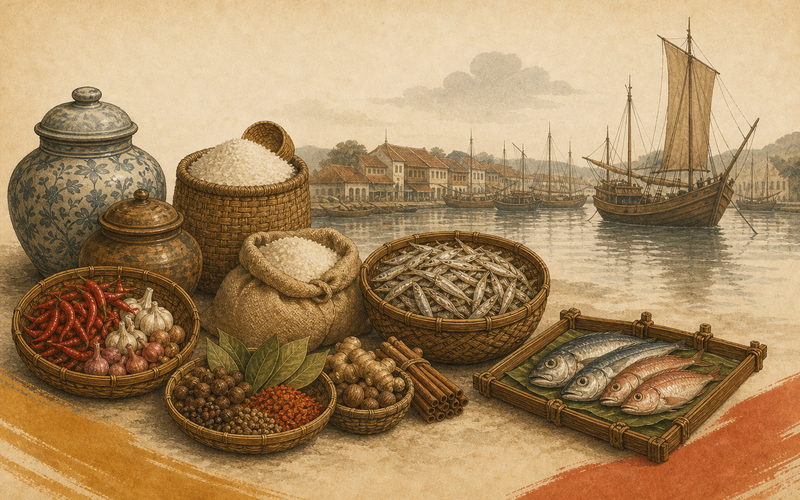
Market life in Indonesian port cities has long been more than a daily search for food. Along coasts and river mouths, markets brought together fishers, boat crews, farmers from nearby hinterlands, spice brokers, cooks, pilgrims, and foreign merchants. Their exchanges made port cities places where food was weighed, tasted, argued over, taxed, and transformed into meals that carried traces of many routes.
This article approaches the port market as a museum object in motion. It cannot be placed behind glass, because its meaning comes from movement: sacks of pepper, baskets of fish, bundles of herbs, ceramic jars, rice, palm sugar, and news from other harbors. In Indonesia, such markets help explain how local foodways remained rooted in place while also becoming part of a much wider maritime world.
Ports as Gateways Between Sea and Hinterland
Indonesian port cities developed where water, storage, labor, and access to inland produce could meet. A port did not live by ships alone. It needed roads, rivers, warehouses, market shelters, weighing practices, and people who could move goods from farms and forests to the quay. Food exchange therefore connected coastal life with upland gardens, rice fields, coconut groves, sago areas, and spice-producing landscapes.
This gateway role is visible in the history of the spice trade. Britannica describes the spice trade as an ancient enterprise involving cultivation, preparation, transport, and merchandising, while UNESCO emphasizes that maritime routes linked Indonesia with broader Asian and western networks. For port markets, this meant that local ingredients could become export goods, and imported goods could enter household kitchens or elite dining.
The market was the human scale of that system. Large historical maps may show routes between famous ports, but the everyday work happened in smaller transactions: a trader judging the dryness of cloves, a cook selecting fish before dawn, a boatman carrying rice, or a household servant bargaining for aromatics. Through these gestures, port cities turned geography into social life.
Spices, Staples, and Everyday Exchange
Spices are often remembered as luxury commodities, but market life also depended on staples. Rice, sago, tubers, salt, dried fish, coconuts, bananas, palm sugar, and cooking fuel mattered as much as pepper, nutmeg, cloves, or cinnamon. A port market had to feed residents and transient populations: sailors waiting for monsoon winds, port workers, religious visitors, administrators, artisans, and families living near the harbor.
The presence of spices shaped taste and value. UNESCO notes that spices were prized not only for cooking but also for ritual, medicinal, and social uses. In Indonesian port cities, this range of meanings made spices especially flexible. They could be ingredients, gifts, remedies, taxable goods, or signs of status. Their exchange also encouraged close attention to quality, origin, aroma, and storage.
At the same time, traditional food exchange was not simply international trade in miniature. Local women, small vendors, fisher families, and itinerant sellers helped decide what foods reached daily meals. Their choices turned traded goods into familiar tastes. A spice might travel across seas, but it became meaningful when pounded into a paste, simmered with coconut milk, rubbed onto fish, or used in festive cooking.
Port Markets as Multilingual Social Spaces
Ports gathered people who did not always share one language, religion, or legal custom. Market exchange therefore required practical forms of translation. Numbers, measures, gestures, trusted brokers, loanwords, and repeated relationships helped strangers trade with one another. Over time, this contact left traces in vocabulary, eating habits, and the social etiquette of buying and selling.
The UNESCO Silk Roads Programme describes ports along spice routes as places where goods moved with knowledge and ideas. Indonesian port markets fit that pattern. A market could circulate information about harvests, ship arrivals, political change, religious festivals, or prices in another harbor. Food exchange was therefore also information exchange, and the person who knew what had arrived could gain advantage.
These social contacts did not erase local identity. A market in Makassar, Banten, Aceh, Gresik, Ternate, or another coastal center reflected its own ecology and history. Some ports looked toward the Indian Ocean, others toward the Java Sea, the Makassar Strait, or eastern spice islands. Each setting shaped the mix of goods and the rhythm of trade.
Cooking at the Edge of Maritime Routes
The foods prepared in port cities often reveal layered histories. Coastal cooking drew from local seafood and plant resources, but it also absorbed techniques and preferences carried by migrants, merchants, and religious communities. Frying methods, spiced broths, pickled condiments, noodle dishes, breads, sweets, and festive rice preparations could all be adapted to local ingredients.
Museums should treat these adaptations carefully. It is tempting to tell food history as a simple story of outside influence, but port cuisine was not passive. Local cooks selected, rejected, renamed, and transformed ingredients. A foreign ceramic jar might hold a local condiment; an imported spice might be used in a ritual meal; a cooking technique might be adjusted to coconut, fish, or rice available nearby.
This is why traditional food exchange in port cities is best understood as negotiation. Taste was shaped by appetite, belief, cost, season, status, and memory. Market life provided the setting where those factors met. The result was not one uniform coastal cuisine, but many port foodways that carried family knowledge and maritime openness at the same time.
Labor, Gender, and Trust in the Market
Market exchange depended on labor that is often less visible than long-distance trade. People cleaned fish, dried produce, packed spices, carried baskets, repaired stalls, cooked snacks, managed credit, guarded goods, and kept informal accounts. Much of this work was repetitive and physical, yet it made the market reliable enough for larger trade to function.
Women have often been central to everyday food marketing and household provisioning in Indonesian communities, though their roles varied by region and period. In port cities, women could be sellers, buyers, processors, cooks, and keepers of culinary knowledge. Their work linked the market to the home, because the success of exchange was measured not only in profit but in meals prepared for families, guests, and ritual obligations.
Trust was another form of infrastructure. Buyers needed confidence in weight, freshness, and origin. Sellers needed predictable customers and fair payment. Repeat relationships, reputation, kinship, religious affiliation, and neighborhood familiarity all helped regulate exchange. In this sense, a port market was not merely an economic zone. It was a social institution built from remembered dealings.
Colonial Pressure and Changing Market Worlds
From the sixteenth century onward, European attempts to control spice production and distribution altered many Indonesian trading environments. The UNESCO World Heritage Centre's tentative-list description of the Land Below the Wind highlights the importance of nutmeg and cloves, the role of trading posts, and the later efforts of the VOC to monopolize key commodities. Such policies could redirect flows of goods and reshape the power around ports.
Yet local market life did not disappear under colonial pressure. People still needed to eat, sell, substitute, and maintain relationships. Some goods became restricted or taxed, while others continued through local circuits. Food exchange remained a way for coastal communities to adapt to changing authority, even when larger political systems tried to discipline trade.
This tension is important for interpretation. Port markets were not romantic spaces of effortless mixing. They could also be places of inequality, debt, forced regulation, and competition. A museum account should hold both realities together: the creativity of exchange and the pressures that shaped who benefited from it.
Reading Port Markets as Heritage
Today, the heritage of Indonesian port markets can be read in old harbor districts, culinary traditions, spice shops, street foods, family recipes, and memories of trading neighborhoods. Some historical port landscapes have changed dramatically, but market habits often preserve older patterns of movement. Early morning fish sales, spice grinding, seasonal sweets, and foods prepared for religious holidays can all carry traces of maritime history.
Food heritage is especially powerful because it is sensory. Smell, texture, sound, and taste can make history immediate. A visitor may understand the spice route more clearly by seeing how cloves are sorted, how fish is preserved, or how a vendor combines ingredients for a coastal dish. These practices connect global history to the hands that prepared food.
For museums, market life encourages a broader view of Indonesian maritime culture. Ships, maps, and forts matter, but so do baskets, scales, cooking stones, storage jars, recipes, and vendor stories. Together they show how port cities made exchange ordinary enough to become culture.
Conclusion
Market life and traditional food exchange in Indonesian port cities reveal the everyday foundations of maritime history. Ports connected the archipelago to long-distance routes, but markets made those connections practical, edible, and socially meaningful.
Through spices, staples, seafood, labor, trust, and adaptation, port communities turned trade into foodways. Their markets remind us that Indonesian maritime heritage is not only a story of ships crossing seas. It is also a story of people meeting at dawn over baskets, weights, aromas, and the shared need to turn movement into meals.