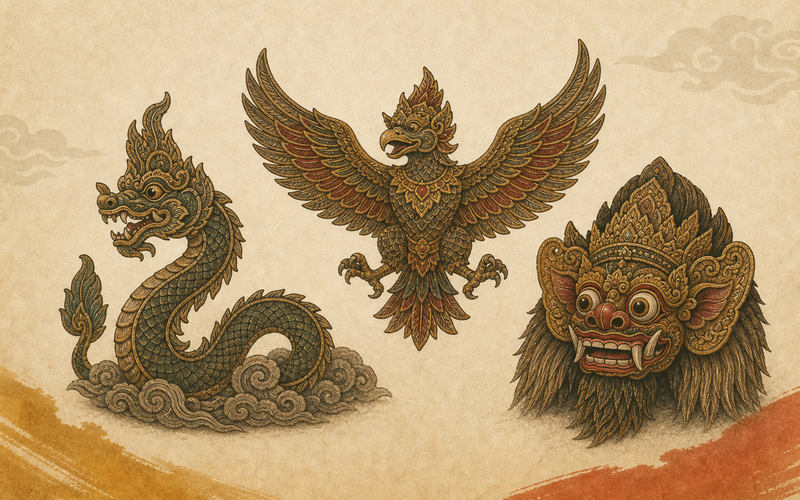
Indonesian mythical creatures are best understood not as a fixed catalogue of fantastic beings, but as signs of the beliefs that shaped life in the archipelago. Across islands and centuries, communities used stories about birds, serpents, guardian beasts, and powerful spirit figures to explain why landscapes felt charged, why rituals mattered, and how moral order could be protected or broken. A museum visitor may first meet these beings in carved wood, temple reliefs, masks, or puppets, yet those forms only make full sense when placed within the beliefs that gave them force.
Those beliefs were never singular. Indonesian societies drew on older local cosmologies, ancestor reverence, sacred geography, and ideas about unseen beings long before the spread of Hindu-Buddhist courts and, later, Islam. As new religious and political frameworks entered the archipelago, mythical creatures were not simply replaced. They were reinterpreted. That layered process helps explain why the same figure can appear in literature, performance, architecture, and public symbolism while carrying slightly different meanings in each setting.
Older Cosmologies and the Living Landscape
Many Indonesian traditions begin from the assumption that the world is inhabited by more than visible human life. Mountains, forests, rivers, caves, coastlines, and old settlement places may all be treated as spiritually charged. In such a worldview, mythical creatures are not only characters in entertaining stories. They can express the presence of powers tied to place, fertility, danger, or ancestral memory. This helps explain why creature imagery often appears near thresholds, ritual objects, and sites of transition.
These older cosmologies also encouraged an understanding of nature as morally and spiritually active. A serpent, bird, or hybrid guardian could represent more than an animal amplified by imagination. It could embody the uncertain boundary between human settlement and forces beyond human control. In museum interpretation, this is important because mythical creatures are often reduced to folklore in the narrow sense of fiction. In many Indonesian settings, however, such beings belonged to systems of respectful caution, ritual negotiation, and place-based knowledge.
Hindu-Buddhist Influence and Cosmic Order
The spread of Hindu-Buddhist ideas across parts of the archipelago introduced new narrative and visual traditions, but these did not arrive in an empty cultural field. They interacted with existing beliefs and reshaped them. Figures such as Garuda and naga gained lasting importance because they could be adapted to Indonesian ideas of rulership, sacred protection, and cosmic hierarchy. Their endurance in the region reflects not mere borrowing, but active local interpretation.
Garuda is especially revealing in this respect. In the wider Hindu tradition, Garuda is associated with Vishnu and noble power. In Indonesian contexts, that figure acquired a long afterlife because communities and states found it useful for expressing vigilance, legitimacy, and elevated authority. The same image could operate in temple art, literary imagination, and modern public symbolism because it linked political order with a cosmological sense of rightful strength. A museum can therefore show Garuda not only as a mythic bird, but also as evidence of how imported religious imagery became deeply localized.
Serpents, Waters, and the Underworld
Naga traditions show another side of belief in mythical beings. Serpent or dragon-like figures are widely associated with water, fertility, subterranean force, and sacred protection across South and Southeast Asia. In Indonesia, naga imagery appears in narrative traditions, architectural ornament, and ceremonial settings, yet its meaning depends on local context. The power of the naga lies partly in its ambiguity. It may protect, nourish, guard, or threaten, depending on the relationship between human communities and the forces it represents.
That ambiguity makes sense in an island world shaped by rivers, monsoon cycles, irrigation systems, and sea routes. Water is life-giving, but it is also destructive and unpredictable. A powerful serpent linked to water can therefore express abundance and danger at the same time. Museums often display naga imagery as an artistic motif, but the deeper interpretive value lies in what the figure says about Indonesian understandings of the cosmos: the upper world, the human world, and the potent realm beneath or beyond ordinary sight were imagined as connected rather than sharply separate.
Ritual Protection and the Balinese Guardian Imagination
Some mythical creatures are most meaningful in ritual performance rather than in textual myth alone. Barong in Bali is a strong example. Although often introduced to outsiders as a mythical animal or protective creature, Barong is better understood through ceremony, performance, and local ideas about balance. The figure is powerful not because it illustrates a simple legend, but because it participates in a worldview in which protection must be continually renewed through ritual action and collective recognition.
This context matters because mythical beings are sometimes flattened into a universal battle between good and evil. Balinese practice is more complex than that shorthand suggests. Protective beings, dangerous forces, masks, and dramatic performance all belong to a larger understanding of balance, vulnerability, and spiritual maintenance. When museums display Barong masks or related objects without that context, visitors may see only theatrical design. When the ritual frame is restored, the same object becomes evidence of how communities imagined protection as something enacted, not merely believed.
Courts, Performance, and Moral Authority
Mythical creatures also gained authority through court culture and storytelling traditions. In wayang performance, beings from myth and epic worlds move through plots concerned with duty, order, temptation, and legitimacy. These performances did more than preserve stories. They taught audiences how power should look, how disorder enters the world, and why moral choices matter. In that sense, mythical creatures helped translate philosophical and political ideas into vivid dramatic form.
Courtly and performative settings also changed the status of these beings. A creature placed in a manuscript, puppet repertoire, or ceremonial ornament was not just an inherited symbol. It became part of a curated language of refinement, authority, and memory. Museums can trace this process by connecting objects to the institutions that used them. A carved guardian, a puppet figure, or a palace-linked motif shows how mythology could serve political culture while still drawing strength from older religious and local beliefs.
Coastal Beliefs and the Power of Dangerous Places
Not all influential mythical beings belonged to temple or court traditions. Coastal communities also shaped stories around spiritually potent shores and seas. One well-known example in Javanese cultural memory is the powerful female ruler associated with the southern sea, often referred to as Nyi Roro Kidul. Scholars and curators treat such figures carefully because regional traditions and later interpretations vary, but the persistence of this belief tradition is significant. It reveals how certain landscapes were understood as politically and spiritually charged.
Stories of sea queens and dangerous waters reflect more than fear of the ocean. They show how maritime environments entered moral and political imagination. The coast is a place of exchange, wealth, storm, disappearance, and contact with forces beyond local control. A powerful mythic being linked to the sea could therefore express sovereignty, risk, and the need for ritual respect. In museum practice, this reminds us that mythical creatures and spirit figures were shaped not only by formal religions, but also by everyday encounters with the archipelago’s ecological realities.
Reading Mythical Creatures in Museums Today
A museum-style approach to Indonesian mythical creatures works best when it avoids two extremes. One extreme is to treat them as literal evidence of belief without regard for changing history. The other is to reduce them to decorative fantasy detached from ritual and social life. The richest interpretation lies in between. These beings were meaningful because communities used them to think through power, misfortune, fertility, sacred geography, and moral danger in historically specific ways.
That is why museums increasingly connect creature imagery to oral tradition, performance documentation, and local context. A mask is easier to understand when paired with the ceremonial system in which it was activated. A serpent motif becomes clearer when linked to beliefs about water and threshold power. A national emblem becomes more intelligible when shown beside its earlier mythological life. Such interpretation does not dissolve mystery entirely, but it helps visitors see that mythical creatures were shaped by coherent systems of belief rather than by random fantasy.
Conclusion
Indonesian mythical creatures endure because they gave form to ideas that communities considered essential: sacred power, rightful rule, dangerous landscapes, ritual protection, and the unstable boundary between the visible and unseen worlds. Their forms changed as older local cosmologies met Hindu-Buddhist traditions, court culture, Islamic-era reinterpretations, and the pressures of modern heritage-making. Yet they remained legible because they answered recurring questions about how people should live within a morally charged world.
For museums, these beings are most valuable when interpreted as part of living belief histories. They are not simply imaginative ornaments attached to the past. They are cultural instruments that helped Indonesians describe place, authority, fear, reverence, and memory. When viewed through that lens, mythical creatures become central evidence for understanding how belief shaped the visual and narrative life of the archipelago.