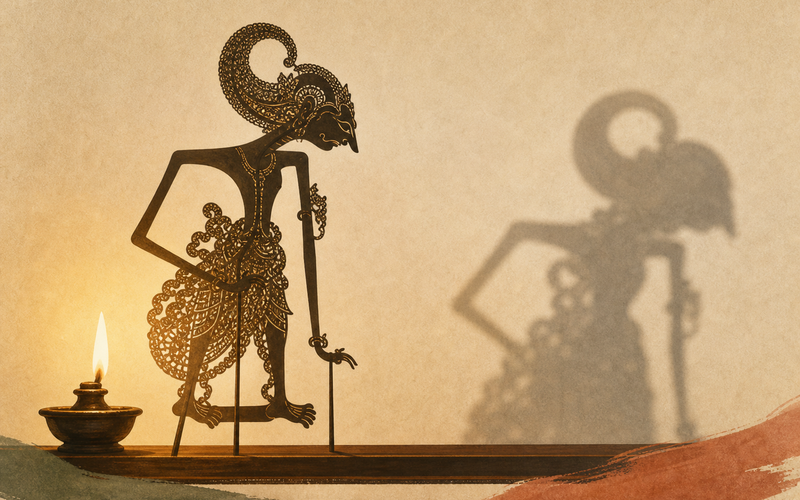
Javanese wayang kulit is often introduced as a shadow-puppet theatre, but that description captures only part of its meaning. In performance, carved leather figures, gamelan music, stylized speech, and a lit screen create a complete environment for reflection. Audiences may come for many reasons: to honor a family celebration, to enjoy a night of storytelling, to hear a skilled dalang, or to participate in an event with older ritual associations. Because of that layered setting, wayang kulit has long occupied a place between art, moral instruction, and spiritual experience.
Its spiritual meaning does not rest on a single doctrine shared by all performers or audiences. Rather, it emerges from the way the form has been understood in Javanese cultural life. UNESCO describes wayang as a long-lived storytelling tradition that transmits moral and aesthetic values, while Britannica notes that performances in Java can carry mystical and religious connotations not found everywhere else in Southeast Asia. For museum interpretation, that is the key starting point: wayang kulit is spiritually significant not because it is reducible to ritual alone, but because it gives visible form to ideas about cosmic order, ethical conduct, and the relationship between the seen and unseen.
A Living Tradition of Moral and Spiritual Instruction
One reason wayang kulit is often interpreted spiritually is that the performance has historically been treated as more than entertainment. UNESCO's description of wayang emphasizes the role of the dalang and the way the repertory transmits moral and aesthetic values through story, language, and music. This suggests that a performance is not only an occasion for amusement. It is also a setting in which communities encounter inherited ideas about justice, self-control, loyalty, duty, and the consequences of disorder.
That moral dimension matters because spiritual life in Java has often been expressed through cultivated behavior rather than through abstract theology alone. A wayang performance presents exemplary characters, difficult choices, comic criticism, and moments of emotional intensity that invite reflection on right conduct. Even when audience members disagree about interpretation, the event encourages them to measure human action against larger ideals. In that sense, the spiritual meaning of wayang kulit often lies in ethical contemplation: the stories ask not only what happened, but what kind of life should be lived.
Shadow, Light, and the Javanese Performance Cosmos
The visual arrangement of wayang kulit has encouraged symbolic readings for generations. The puppets move between lamp and screen, producing shadows that are more familiar to many spectators than the painted figures themselves. Britannica's discussion of shadow theatre notes that the screen may be interpreted as heaven, the stage base as earth, the puppets as human beings, and the puppeteer as a godlike controlling presence. Whether or not every spectator thinks in exactly those terms, this symbolic framework helps explain why the medium so readily invites spiritual reflection.
The logic of shadow and illumination is especially powerful in a museum context because it makes material objects carry metaphysical suggestions. The puppets are made from leather, horn, pigment, and careful carving, yet their fullest presence appears in projected form. What the audience sees is both object and image, body and trace. This tension between substance and shadow resonates with broader Javanese habits of thought in which outward form may point toward inner reality, and visible action may reveal only part of a deeper order.
The Dalang as Mediator and Custodian of Meaning
At the center of the performance is the dalang, whose role helps explain why wayang kulit can be described in spiritual terms. UNESCO emphasizes that the dalang must command a vast repertory, recite narrative passages, manipulate the puppets, and shape the total performance with wit and authority. The dalang is therefore more than a technician. He is the person who animates the dramatic world, coordinates the gamelan, gives voice to many characters, and interprets inherited stories for the present community.
This mediating role has long earned the dalang unusual respect. In many discussions of Javanese performance culture, the puppeteer is understood as a cultivated person whose knowledge is literary, artistic, and moral at once. Some performances are associated with rites such as ruwatan, while others are staged for weddings, commemorations, or public festivals. The meanings of these occasions differ, but the recurring pattern is clear: the dalang stands at the point where story, ceremony, and communal expectation meet. That position lends the performance an authority that can feel spiritual even when the event is not narrowly religious.
Epic Narratives and the Discipline of Inner Character
Wayang kulit stories draw from several narrative worlds, including the Ramayana, the Mahabharata, local cycles, and later adaptations. UNESCO notes this layered repertory, while Britannica points out that many of the best-known plays in Java are local developments rather than simple retellings of Indian epic. This is important because the spiritual meaning of wayang lies not in preserving a frozen scripture, but in reworking inherited stories so that they continue to illuminate present concerns. The epics offer a language for thinking about power, temptation, loyalty, and rightful action.
In performance, these themes are not presented as abstract lessons alone. They are embodied through voice, gesture, musical mood, and the contrast between refined and coarse characters. Noble restraint, comic interruption, heroic doubt, and destructive excess all become audible and visible patterns. Spiritual meaning therefore emerges through aesthetic form. Audiences are asked to feel the difference between balance and disorder, patience and aggression, wisdom and vanity. That emotional education is part of why wayang kulit has remained such a powerful vehicle for moral imagination.
Ritual Atmosphere, Occasion, and Community
The spiritual significance of wayang kulit also depends on context. Britannica notes that performances may be commissioned for major occasions and can be interpreted in religious or mystical ways. In practice, this means that the same artistic tradition can function differently depending on the host, the locality, the story chosen, and the purpose of the event. A village celebration, a courtly performance, a tourist presentation, and a ritualized ruwatan do not carry identical meanings, even when they share instruments, puppets, and narrative conventions.
That variation should not be treated as a weakness. It is one reason wayang has endured. The tradition can move between sacred atmosphere and public festivity without losing its depth. Humor and political commentary can appear alongside solemn instruction. Comic servants may speak in ordinary language while heroes remain tied to elevated speech and epic time. This capacity to join everyday life with older cosmological ideas gives wayang kulit much of its spiritual force. It reminds audiences that the unseen is not separate from the social world, but woven into it through performance.
Why the Spiritual Reading Still Matters
Today, wayang kulit is also performed on modern stages, in educational programs, on digital media, and in shortened formats adapted to contemporary audiences. UNESCO has supported safeguarding efforts precisely because the tradition must compete with other forms of entertainment and because some of its older features risk being weakened. Yet the continuing vitality of wayang suggests that its spiritual meaning has not disappeared. Instead, it survives through reinterpretation, through the continued authority of master performers, and through the ability of the form to make ethical questions feel collective and urgent.
For museums, curators, and readers, a spiritual interpretation of wayang kulit should therefore remain careful and plural rather than romanticized. Not every performance is equally ritualized, and not every audience member seeks the same depth of meaning. Even so, Javanese wayang kulit continues to matter because it stages a world in which art is never only decorative. Through shadow, sound, and story, it invites people to think about invisible values, disciplined conduct, and the fragile balance between human action and a greater order.
Related Reading
For historical background, see the history of Indonesian shadow puppet storytelling. For symbolism and character interpretation, read Wayang Kulit and the Javanese worldview and Wayang Kulit symbolism.
Conclusion
The spiritual meaning of Javanese wayang kulit performances lies in their ability to unite material craft with moral and metaphysical reflection. Leather puppets, a lamp, a screen, epic stories, and the authority of the dalang together create a performance language through which communities can consider character, cosmos, and responsibility.
That meaning is not fixed in one formula. It changes with context, patronage, locality, and interpretation. Yet across those differences, wayang kulit remains spiritually powerful because it turns performance into a space where the visible and invisible, the entertaining and the serious, and the communal and the inward are brought into relation.