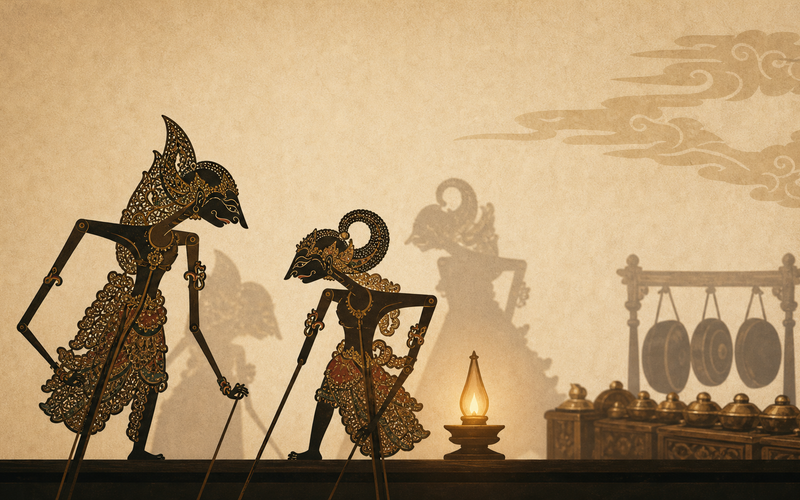
Wayang kulit is often described simply as Javanese shadow-puppet theatre, but that definition identifies only its medium. The tradition is also a symbolic system in which shape, sound, placement, voice, and story work together. A carved leather figure does not speak through realism. It speaks through convention. Audiences recognize character not because a puppet copies ordinary life, but because its posture, facial profile, costume, and movement signal moral quality, rank, temperament, and dramatic role.
This helps explain why symbolism is so central to wayang kulit. UNESCO describes wayang as an ancient storytelling tradition in which puppeteers transmitted moral and aesthetic values, while Britannica notes the form's mystical and religious connotations in Java. For museum interpretation, symbolism is therefore not a decorative extra added on top of performance. It is one of the main ways the tradition communicates. Hidden meanings in wayang are not fully hidden in the modern sense of secrecy; rather, they are embedded in conventions that become legible through repeated cultural knowledge.
Shadow as More Than Illusion
The most obvious symbol in wayang kulit is the shadow itself. Britannica notes that the term wayang is connected with "shadow" and that performances are watched as figures cast onto a screen lit from behind. This staging immediately creates a doubled world: the leather puppet exists as an object, yet the audience often encounters it as an image. In symbolic terms, that difference matters. Viewers do not see only what something is made of; they see what it becomes in performance.
Because of that, shadow in wayang kulit can suggest mediation between visible and invisible realities. The material puppet is solid, colored, carved, and handled by the dalang, but on the screen it becomes simplified and transformed. The result is well suited to stories about moral testing, cosmic order, and unseen power. A shadow is present and absent at the same time. It allows the performance to represent heroic struggle, interior conflict, and spiritual atmosphere without relying on naturalistic illusion.
The screen deepens that symbolism. It is both a practical surface and a boundary. Audiences may watch from either side, but the shadow side has traditionally been prized for its visual clarity. In this arrangement, wayang kulit invites reflection on how truth is perceived indirectly. Meaning emerges through projection, voice, music, and interpretation rather than through literal depiction alone.
Puppet Design and Moral Character
Wayang kulit puppets are highly stylized, and that stylization is one of the clearest symbolic languages in the form. Britannica describes wayang kulit figures as elaborately painted leather puppets, and even a brief comparison among characters shows that design choices are purposeful. Noble heroes often appear with refined facial lines, lowered eyes, and controlled posture, while rougher or more aggressive characters may have wider eyes, heavier bodies, stronger gestures, or more forceful profiles. These conventions are not photographic portraits. They are visual arguments about character.
For that reason, wayang symbolism is closely tied to ethics. Physical form indicates inner disposition, self-mastery, and social refinement. A spectator trained in the tradition can read difference quickly: composure is shown differently from arrogance, and disciplined strength differently from unruly violence. The puppet body becomes a compressed moral vocabulary. Even when details vary between regions and workshops, the broader principle remains stable: visual form helps guide interpretation before a character speaks.
This is also why wayang figures are powerful museum objects even outside performance. Their proportions can look unfamiliar to viewers expecting realism, yet those departures are meaningful. Elongated arms, delicate hands, or angular profiles are part of a design system that turns appearance into narrative and moral signal.
The Gunungan and the Shape of the World
Among the most symbolically charged figures in wayang kulit is the gunungan, also known as the kayon. The British Museum describes a Javanese gunungan as representing a "Tree of Life" or cosmic mountain, and notes that it can also be used to suggest a mountain, fire, an ocean wave, a cave, or a windstorm. This flexibility helps explain its importance. The gunungan is not only one object within the story. It is a device for representing the world itself and the changing states of the world.
In performance, the gunungan helps mark beginnings, endings, and transitions. That practical role is inseparable from its symbolic role. It can stand for the cosmos before the story unfolds, for a landscape through which action moves, or for upheaval when the dramatic world changes. Rather than isolating scenery from meaning, wayang condenses both into a single emblem. The audience sees not just a scenic marker, but a sign that order, motion, danger, or renewal is being announced.
This makes the gunungan especially revealing for the study of Indonesian visual culture. It shows how wayang can transform one figure into many layers of significance at once. A museum label may call it a prop, but within the logic of performance it is also a cosmological image, a temporal marker, and an interpretive bridge between narrative episodes.
The Dalang as Interpreter of Symbolic Meaning
Wayang symbolism does not reside only in objects. It also depends on the dalang, the master puppeteer who activates and interprets the performance. UNESCO emphasizes that dalang are expected to command a vast repertory, manipulate the puppets, and transmit moral and aesthetic values. That means symbolism in wayang kulit is never fully automatic. The same puppet can carry different emotional weight depending on pacing, vocal tone, musical support, and context.
This interpretive role is crucial because wayang is a living tradition, not a fixed museum codebook. A dalang controls entrances, confrontations, pauses, and transitions, shaping how symbolic contrasts are felt by the audience. The placement of figures on the screen, the rhythm of speech, and the timing of comic interruption all affect meaning. Britannica notes that good characters are introduced on one side and evil ones on the other, but the dramatic force of that contrast still depends on performance.
The dalang therefore stands between inherited symbolism and present understanding. He preserves convention, but he also renews it. This is one reason wayang has remained culturally durable. Hidden meanings survive not because they are frozen, but because trained performers continue to make them legible in changing social settings.
Story Worlds, Epics, and Local Interpretation
Wayang stories borrow from several narrative sources. UNESCO notes that the repertory includes indigenous myths, Indian epics, and even heroes from Persian tales, while Britannica points out that many Javanese stories are local elaborations rather than direct repetitions of Indian originals. This matters for symbolism because story itself is part of the meaning system. Characters and episodes carry ethical associations accumulated over generations.
The symbolism of wayang is therefore narrative as well as visual. A confrontation is not just a fight scene. It can symbolize the testing of discipline, the struggle between order and disorder, or the obligations of kinship and rule. Comic servants may bring social criticism into epic time, allowing ordinary speech to comment on elevated worlds. UNESCO notes that comic characters have historically provided a way to address sensitive political and social issues, showing that symbolism in wayang also includes indirection and layered public speech.
Such narrative layering keeps the form intellectually rich. A single performance can present courtly ideals, popular humor, inherited myth, and present-day commentary together. Hidden meaning in this context does not mean obscure meaning. It means that several levels of meaning can coexist without being reduced to one explanation.
Why Symbolism Still Matters
Modern audiences encounter wayang kulit in many settings, from village celebrations and formal cultural events to museums, classrooms, and recorded media. UNESCO has also noted pressures from newer entertainment forms, which can encourage changes in pacing and emphasis. Yet symbolism remains vital because it is one of the reasons the form continues to reward sustained attention. The puppets are not interchangeable figures. The screen is not a neutral backdrop. The stories are not only plots. Each element is part of a broader language of signs.
For museums, this has an important consequence. Wayang kulit should not be presented only as heritage craft, although its craftsmanship is extraordinary. It should also be interpreted as a performance tradition in which objects achieve meaning through relation: puppet to light, voice to gesture, gunungan to transition, epic narrative to local commentary. The hidden meanings of shadow and story are therefore best understood as relational meanings. They emerge through performance, memory, and cultural literacy.
Conclusion
Wayang kulit symbolism lies in the interplay between material object and projected image, stylized body and moral character, cosmological emblem and dramatic action. Through shadow, puppet design, narrative convention, and the authority of the dalang, the tradition turns performance into a language of layered signs.
That language has never been entirely fixed, and that is part of its strength. The meanings of wayang kulit remain durable because they are carried by performance rather than by static explanation alone. In shadow and story, Javanese theatre continues to make ethics, cosmology, and social thought visible without surrendering their depth.