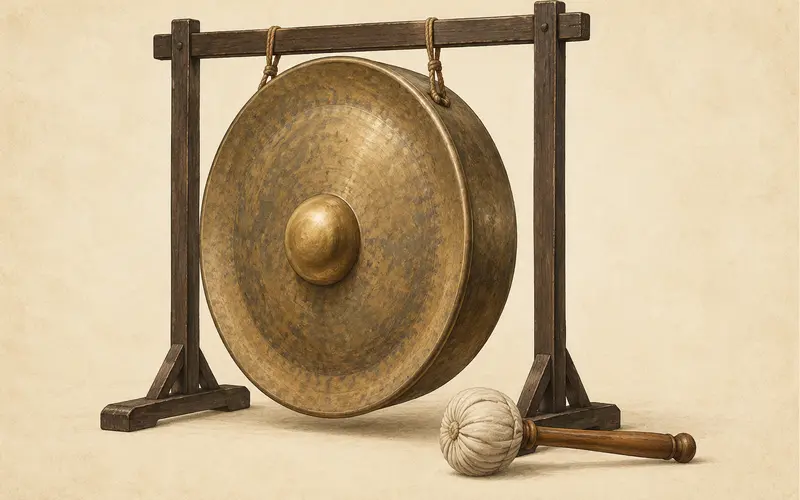
Javanese bronze gongs are struck metal instruments made for gamelan ensembles, with large hanging gongs marking musical cycles and smaller gong forms taking other ensemble roles. This article focuses on Central Java: the makers of Wirun in Sukoharjo and the musical and heirloom traditions documented at the Yogyakarta court. A gong connects three kinds of knowledge: shaping metal, listening to resonance, and knowing when a stroke belongs in a performance.
For the ensemble around the instrument, begin with gamelan music and its cultural settings. The wider collection is Music and Dance.
A Bossed Gong Is a Shaped Sounding Body
The familiar hanging gong has a raised central boss and a deep rim that turns inward at the back. It hangs vertically and is struck with a padded beater. Roger Vetter's instrument glossary documents this construction for the gong siyem, also called suwukan. His survey of Yogyakarta ensembles identifies the gong ageng as the largest gong, sometimes a metre or more across. Instrument glossary, palace ensemble survey.
Size alone does not explain the instrument. The central boss provides a striking surface; the surrounding face and rim participate in its vibration. Risnandar's study at ISI Surakarta names the boss pencu and the face rai, describing the adjustment of different regions of the sounding body. Risnandar, pp. 54–57.
Casting, Forging, and Finishing in Wirun
Bronze here combines copper and tin. A 2021 study of Wirun Palu Gongso maps the making of a Javanese kempul through melting, casting, cooling, forging and inspection, pemetakan, finishing, and tuning. The authors report comparable production routes for gong, bonang, and kenong, with difficulty and time increasing with size. Citrawati and colleagues, pp. 36–37.
Casting is therefore one stage in a longer process. The solidified metal is worked further before the finished instrument is accepted for its sound. This makes gong production a useful companion to traditional metal casting in Java: an instrument's manufacture includes substantial work after the pour.
The labor belongs to identifiable communities. Fauziah, Rinawati, and Hastuti studied three production houses in Wirun, Mojolaban, Sukoharjo, in early 2021. They describe melting, molding, forging, and finishing, and identify the physical effort of lifting materials and hammering unfinished instruments. Citrawati's team also records noise as a priority for improvement. These workshop studies bring makers' working conditions into the history of the finished bronze. Wirun workforce study, workshop study.
Tuning Means Listening to More Than Pitch
Pelarasan, tuning, joins metalworking to musical judgment. Risnandar describes adjusting the gong's face and adjacent regions to obtain the intended sound, including its audible ombak, or pulsation. His research draws on tuners, owners, and musicians, treating their practical knowledge as the basis of the account. Risnandar.
A study by Rahmat Alkausar and Hendra Setiawan tested four tuning points on one 70-centimetre suwukan. In that experiment, adjustments changed amplitude, tone duration, and pulsation while the measured fundamental and dominant frequencies remained unchanged. Its result gives a concrete reason to listen beyond a single pitch reading: how a gong sustains and pulses can matter to its tuning. Suwukan acoustic study.
The target also belongs to an ensemble. Vetter explains slendro and pelog as tuning models, with individual gamelans realizing them differently. Palace tuning models. That relationship helps explain why exchanging an instrument between sets is a musical decision. For the broader regional comparison, see Javanese and Balinese gamelan.
Musical Time and the Life of an Heirloom
Gongs make the structure of a performance audible. The Smithsonian's commentary identifies the cycle between great-gong strokes as a gongan, subdivided by smaller gongs such as kenong and kempul. Its example, Ladrang Sri Widada, has thirty-two beats per gongan. Its recording of a Yogyakarta ensemble, made on 1 November 2013, offers a listening context for these objects alongside voices, strings, and other percussion. Smithsonian performance and commentary.
At the Yogyakarta court, some sets also have the status of pusaka, heirlooms. Vetter records offerings commonly directed toward their gong ageng when ensembles are moved or played ceremonially. His photograph documents offerings to K.K. Gunturmadu during the opening of Sekaten on 21 December 1982. This is evidence of a particular court practice, rather than a meaning assigned to every bronze gong. Vetter's field account.
An heirloom ensemble can retain its identity through replacement of individual instruments. In a 1982 conversation, the court tuner R.R. Mangkuasmara told Vetter that K.K. Gunturmadu's two large gongs had been made during the Seventh Sultan's reign as replacements. The inherited history of a set and the age of each metal component are therefore different questions. Palace maintenance history.
What a Museum Can Show—and Let Us Hear
A documented collection object anchors the comparison. The Metropolitan Museum of Art's Bonang Barung or Kromo, accession 89.4.777a–c, is catalogued as Javanese, late nineteenth century, with bronze, wood, felt, and polychrome materials. Its horizontal gong arrangement presents another form within gamelan's material world. Met collection record.
For a hanging gong, a useful display connects the boss and rim to the maker's work, its sound to the ensemble, and its history to named owners or performers. A recording can supply what the silent surface cannot: the stroke, the sustained resonance, and the next entrance in the musical cycle. Together, these make bronze legible as a material shaped for collective listening.