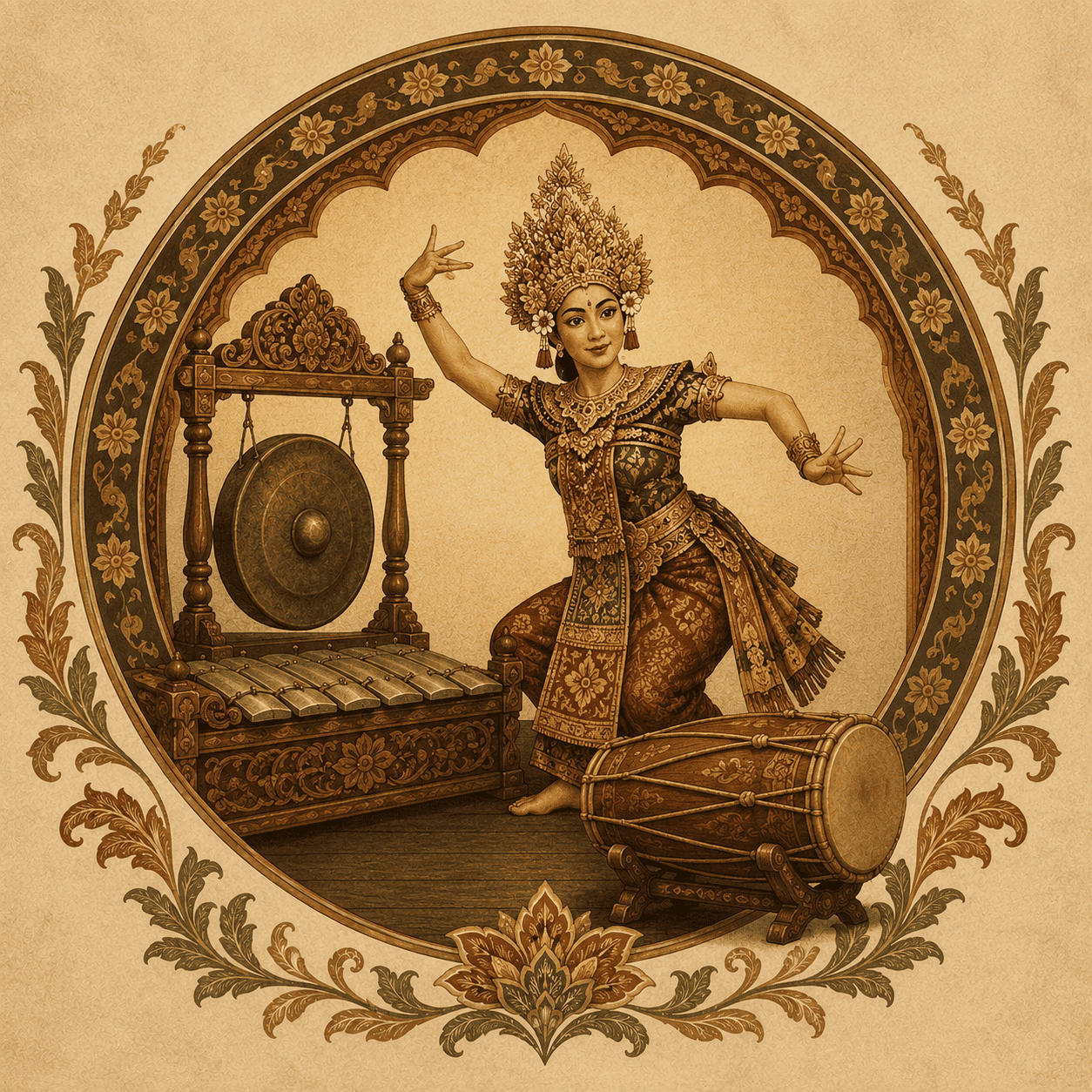
Music and Dance is designed as an editorial pathway for slow reading about gamelan, court dance, ritual movement, ceremonial rhythm, sound, gesture, and embodied memory in Indonesian performance traditions, not simply a list of articles. This page helps readers trace how objects, practices, and historical interpretation connect across time. Gamelan, court dance, ceremonial movement, and sound in cultural memory. Framed this way, each article becomes part of a wider conversation about memory, identity, technique, belief, and the changing meanings attached to Indonesian heritage in museums, local communities, and public history.
The topic currently includes 7 articles, including Caci of Manggarai: Ritual Combat, Performance, and Community in Flores, Sasando Music and Rote Island's Cultural Memory and Angklung and Community Music in West Java. It will continue to grow as new objects, references, and comparative sources are added. Each entry is prepared with attention to source transparency: what can be documented, what remains interpretive, and how an object or practice can be read in relation to the people who made, used, inherited, collected, or described it. When sources disagree or leave gaps, those limits are treated as part of the historical record rather than hidden behind a smooth summary.
The distinctive focus here is gamelan ensembles, Javanese and Balinese court dance, eastern Indonesian ritual dances, ceremonial movement, and musical discipline. A museum approach matters because material culture rarely carries only one meaning. One object may be a practical tool, a marker of rank, a ritual instrument, evidence of exchange, or a vessel of family memory. The purpose of this Music and Dance page is to make those layers visible without forcing them into a single fixed explanation.
In practical terms, this landing page works as a map. Readers can begin with one article, then compare terms, materials, regions, visual styles, social functions, and historical sources across the rest of the section. The goal is not just to deliver isolated facts, but to build cumulative understanding from one article to the next. In that sense, the topic becomes a living archive: open to refinement, correction, and new research as the collection develops.