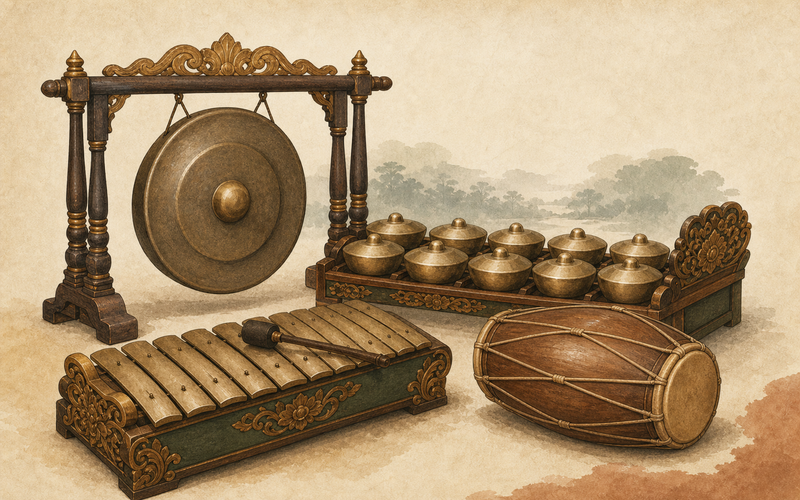
Gamelan is one of Indonesia's most recognizable musical traditions, but it is best understood as a family of ensemble practices rather than a single sound. In Java and Bali, and in related forms elsewhere, gamelan brings together tuned bronze or iron instruments, gongs, drums, melodic elaboration, and carefully coordinated listening. It can accompany ceremony, court dance, wayang theatre, processions, village events, and modern performance.
For readers searching for the cultural significance of gamelan music, the key point is simple: gamelan matters because it organizes social time. It marks entrances, transitions, ritual moments, dramatic moods, and communal attention. UNESCO recognizes gamelan as Indonesian intangible cultural heritage, while Britannica describes it as an Indonesian orchestra type associated especially with Java and Bali. A museum view should therefore ask not only what the instruments are, but what kinds of relationships they create among performers, dancers, puppeteers, hosts, and audiences.
What Gamelan Is
A gamelan is an ensemble of instruments tuned to work together as a set. Britannica notes that gamelan consists largely of gongs and tuned metal instruments struck with mallets, with instruments such as bonang, gambang, metallophones, suling, rebab, voices, and kendang appearing in different contexts. The kendang, or drum, often has a leading role because it shapes tempo and coordinates movement, especially in dance or theatre.
This structure makes gamelan different from an orchestra tuned to a universal pitch standard. Individual gamelan sets are tuned for their own internal balance. Official Kraton Yogyakarta material describes court gamelan as a Javanese ensemble using pentatonic slendro and pelog systems, with instruments such as kendang, bonang, gender, gambang, suling, siter, slenthem, demung, saron, gong, kenong, kethuk, kempyang, kempul, and peking. Balinese and Sundanese traditions have their own histories, instruments, and sound ideals, so the identity of an ensemble is partly built into the instruments themselves.
For a closer look at one melodic instrument, see the bonang’s structure, sound, and role in Javanese gamelan, including its gong rows and mipil and imbal techniques.
Why Gamelan Sounds Layered
Many listeners first notice the shimmering texture of gamelan. That texture comes from interlocking parts rather than from one melody being played by everyone at once. Some instruments outline a central melodic framework, others elaborate it, and gongs mark important points in the musical cycle. Britannica identifies this punctuation of musical time as a major feature of gamelan structure.
This layered sound has cultural significance because it depends on disciplined cooperation. Each musician contributes a part that may sound incomplete alone but becomes meaningful inside the whole. It is tempting to turn this into a simple metaphor for harmony, but museums should be more precise. Gamelan teaches coordinated attention: performers must listen across the ensemble, respond to the drummer, understand cyclical time, and support the larger occasion.
Ceremony, Dance, and Wayang
Gamelan is closely tied to performance settings. In Java, it accompanies court dance, wayang kulit, wayang wong, ceremonial processions, and public events. In Bali, gamelan is deeply embedded in temple festivals, dance-drama, and communal ritual life. These settings are not interchangeable. Javanese court performance often values controlled refinement and measured pacing, while many Balinese styles are known for dynamic energy and dense rhythmic interaction.
Wayang offers one of the clearest examples of gamelan's cultural work. In shadow puppet theatre, music does not merely decorate the story. It supports the dalang, marks emotional shifts, accompanies character entrances, and helps audiences move through a long performance. Readers interested in this connection can continue with the history of Indonesian shadow puppet storytelling and the spiritual meaning of Javanese wayang kulit performances.
Courts, Villages, and Regional Difference
Gamelan traditions developed in both courtly and community settings. The royal courts of Yogyakarta and Surakarta became important centers for preserving certain Javanese repertories, dance forms, and ceremonial uses. There, gamelan was part of a broader courtly system that also included etiquette, textiles, heirlooms, and architecture. See also Indonesian royal court traditions in Yogyakarta and Surakarta.
For Yogyakarta specifically, Kraton sources distinguish Gangsa Ageng from Gangsa Pakurmatan, the latter used for important and sacred processions. This kind of local terminology helps keep court claims grounded in a documented place rather than treating all Javanese gamelan as interchangeable palace music.
Village and temple contexts matter just as much. Gamelan can belong to local communities, religious institutions, schools, and neighborhood groups. In Bali, ensembles may be tied to banjar organization and temple calendars. In Java, community groups can perform for social events, public commemorations, or training. Treating gamelan only as palace music would miss the breadth of its social life.
Instruments as Museum Objects
In a museum, gamelan instruments are visually compelling: bronze keys, suspended gongs, carved frames, drums, and resonators all invite close looking. Yet these objects were made for sound and coordination. A silent gong in a case can show craftsmanship, but it cannot fully communicate timing, vibration, ensemble tuning, or the relationship between music and movement.
Good interpretation therefore connects object and performance. Labels should explain the role of each instrument, the ensemble context, and the occasion for which it might be used. If an article or gallery uses images, useful alt text should identify specific instruments where possible, for example: "Javanese gamelan instruments with bronze metallophones and hanging gongs used in ensemble performance." Avoid vague descriptions such as "traditional Indonesian instruments" when the region or ensemble type is known.
For the workshop processes behind these instruments, see Javanese bronze gongs: casting, forging, and tuning, which connects evidence from Wirun with the musical and heirloom life of Yogyakarta gamelan.
Gamelan Today
Gamelan remains a living practice. It is taught in Indonesian communities, arts schools, universities, and international ensembles. UNESCO recognition has helped draw attention to safeguarding, but the tradition depends on everyday transmission: teachers, instrument makers, performers, dancers, puppeteers, and audiences who keep repertories meaningful.
Modern performance does not make gamelan less traditional. New settings can preserve older knowledge while adapting length, staging, or audience expectations. The careful point is that change should not erase the difference between regional styles or the discipline required to perform them. Gamelan survives because it is both inherited and practiced.
For readers and visitors, this also means that a short clip or single instrument cannot stand for the whole tradition. The meaning of gamelan becomes clearer when sound, occasion, regional style, and ensemble discipline are understood together.
Related Reading
For a focused comparison, continue with Javanese and Balinese gamelan. For performance contexts, see Indonesian court dances, royal court traditions in Yogyakarta and Surakarta, and the history of Indonesian shadow puppet storytelling. The wider cluster is Music and Dance.
Conclusion
The cultural significance of gamelan music lies in the way it joins sound, place, ceremony, and social cooperation. It is an Indonesian ensemble tradition with deep roots in Java and Bali, but it should never be reduced to a single generic "Asian music" sound. Its instruments, tuning, rhythms, and performance contexts all carry specific histories.
For museum audiences, gamelan is especially valuable because it shows how intangible heritage lives through material things. The bronze key, the gong, the drum, and the carved frame matter because they make collective action audible. Gamelan is not only music to hear; it is a cultural system for gathering, timing, remembering, and performing together.