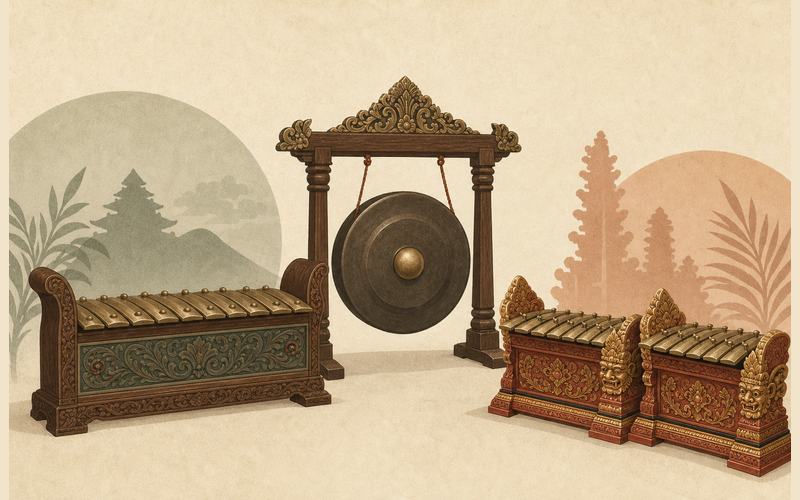
Gamelan is one of Indonesia's most recognizable sound worlds, yet it is best understood not as a single fixed orchestra but as a family of ensemble traditions. Java and Bali are especially important in this story. Both islands are associated with sets of tuned metallophones, knobbed gongs, drums, and other instruments that are played in carefully coordinated patterns. Both traditions also connect music to dance, theatre, ceremony, teaching, and public identity. For museum interpretation, this makes gamelan a rich subject because each instrument is both a crafted object and a participant in collective sound.
The comparison between Javanese and Balinese gamelan should begin with kinship rather than opposition. These traditions share materials, instrument types, and broad musical ideas, but they have developed within different social landscapes. Javanese gamelan is often associated with courts, wayang kulit, refined movement, and long forms of musical patience. Balinese gamelan is often associated with temple ceremonies, dance drama, village organizations, and brilliant rhythmic energy. These descriptions are useful starting points, but they should be handled with care, because both islands contain many local styles and historical layers.
A Shared Ensemble Language
The most obvious similarity is the idea of the ensemble itself. A gamelan is not simply a collection of separate instruments that happen to play together. Its bronze keys, gong chimes, large hanging gongs, drums, flutes, voices, and sometimes bowed or plucked strings are tuned and understood as a set. The identity of the music depends on interdependence: one part marks the main melody, another elaborates it, the drums guide motion, and the gongs articulate larger cycles of time.
This ensemble thinking gives gamelan a strong social meaning. Musicians must listen across the group, adjusting touch and timing so that the whole texture breathes as one. In Java and Bali, that discipline can become a cultural model for coordination, hierarchy, and mutual attention. A museum display that isolates a single saron, gender, gong, or kendang can show craftsmanship, but it also needs to remind visitors that the object was made for relationship.
Tuning, Scales, and Local Sound
Javanese and Balinese gamelan are frequently discussed through the tuning systems called slendro and pelog. In broad terms, slendro is often described as a five-tone system and pelog as a seven-tone system from which pieces may select particular tones. Yet these labels should not be mistaken for the standardized scales of a piano. Gamelan tuning is normally local to the set, and two ensembles that are both called slendro or pelog may still differ in pitch and interval.
That local tuning is central to the character of the music. In Java, a courtly ensemble may be valued for a resonant, balanced sound that supports long melodic unfolding. In Bali, paired metallophones are often tuned slightly apart so that their combined sound produces a shimmering wave of vibration. This does not make one tradition simpler or more advanced than the other. It shows how different communities have cultivated different ideals of resonance, precision, and musical brightness.
Javanese Gamelan and Courtly Reflection
Javanese gamelan is strongly connected to the courts of Central Java, especially Yogyakarta and Surakarta, although it also lives in villages, schools, radio, universities, and diaspora communities. In courtly settings, gamelan may accompany dance, poetry, ceremonies, and theatrical forms. Its sound is often described as spacious or meditative because many pieces give listeners time to hear the relationship between a core melody and its surrounding elaborations.
Wayang kulit, the Javanese shadow-puppet theatre, shows this relationship especially clearly. The gamelan does not merely decorate the story. It helps shape atmosphere, transitions, character entrances, battle scenes, comic passages, and moments of emotional reflection. The dalang, or puppeteer, works with the musicians as a dramatic and musical leader. In this setting, gamelan becomes a partner in storytelling, moral interpretation, and night-long communal attention.
Balinese Gamelan and Ceremonial Energy
Balinese gamelan is also diverse, but many visitors first encounter it through the vivid power of gong kebyar, dance accompaniment, or temple processions. Balinese ensembles are often praised for rapid interlocking patterns, sudden changes in dynamics, and sharply coordinated accents. The technique commonly called kotekan, in which paired parts interlock to create a fast composite line, is one reason the music can seem to flash and surge.
This energy belongs to social life as much as to musical style. In Bali, gamelan is closely tied to temple festivals, processions, dance drama, life-cycle ceremonies, and village-based artistic organizations. Different ensembles may be associated with different ritual or performance needs, from older sacred repertories to modern public stages. The result is a sound world in which virtuosity, devotion, communal labor, and display can meet in the same performance.
Instruments as Museum Objects
In a museum, gamelan instruments can be visually compelling: carved wooden frames, bronze keys, suspended gongs, painted details, and signs of repeated use all invite close looking. But they can also be misunderstood if they are treated only as decorative sculpture. A gong is not only a circular bronze form. It is a time-marker, a center of resonance, and often a prestigious object within the ensemble. A metallophone key is not only a shaped bar. It belongs to a tuned system and a learned technique of striking and damping.
Good interpretation therefore connects object, hand, ear, and occasion. Visitors need to know how a musician sits at the instrument, how mallets are held, why damping matters, and how one part fits into the whole. Audio, video, diagrams, and community voices can help restore the ensemble context that a silent display case removes. This is especially important because gamelan knowledge is transmitted through practice, memory, correction, and participation rather than through notation alone.
Similarities Without Flattening Difference
The shared vocabulary of gongs, metallophones, drums, cycles, and collective timing can make Javanese and Balinese gamelan look similar at first glance. That similarity is real. Both traditions teach listeners to hear music as layered time rather than as a single solo line. Both connect sound to forms of etiquette, ceremony, and embodied training. Both have also traveled internationally through conservatories, community ensembles, recordings, and museum programs.
At the same time, comparison should not flatten difference. Javanese gamelan is not always slow, and Balinese gamelan is not always fast. Java has regional and popular traditions beyond the courts, while Bali has older and quieter ensembles as well as explosive modern ones. The better comparison is not a list of stereotypes, but a study of how related musical tools have been shaped by different histories of court patronage, temple obligation, village organization, tourism, education, and performance.
Cultural Roles Today
Today, gamelan continues to serve local communities while also circulating globally. In Indonesia, it can accompany ceremonies, dances, theatre, state occasions, education, and contemporary composition. Outside Indonesia, gamelan ensembles often introduce students and audiences to forms of musical cooperation that differ from Western orchestral habits. These international settings can create respect and curiosity, but they also require careful attention to context, teachers, and living cultural authority.
For museums, the responsibility is to present gamelan as living heritage rather than as a frozen remnant of the past. The instruments may be old, but the tradition is not only historical. It is practiced, revised, taught, and heard in new situations. Interpreting Javanese and Balinese gamelan together allows visitors to see both continuity and difference: a shared Indonesian ensemble imagination, and two richly developed cultural worlds of sound.
Conclusion
Javanese and Balinese gamelan are connected by bronze resonance, cyclic time, ensemble discipline, and deep cultural memory. Their differences matter because they show how music is shaped by place: by courts and temples, puppeteers and dancers, teachers and village groups, ceremonies and stages.
To compare them well is not to choose one as more authentic or more sophisticated. It is to listen for how each tradition makes community audible. In the museum, that means treating every instrument as part of a larger relationship between craft, sound, history, and living practice.