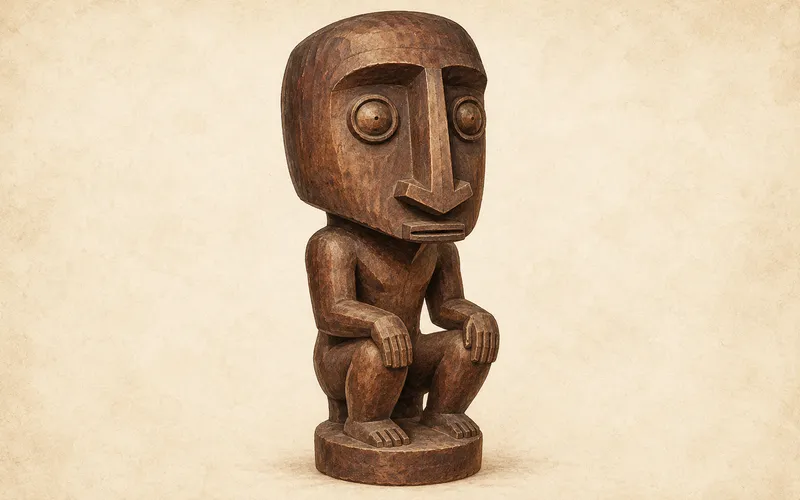
Korwar are carved ancestor figures associated with Cenderawasih Bay in northwestern New Guinea, within Indonesia. Historical museum accounts describe them as places where the spirits of deceased relatives could be invited and addressed. Their large heads, compact bodies, and strongly defined faces make many examples recognizable, but the category includes different regional forms and histories.
These figures belong to relationships between living people and particular deceased persons. Reading them simply as anonymous “tribal statues” loses that connection. A closer account asks where a figure came from, whose memory it served, how it was used, and what changed when it became an artwork or museum collection object.
Names and the Cenderawasih Bay Setting
An account from BPNB Papua uses the spelling karwar when discussing Biak culture and distinguishes the spirit from the carved representation, for which it also records amfyanir. Retaining these terms helps keep the discussion connected to local language rather than reducing every object to a generic religious category. Spellings in museum catalogues may differ. BPNB Papua: Karwar.
The geographical frame matters just as much. Cenderawasih Bay is a particular region, not a synonym for Papua as a whole. A figure attributed to Biak, Doreh Bay, or another locality should retain that information wherever it is available. Older collection records also preserve historical place names. Those names can help trace documentation, but readers should not mistake an old catalogue's administrative vocabulary for a current map.
Carved Form and Regional Differences
The British Museum's regional comparison describes seated figures among many Biak examples, standing or squatting figures with openwork shields around Doreh Bay, and enlarged heads associated with Wandammen Bay. Its own figure Oc1954,06.7 is attributed to Wandammen by style. That qualification is important: a stylistic attribution is an interpretation, not the same evidence as a recorded place of collection. British Museum: regional styles.
One Doreh Bay example, Oc1865,0503.3, shows a wooden figure seated behind a shield, with blue glass beads set into its eyes. Its recorded height is 28.4 centimetres. Wood and imported-looking materials need not belong to separate stories: the beads are part of this particular object's construction. Close looking begins with such visible features before moving to an explanation of what they meant. British Museum: Doreh figure.
Relatives, Presence, and Consultation
The Metropolitan Museum describes korwar as representations of recently deceased individuals, associated with inviting an ancestor's spirit for consultation or offerings. Its interpretation places these figures within family relationships. The spiritual presence described here belongs to the religious understanding of the users; it is not a physical property that a museum can establish by examining the wood. The Met: ancestral presence.
That distinction need not diminish the relationship. A carving can have been treated as a relative's presence even when a modern label describes it as sculpture. The interpretive task is to explain the historical practice in terms that preserve its significance. The museum's discussion of sacred objects considers comparable questions about material form and religious use without making different traditions interchangeable.
The Household, Journeys, and Skilled Makers
A British Museum record for a Biak figure preserves an older label describing korwar kept in houses and carried on journeys. Its curatorial commentary identifies a religious specialist, called mon, in making and consulting figures. These details connect the object to both a domestic setting and occasions when people sought guidance beyond the home. They should be attributed to the historical account rather than assumed to describe every present-day household. British Museum: Biak figure.
The Bowers Museum likewise connects carving skill with religious expertise and describes the creation of korwar as selective. This helps avoid imagining an automatic, identical commission after every death. An object biography should ask who commissioned and made the figure, if that information survives. The category name alone cannot recover the identity of the deceased or establish the decisions that led to its making. Bowers Museum: making and selection.
Interpreting the Large Head
BPNB Papua records Biak cultural commentator Micha Ronsumbre's explanation of the large head: it expresses the importance of thinking before acting. In the Met's audio interpretation, Insos Ireeuw connects the head with a person's thoughts and memories. These are attributed explanations, offered by named voices, rather than a single universal code that can be mechanically applied to every carving. BPNB Papua, The Met audio.
The proportions also invite careful visual description. The head can dominate the silhouette while the torso and limbs remain compact. Calling those choices “primitive” explains nothing about their deliberate arrangement. A visitor can first notice scale, posture, and the relationship between solid wood and open space, then ask which interpretation is supported for the specific figure. Not every facial feature needs an invented symbolic meaning.
Collection Histories and the Limits of Labels
The Doreh figure entered the British Museum in 1865 through a donation by C. J. Jessop; the acquisition notes say the donor's brother collected the group. This establishes part of its museum history, but does not by itself describe the circumstances of its original transfer. A donation date should not be presented as a carving date, and a named European donor should not displace the unnamed maker. British Museum: acquisition record.
Harvard's Peabody Museum provides another reminder about documentation. Its korwar entry includes older descriptions alongside an explicit notice that historical collection language may be offensive or discriminatory. Such wording is evidence of earlier cataloguing practices, not neutral terminology to repeat uncritically. A useful label distinguishes what was observed, what was inferred, and what remains unknown. Peabody Museum: collection record.
Later Carving and Cultural Continuity
The Asia and Pacific Museum in Warsaw documents a korwar kaku, MAP 21633, made on Biak in the 1990s by a member of the Ronsumbre family. Its catalogue states that the carving did not serve the earlier ritual purpose while remaining connected with an important religious tradition. This specific example prevents a simple equation between continuity of form and continuity of use. Museum? What for?, pages 44–45.
Later work deserves identification on its own terms. A modern carving need not be mislabeled as ancient to matter, while a historical ritual figure should not be reduced to a decorative model. Maker, date, purpose, and community interpretation allow those differences to remain visible. The Beliefs and Rituals collection brings together further examples of objects whose meanings depend on relationships and changing circumstances.
For a comparison from southwestern New Guinea, Asmat bisj poles connect named ancestors with monumental carving and communal memorial ceremonies.
Conclusion
Korwar figures unite carving, remembrance, and historical understandings of ancestral presence. Their striking forms are an invitation to look closely, but form alone cannot supply a complete account of a person's life or a family's practice.
The strongest museum interpretation brings named places and voices together with individual object records. It gives historical ritual use and later artistic expression room to be understood without flattening either into a timeless image of Papua.