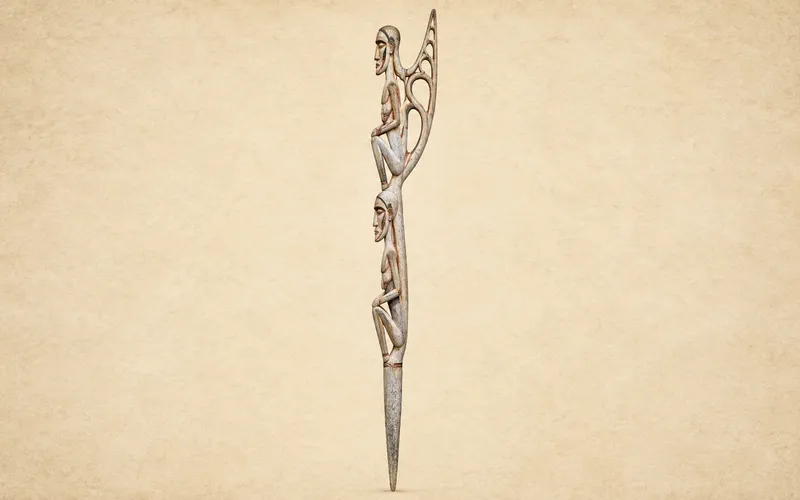
Bisj poles, also written bis, are tall wooden memorial sculptures associated with particular communities in the Asmat region of southwestern New Guinea, Indonesia. Human figures rise along a narrow vertical body, often beneath an elaborate projecting element. These figures commemorate deceased people, making the pole part of relationships among ancestors, relatives, and the wider community.
Their scale can dominate a gallery, but size alone does not explain them. A bisj pole brings together the structure of a tree, the decisions of a skilled carver, and a ceremony with its own purposes. Understanding it means following those connections rather than treating it as an isolated monument.
Asmat Carving and Its Local Context
Asmat Museum's account of the arts places carving within a wider field of music, decoration, and community life. It emphasizes local knowledge in selecting wood and recognizes differences in motifs among Asmat groups. This perspective keeps the maker's environment and judgement in view: “Asmat carving” names a varied tradition, not a single design repeated throughout the region. Asmat Museum: arts and culture.
The Met likewise identifies bisj production with a limited part of the Asmat region. That qualification matters when comparing Papuan sculpture. The korwar figures of Cenderawasih Bay, for example, belong to a different regional setting. Shared interest in ancestors does not make the objects, communities, or ceremonies interchangeable. The Met: regional context.
From a Buttressed Tree to a Monumental Pole
The distinctive upper projection begins as part of a tree. Carvers retain one plank-like buttress root while removing the others, then invert the carved trunk so that the root becomes the projecting cemen. This method creates the main pole and its extension from one piece of wood. The apparent attachment is therefore a transformation of the tree's existing structure. The Met: construction.
Consider what this requires before the first figure is completed. The carver must assess the trunk and root together, allowing enough material for the vertical figures and the outward-reaching form. The finished spaces between limbs and carved elements are as deliberate as the wood that remains. “Monumental” describes the result, but the achievement also lies in managing slender connections, changing planes, and a complicated silhouette.
Named Artists and Identifiable Works
Museum records preserve names that should stay central to the discussion. The Met attributes a pole from Omadesep village on the Faretsj River to Fanipdas, dating it to around 1960 and recording a height of about 5.47 metres. Another, by Jiem from Otsjanep village on the Ewta River, is approximately 4.72 metres high. These are individual works with named makers, not anonymous examples of a timeless style. Fanipdas collection record, Jiem collection record.
Emily Caglayan's Met essay describes the honoured position of carvers, known as wowipits, and recounts Fumeripits as a culture hero associated with the beginnings of carving. The latter is an origin tradition, not an archaeological date for the invention of wood sculpture. Named historical artists and accounts of cultural origins contribute different kinds of knowledge; neither needs to replace the other. Caglayan: The Asmat.
Ancestors, Figures, and the Journey to Safan
The Minneapolis Institute of Art describes its pole as having three male figures and a canoe carved along the back, rather than at the base. Its interpretation connects the canoe with the ancestors' journey to Safan, the afterworld. This provides a useful example of how one work can vary within a recognized sculptural type. Mia: examining a bis pole.
An ancestor figure need not be a naturalistic portrait to refer to a particular person. Recognition can depend on names, relationships, and the circumstances of a ceremony, not facial likeness alone. A museum photograph may preserve form while losing the spoken account that once identified the figures. Where those names survive, recording them helps recover the human specificity behind the repeated bodies.
Memorial Ceremony and Historical Violence
In her recorded discussion of the Met's poles, curator Maia Nuku explains the ceremony as a gathering that helps the recently deceased depart for Safan and restores community balance. The account connects sculpture with mourning, collective activity, and renewed ties among people. The pole's meaning unfolds through the event, not simply through its appearance. Nuku and Zucker: bis ceremonies.
Historical accounts also connect bisj feasts with obligations to avenge deaths and with headhunting raids. The Met distinguishes those past connections from later occasions for holding a feast. That history should be acknowledged without turning violence into the defining character of Asmat people or assuming that a contemporary carving documents a raid. Dates, purposes, and circumstances matter. The Met: historical ritual context.
The Cemen and the Return to the Sago Grove
Nuku identifies the cemen as a phallic element and explains its connection with vitality flowing back toward the earth. She also describes poles being carried to a sago grove after the ceremony. These are attributed religious interpretations of the sculpture's form and destination, not meanings that can be established from its outline alone. Nuku: cemen and the grove.
Such an ending challenges the expectation that every important monument must be preserved indefinitely. In the documented ritual cycle, leaving a pole to decay could complete its work rather than signal neglect. Museum conservation gives a surviving object a different future. The article on sago heritage supplies broader food and landscape context, while the significance of this particular placement belongs to the bisj account.
Changing Purposes and Museum Lives
The Smithsonian documents an approximately 4.36-metre pole from Birufu, collected in 2000, whose accession information explicitly states that it was made for sale. Its record describes stacked figures, an upper projection, and white, red, and black colouring. This is concrete evidence that recognizable bis forms can be made under circumstances different from a memorial commission. Smithsonian: Birufu pole.
Asmat Museum's historical account describes restrictions on cultural activity and later efforts to support carving and establish a museum. Read alongside individual collection records, this history resists a simple story of either unbroken continuity or disappearance. A useful label identifies who made the work, why it was made when known, and how it entered the collection. The Beliefs and Rituals collection connects this discussion with other objects whose purposes changed over time. Asmat Museum: cultural change and renewal.
Conclusion
Bisj poles make ancestral relationships visible through exceptional knowledge of wood and form. Their figures, projecting roots, and ceremonial settings belong to particular makers and communities.
Looking carefully means attending both to the carving and to its changing life: commissioned memorial, participant in ritual, work made for sale, or preserved museum object. Those distinctions allow the poles' scale to impress without obscuring the people and histories behind them.